For a hundred years, marketing has had one job: get inside a human head. Find the fear, the hope, the status anxiety, the shortcut the brain takes when it is tired. Then build a message that fits.
Now a new buyer is arriving. It doesn't get tired. It doesn't feel status anxiety. It reads every spec sheet, compares every price, and never once looks at your hero image. The AI agent is becoming the one that searches, shortlists and, more and more often, buys. So the oldest question in marketing needs a new answer. Who, exactly, are you persuading?
This is no longer a thought experiment
Gartner expects AI agents to sit in the middle of 90% of B2B buying by 2028, with more than $15 trillion moving through agent-brokered purchases (Sista AI). On the consumer side, IBM found that 45% of people already use AI somewhere in their buying journey (Braze).
The traffic is changing character too. According to Adobe, visitors referred by AI converted 38% worse than other traffic in March 2025. A year later, they converted 42% better (Elogic).
And marketers can feel it. 71% of marketing leaders say agents have already weakened their ability to connect directly with customers (Braze). The platforms feel it as well. Recently, Amazon blocked Meta's new shopping agent from its store (Deepak Gupta). When the gatekeepers start fighting over who gets to shop, you know the shopper has changed.
The paradox: we hand over the search, not the decision
Here is where the behaviour gets interesting. People love giving agents the boring part. They are far less keen to give up the final say. One 2026 report found that only 14% of consumers are willing to let an agent buy without supervision (Webtonic). The market has already bent to that instinct. In 2026, most agentic commerce looks like this: discover with an agent, then buy on the merchant's own site (Elogic). Even OpenAI pulled back on its instant checkout inside ChatGPT (GEO Toolbox).
This is not a technology gap. It's psychology. We delegate effort, but we hold on to control. Choosing is part of how we express who we are, and handing that to a machine feels like handing over a piece of ourselves. Agents will take over first where the decision is tedious, the stakes are moderate and the criteria are clear, like reordering supplies. Everywhere else, a human still signs off.
B2C and B2B: same agent, different logic
The agent looks the same in both worlds. The psychology around it does not.
In B2C, the agent is a personal shopper. It serves one person, with one set of tastes, often for low-stakes, repeat purchases. Groceries, refills, a phone case. Here the agent quickly learns habits, and habits are hard to break. Once an agent "knows" you prefer a brand, it keeps choosing it. The battle is to become the default early, before the habit hardens. Emotion still matters, but it shows up as loyalty and preference set long before the agent acts.
In B2B, the agent is a research analyst. It serves a buying group, not a person, and the stakes are higher. It gathers vendors, compares features, checks compliance and drafts a shortlist. But it rarely makes the final call. Committees do, and committees are driven by fear of the wrong decision as much as hope for the right one. The agent cuts the research time. It does not remove the politics, the risk-aversion or the need for someone to defend the choice.
So the logic flips. In B2C, the agent increasingly is the decision, so you win by becoming the habit. In B2B, the agent is the filter, so you win by surviving the shortlist and then reassuring the humans who sign.
So who do you persuade? Three audiences, not one
The answer is not "the agent instead of the human." It's both, at different moments, for different reasons.
1. The principal: the human who sets the brief. Before an agent searches anything, someone tells it what to look for. "Find me a CRM that's easy for a small team." "Book a hotel near the venue, nothing fancy." That brief is shaped by memory, reputation and gut feel, all built long before the task begins. If your brand isn't in the principal's head, it won't be in the agent's instructions. Classic brand building matters more, not less.
2. The agent: the machine that builds the shortlist. Agents don't respond to emotion. They respond to evidence they can read: clear specs, honest pricing, structured data, reviews, and consistent facts about you across the web. You can't charm an agent. You can only be easy to understand and hard to rule out. Today, a quarter of the content on US retailer home pages can't even be read by AI models (Elogic). That's a shortlist you never made.
3. The approver: the human who says yes. When the agent comes back with three options, a person picks. That moment is pure psychology again: trust, risk, what feels safe to defend to a boss or a partner. In B2B, that "person" is often a committee, and each member wants a different kind of reassurance.
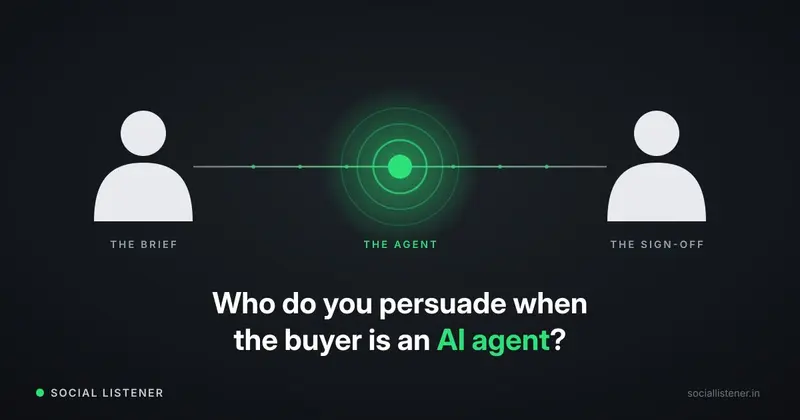
The agent sits in the middle. Humans sit at both ends. Marketing that only speaks to one of the three will lose to marketing that speaks to all of them.
What to do about it
The playbook follows the buyer's journey: win the human who writes the brief, become legible to the agent that searches, then reassure the human who approves.
Win the brief. Before any search runs, a buyer tells the agent what to look for. If your brand isn't in that sentence, the agent may never look for you. SEO wins the search. Brand wins the brief. (More on this in our next piece, How to Win the Brief.)
Make your facts boring and consistent. Pricing, specs, policies and proof points should say the same thing on your site, on review platforms and in every listing. Agents filter out contradictions.
Track share of answer. Watch how often AI assistants mention you, and how they describe you. That description is now your first impression.
Design for the moment of approval. Guarantees, easy reversal, recognisable customers and clear proof reduce the risk of saying yes. Keep your own site the best place to finish the purchase.
In B2C, become the habit. Agents learn preferences and repeat them. Win the first purchase and make reordering effortless.
In B2B, survive the shortlist, then arm the committee. Make comparison easy, then give each member the reassurance they need: ROI for finance, security for IT, ease of use for the team, and a story the champion can defend.
Persuade twice, prove once
Every agent-led purchase now runs through three moments. Two are human. One is not.
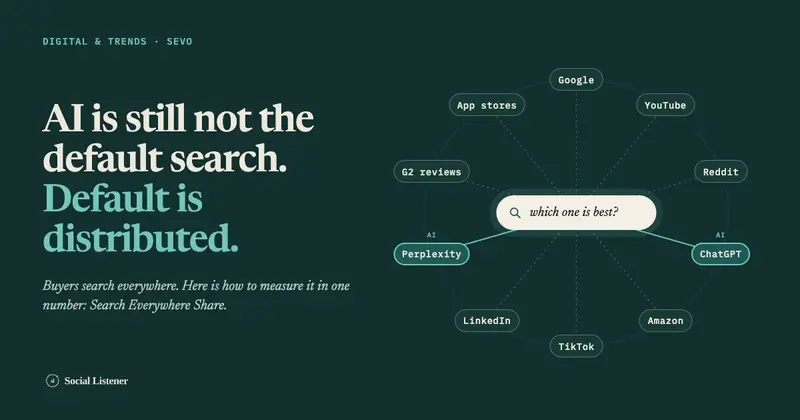
The brief: persuade the human who sends the agent. This is where memory does its work. The buyer reaches for the brands that come to mind in that moment, and those memories are built everywhere they look: video, forums, reviews, colleagues, AI answers. That's why the real shift isn't AI search, it's search everywhere. If you're not in the buyer's sentence, the agent won't come looking. In B2C, this is where habits form. In B2B, it's where a champion first hears your name.
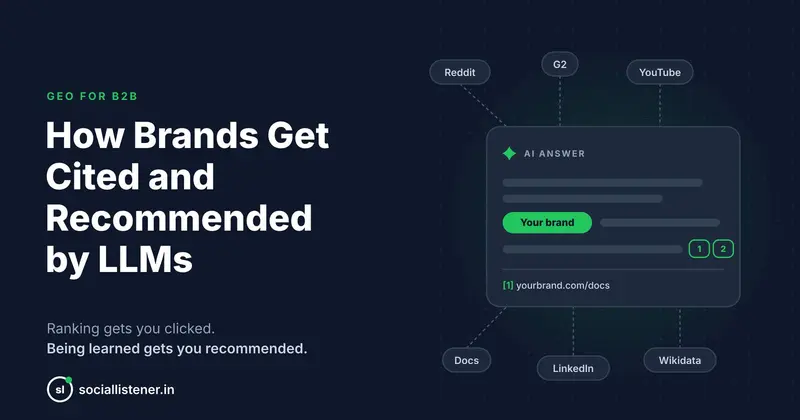
The shortlist: prove yourself to the machine. Here, charm is worthless. The agent wants facts it can read, check and compare: clear specs, honest pricing, consistent descriptions, and independent sources that agree about you. We broke down how models decide who to name in How Do Brands Get Cited and Recommended by LLMs? The rule is simple: be easy to understand and hard to rule out. Many brands fail here without knowing it: a quarter of the content on US retailer home pages can't even be read by AI models (Elogic).
The sign-off: persuade the human again. The agent comes back with three options, and a person chooses. Now it's psychology again: trust, risk, and whether the choice feels safe to defend. In B2C, make the yes easy to reverse. In B2B, give every committee member their own reason to agree: numbers for finance, security for IT, ease for the team, and a story for the champion.
Most brands are pouring their effort into the middle moment, because it looks technical and measurable. But the agent only searches for what a human asked for, and only buys what a human approves. The middle is where you can lose. The ends are where you win.
The buyer still has a pulse
Go back to the buyer from the start, the one that never looks at your hero image. It still won't. But someone sent it shopping, and someone will read what it brings back. Both of them are human, carrying the same memories, fears and shortcuts marketing has always worked with.
So who do you persuade when the buyer is an agent? The same person you always did. You just have to reach them twice, and get past the machine in between. Next, we go deep on the first moment: how to win the brief. Sign up for the Social Listener newsletter and we'll update you when it goes live.