Marketing has a new obsession. Every agency now sells GEO. Every SEO tool has an "AI visibility" tab. Investors have put more than $300 million into startups that track how often ChatGPT mentions your brand.
Here is the awkward part. In the second quarter of 2026, standalone AI tools took 1.83% of US desktop activity, according to Datos. Traditional search engines took 10.52%, nearly six times as much. AI is growing fast, up about a third in a year, but it is still a small slice of how people search.
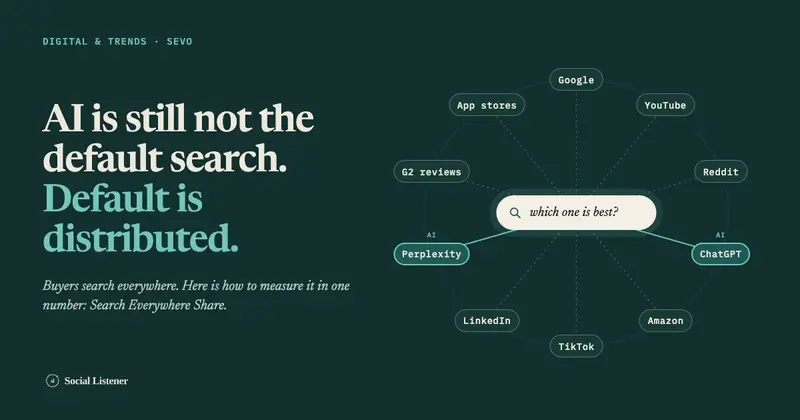
That doesn't make AI unimportant. It makes it one place among many where buyers look for answers. Search Everywhere Optimization, or SEVO, is the idea that you should be findable in all of them. This piece explains where the term came from, what the data says about where people search, how buying decisions actually get made, and what to measure. It ends with a scorecard any brand can use, and a single metric to track it: Search Everywhere Share.
What SEVO is, and who named it first
SEVO means making your brand findable wherever people look for answers: search engines, AI assistants, video, social, communities, marketplaces, maps and app stores. Traditional SEO asks "do we rank on Google?" SEVO asks "when someone is curious about our category, wherever they go, do they find us?" The credit for the name belongs to Ashley Liddell of the search agency Deviation. Rand Fishkin of SparkToro credited her with coining "Search Everywhere Optimization" in May 2025. Here is how the idea spread:
November 2023: Researchers led by Pranjal Aggarwal publish the GEO paper, the first serious attempt to optimise for AI-generated answers.
January 2025: Neil Patel calls Search Everywhere Optimization "the new SEO" and brings the term to a mass audience.
May 2025: Fishkin backs Liddell's term, arguing that SEO should keep its three letters and treat the E as "Everywhere".
2025 to 2026: Agencies such as Single Grain start selling "SEVO" as a service. Michigan Technological University adopts the idea for its own web team and lists eight areas it covers, from app stores to voice search.
How the idea is being tested. Only parts of SEVO have been tested so far. The GEO paper tested one channel, and found that certain content changes could lift visibility in AI answers by up to 40%. SparkToro and Datos measured where searches actually happen across 41 major sites. Vendors test AI mentions every day. What nobody has tested yet is the whole picture: one brand, measured across every place its buyers search, with a single number. That gap is the subject of this piece.
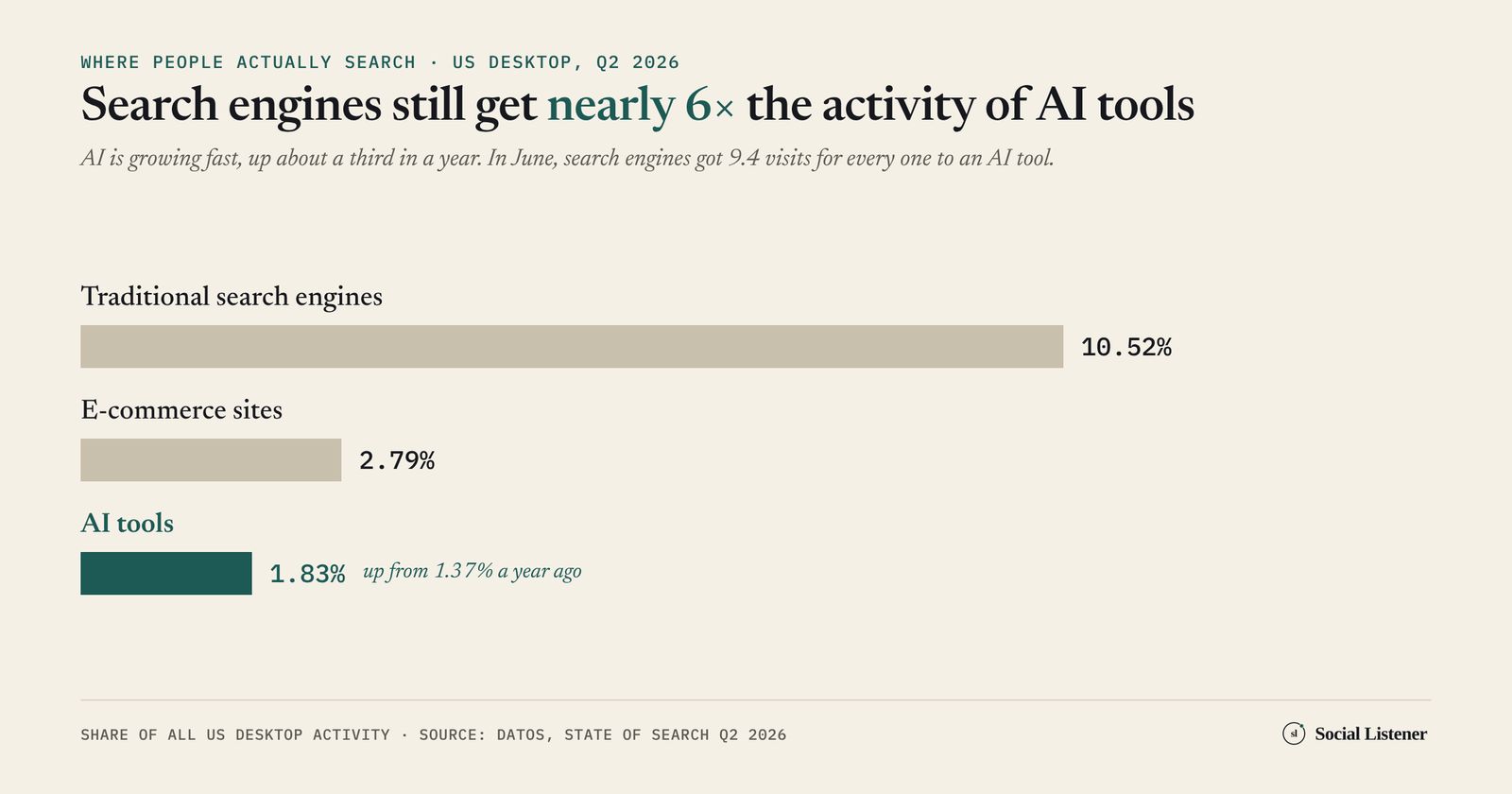
Four things in this data matter more than the headline.
AI is growing fast from a small base. In the second quarter of 2026, standalone AI tools took 1.83% of US desktop activity, up from 1.37% a year earlier. That is growth of about a third in twelve months. Europe and the UK followed the same pattern, rising from 1.34% to 1.91%.
Search hasn't shrunk to make room. Traditional search engines took 10.52% of US desktop activity in the same quarter, and their share rose slightly. Google still held between 92% and 94% of search engine use. People are adding AI to their habits, not swapping search for it.
Reach is much bigger than share. In SparkToro and Datos's 2025 data, around 40% of US desktop devices used ChatGPT, even though it handled only about 3% of searches. People use AI for certain questions, not all of them.
AI also lives inside Google. In 2025, about 16% of Google results pages showed an AI Overview. Google's separate AI Mode drew just 0.13% of US page visits in June 2026, but AI Overviews sit on top of ordinary searches. So a brand can lose the AI answer without anyone ever opening ChatGPT.
One caveat: this data covers desktop only. Mobile apps, where TikTok, Instagram and much of ChatGPT use happen, are not measured. The real AI and social share is likely higher. But the shape holds: search is spread out, and AI is one part of it, not the whole of it.
How decisions are actually made
Search share tells you where questions are typed. It doesn't tell you where decisions are made. For that, you have to look at how people buy, and B2B and B2C buyers work very differently.
B2B: the shortlist is formed before you know a buyer exists.
6sense surveyed more than 4,000 B2B buyers in 2025. 94% of buying groups had ranked their preferred vendors before first contact, and they bought from that favourite 77% of the time.
The same study found 94% of buyers used AI models to summarise reviews or analyse data during the purchase.
Forrester's State of Business Buying 2026 calls generative AI search the new starting point for B2B buyers. But it also found a typical purchase involves 13 internal stakeholders and nine external influencers, and more than 60% of buyers run a trial.
So a B2B buyer may start with ChatGPT, but the decision is shaped by 22 people reading analyst notes, peer reviews, LinkedIn posts, community threads and vendor websites. AI summarises. People decide. Your brand has to be findable at each of those points.
B2C: short journeys, many entry points.
In a May 2026 survey of 1,295 US consumers by Smarty Marketing, 56.7% started shopping searches on Google, 29% on Amazon, 7.3% on ChatGPT and 4.6% on Reddit. Social platforms were not included.
Google itself said in 2022 that nearly 40% of young people go to TikTok or Instagram, not Google, when looking for somewhere to eat.
In SparkToro's data, Amazon handled more US desktop searches than Bing, YouTube and ChatGPT.
A consumer's journey is short, but it jumps between platforms: a video to see it, a thread to trust it, an AI to compare it, a marketplace to buy it.The common lesson. In both cases, no single platform makes the decision. AI is a powerful new step, particularly for comparing options, but it sits inside a longer journey. A strategy built only for AI answers optimises one step and ignores the rest.
The GEO gold rush
When a market gets crowded this fast, it is usually responding to anxiety more than to evidence. In roughly eighteen months, about two dozen AI visibility startups raised more than $300 million. Profound raised $96 million at a $1 billion valuation in February 2026. Bluefish raised $43 million, Peec AI $21 million, and Scrunch and Evertune $15 million each. The established players moved too. Ahrefs launched Brand Radar, Semrush built an AI Visibility Toolkit before Adobe bought it for about $1.9 billion, and HubSpot now offers a free AEO grader. Much of this is useful. Knowing whether ChatGPT recommends you is a real question. But the rush has created three problems.
Effort follows the hype, not the buyer. Teams spend weeks optimising for a channel that handles around 3% of searches, while their Amazon listings, YouTube presence and review profiles go unmanaged.
Every vendor measures something different. One counts mentions, another citations, another "share of voice" across a sample of prompts it chose itself. The numbers can't be compared, and they can't be added to anything else.
Everyone is now an expert. Agencies that sold SEO in 2024 sell GEO in 2026, often with the same deliverables and a new label.
The answer is not to ignore AI. It is to put AI in its place: one important line on a scorecard that covers every place your buyers look.
The measurement gap
SEVO has a name, a growing number of believers and a market of tools. What it doesn't have is a scoreboard. Today a marketing team that takes SEVO seriously ends up with five dashboards that don't talk to each other: Search Console for Google, an AI visibility tool for ChatGPT, a social listening tool for TikTok and Reddit, a marketplace console for Amazon, and a review platform for G2 or Trustpilot. Each uses its own units. None answers the question a CMO actually asks: "Across all the places our buyers look, how findable are we, and is it getting better?"
The gap exists for three reasons.
The platforms don't share data. Google, OpenAI, TikTok and Amazon each guard their own numbers. No single tool sees everywhere.
Each vendor sells one slice. It is in a GEO vendor's interest to make AI visibility look like the whole game.
Nobody has agreed on a unit. A ranking, a citation, a view and a review are different things. Until they are expressed in a common unit, they can't be added together.
The last problem is the one we can solve, and it doesn't need a new tool. It needs a common unit: presence at the moments where buyers look.
The Search (SEVO) Scorecard: what to measure, and where
The scorecard turns "search everywhere" into five places a brand can actually check. Each has its own measure and its own source of data. Together they roll up into one number.
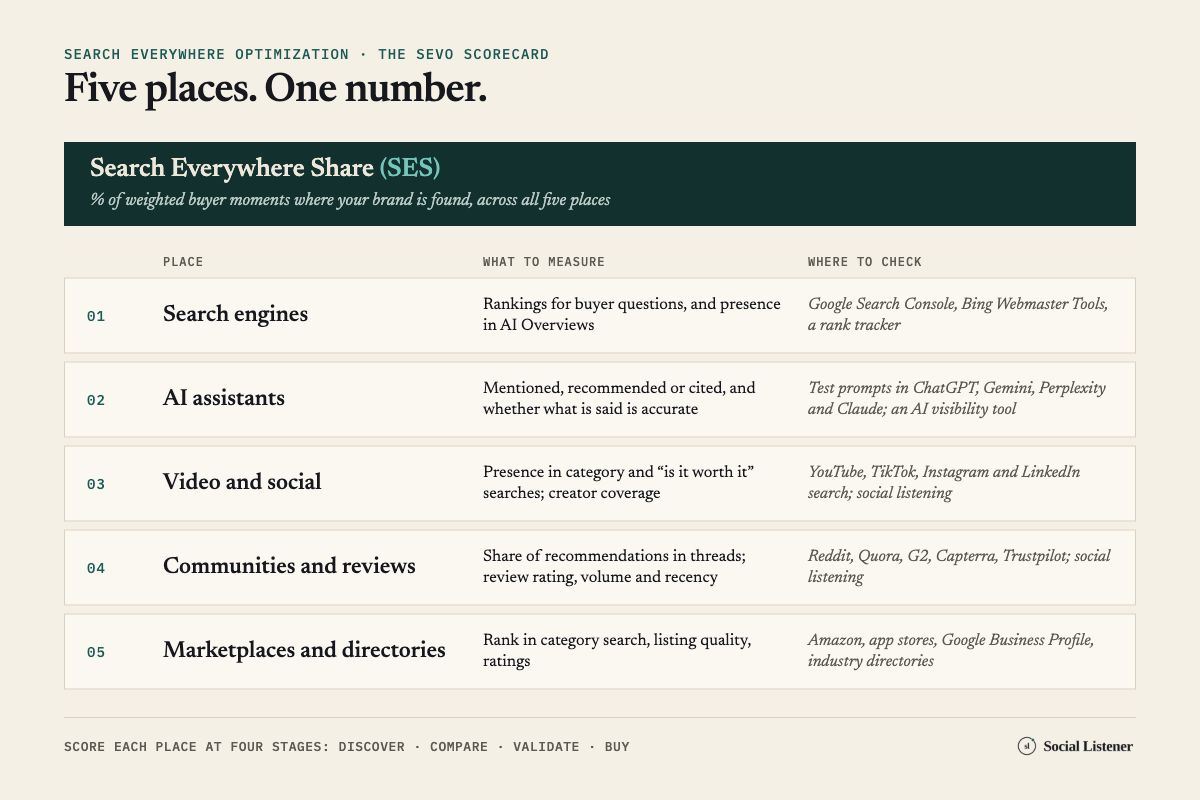
Not every place matters equally for every brand. A B2B software company will weight AI assistants, communities and review sites heavily, because that's where shortlists form. A consumer brand will weight marketplaces, video and social. The weighting is where your knowledge of your own buyers goes in, and it's what makes the scorecard yours rather than a vendor's.
Search Everywhere Share: the metric
We propose one number to sit on top of the scorecard: Search Everywhere Share (SES). It is the share of the moments where your buyers look for answers in which your brand is found.
It is built from a simple idea. A buyer's journey is a series of moments: a question asked in a particular place. "Best CRM for a 50-person team" asked in ChatGPT is one moment. The same question on Reddit is another. "Is [brand] worth it" on YouTube is a third. You can't control the platforms, but you can check, moment by moment, whether you show up.
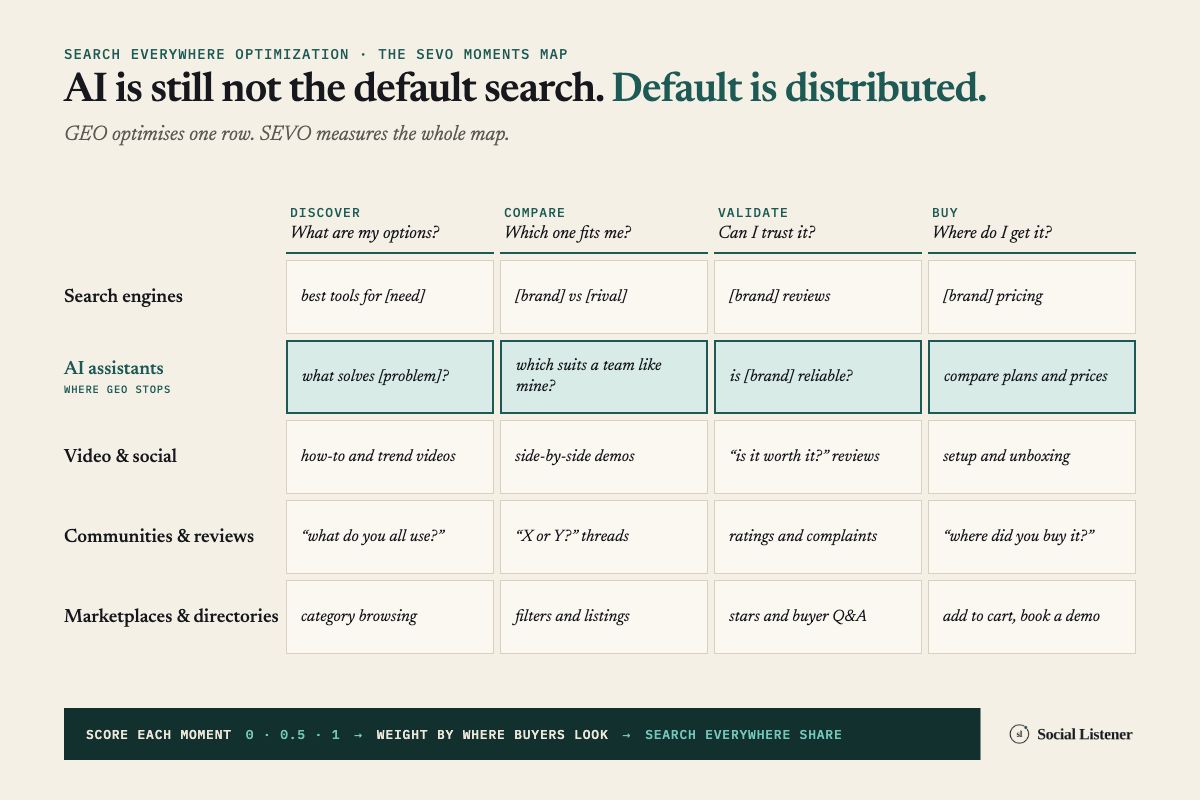
The Moments Map gives you a starting set of 20 moments. Replace the example questions with your buyers' real ones, and add rows or columns where your category needs them.
How to calculate it
List the moments. Write down the 20 to 50 questions your buyers ask, from first discovery to purchase, and the places they ask them. Use sales calls, search data, community threads and customer interviews.
Weight each moment. Give it a weight from 1 to 3 based on how many of your buyers use that place for that question, and how close it sits to the decision. A comparison question in the place most of your buyers trust gets a 3.
Score your presence. For each moment, score 0 if you're absent, 0.5 if you appear but not prominently or not favourably, and 1 if you're in the top results, recommended or cited.
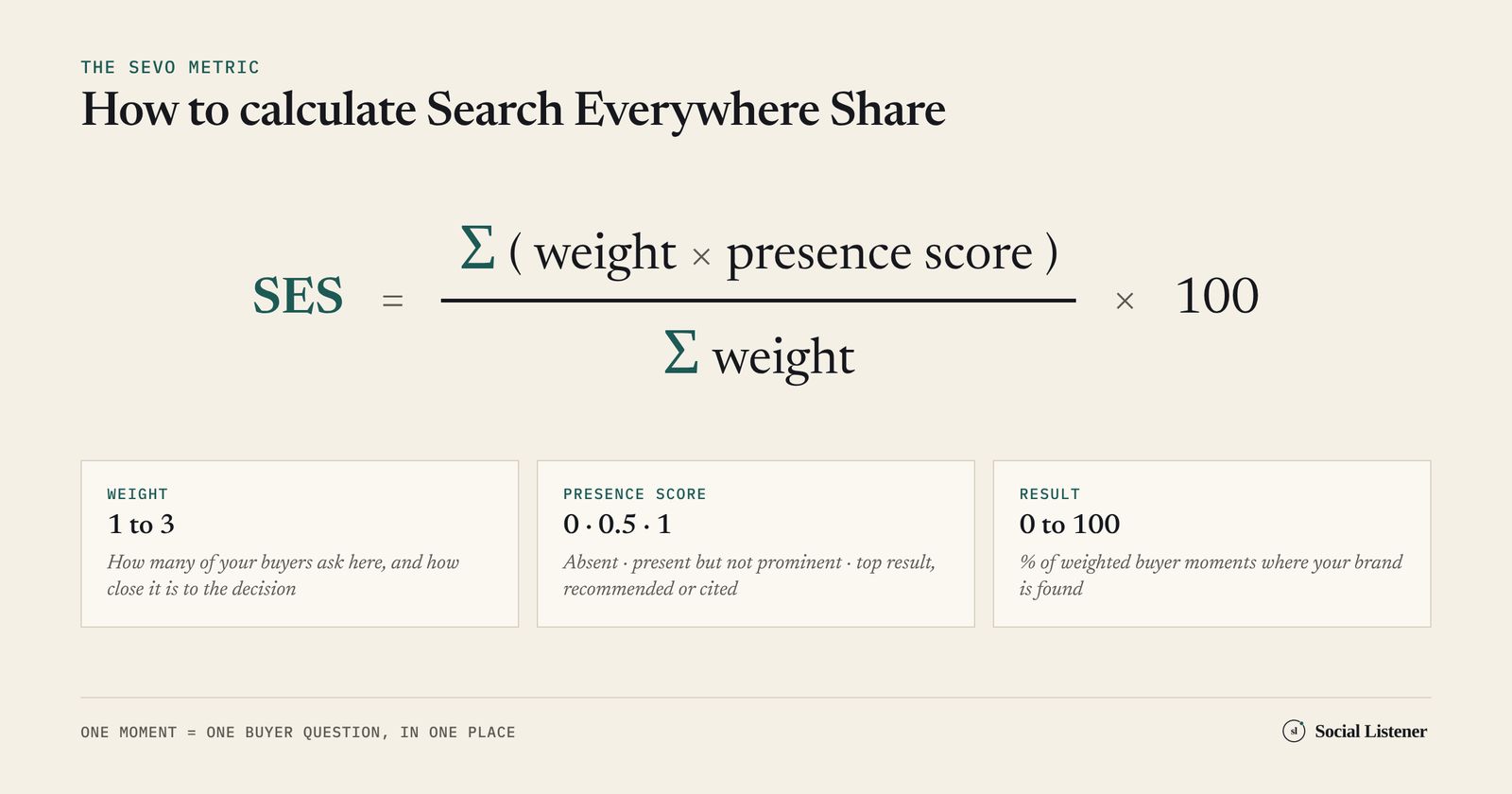
A brand that scores 1 on every moment has an SES of 100. A brand that dominates Google but is missing on Reddit, YouTube and AI answers might score 35, however good its rankings look.
Two companion measures make it more useful.
Competitive SES: run the same moments for your top two competitors. The gap between you is often more telling than your own score.
The gap list: every heavily weighted moment where you score 0. This is your SEVO work plan, in priority order.
SES is deliberately simple. It can be run in a spreadsheet, checked by hand each quarter, and improved with tools later. It uses the vendors' data rather than competing with it: an AI visibility tool fills in the AI moments, Search Console fills in the Google moments, and so on. What changes is that all of it finally adds up to one number.
Where to start this quarter
You don't need a new tool or a new agency to begin. You need a list, a spreadsheet and an afternoon a month.
Map 30 buyer moments. Ask sales and customer service for the ten questions they hear most. Add the comparison and "is it worth it" questions. Note where each one gets asked.
Score yourself and two competitors. Search each moment by hand: Google, ChatGPT and Perplexity, YouTube, Reddit or LinkedIn, and the marketplace or review site that matters in your category.
Calculate your first SES. Don't worry if it's low. Most brands that check honestly find they are missing from half the places their buyers look.
Work the gap list. Fix the top five heavily weighted zeros before buying anything new.
Re-score every quarter. Bring in an AI visibility tool or listening tool only when you know which moments it needs to cover.
GEO is a good tactic. SEVO is the strategy it belongs to. And a strategy you can't measure is just an opinion.
Every few years, marketing finds a new centre of gravity and rushes towards it. First it was the search box, then the social feed, and now it is the AI answer. Each time, the rush made sense, and each time it left the same blind spot. Buyers never moved to one new place. They added it to all the places they already used.
That is what the data says today. AI assistants handle a small but growing share of searches. Google still handles most of them. Amazon, YouTube, Reddit, review sites and a dozen other places fill in the rest. A B2B buyer may ask ChatGPT for a shortlist, then check it against G2, LinkedIn and a Reddit thread before talking to anyone. A shopper may watch a TikTok, read the reviews and buy on Amazon without opening a search engine at all.
So the question for a brand is no longer “do we rank?” or “does ChatGPT mention us?” It is a harder and more useful question: across every place our buyers look, how often are we found? That is what Search Everywhere Share measures. It won’t tell you to ignore AI. It will tell you how much AI matters for your buyers compared with everything else, and where your biggest gaps really are.
Sources
GEO: Generative Engine Optimization, Aggarwal et al., 2023 (KDD 2024)
It's Still SEO: Search Everywhere Optimization, Rand Fishkin, SparkToro, May 2025
Search Everywhere Optimization, Neil Patel, January 2025 (also the source of the Google 40% figure)
Google holds 73.7% of desktop searches, PPC Land on the SparkToro and Datos study, March 2026
Google still leads shopping searches as AI falls short at 7%, PPC Land on the Smarty Marketing survey, May 2026
6sense 2025 B2B Buyer Experience Report, November 2025
Forrester's 2026 Buyer Insights, January 2026
GEO pure plays raise hundreds of millions, Everything PR, updated November 2026
Search Everywhere Optimization, Michigan Technological University
SEVO services, Single Grain