Social listening used to be about knowing who mentioned your brand, where they mentioned it, and whether the conversation was positive or negative. For years, businesses invested in platforms that could track hashtags, monitor sentiment, measure engagement and generate dashboards.
But the nature of online conversations has changed. Consumers no longer express their opinions through predictable keywords or direct brand mentions. They communicate through memes, communities, cultural references, emerging narratives and conversations that often happen without mentioning a brand at all.
Companies already collect mentions, dashboards and sentiment scores. What they rarely get is the one conversation that should change a decision. A complaint that reveals why a competitor is losing customers. A question on a forum that tells you exactly how buyers describe the problem. A spike in chatter a week before the press notices.
Social listening tools promise to close that gap. They range from under $50 a month to contracts that cost more than a senior hire. Some are built for global consumer brands with research teams. Others are built for a founder who wants to know when someone on Reddit asks for a recommendation.
“Your most unhappy customers are your greatest source of learning.” — Bill Gates
The mistake most teams make is buying the biggest tool they can afford. The better question is which tool fits the kind of listening you actually need. There is also a new job on the list. Buyers increasingly ask ChatGPT, Gemini, Claude or Perplexity before they ask Google. So listening is no longer only about what people say.
This raises an important question: Which social listening platforms are genuinely equipped for the AI era, and which are simply adding AI features to traditional monitoring tools? Half the tools on this list now track that, in very different ways.
How we compared Social Listening Tools
We looked at ten tools across six things that matter when you choose one.
What it does well: the job the tool is really built for, not the full feature list.
Who it suits: company size and team type.
Company behind it: ownership, scale and stability, because a listening tool is a multi-year bet on someone else's data access.
Standout abilities: what it does that others do not.
Watch-outs: limits, trade-offs and the kind of buyer who will be disappointed.
The sixth is AI visibility: whether the tool can show how AI assistants mention your brand and which sources they cite, and how it uses AI inside the product to save your team time.
Pricing is mentioned where vendors publish it. Many enterprise tools do not, and prices change often, so treat every number here as a starting point for your own conversation with the vendor. Social Listener has no commercial relationship with any company in this list.
We haven’t tested every tool on this list ourselves. This comparison is based on secondary research from vendor websites, independent reviews and published reports, so check details with each vendor before you buy.
The enterprise suites
These four are built for global brands with research, PR or customer experience teams. They cost the most and do the most. They are rarely the right choice for a team under 20 people.
1. Brandwatch
What it does: Deep consumer research from public conversation. It is the tool insights teams use to answer questions like how a category talks about price, or which audience segments are driving a trend.
Best for: Large brands and agencies with dedicated analysts.
Company behind it: Part of Cision, the media intelligence group, since 2021. Brandwatch now sits alongside Cision's PR and media monitoring products and also covers social media management and influencer marketing.
Standout abilities: A very large historical archive, coverage across more than 100 million sources, and Iris AI for summaries, trend detection and topic clustering. It was named Social Listening Solution of the Year at the 2026 MarTech Breakthrough Awards.
AI features: Iris AI summarises conversations, spots trends and clusters topics. Brandwatch's suite now also lists GenAI monitoring alongside its listening products, so ask in the demo which AI assistants it covers and whether it shows the sources they cite.
Watch-outs: Built for analysts, so expect a learning curve. Pricing is custom and sits firmly in enterprise territory.
2. Sprinklr
What it does: Listening as one part of a much larger customer experience platform that also runs customer service, social publishing and marketing
Best for: Global enterprises that want listening, care and marketing on one contract.
Company behind it: Listed on the New York Stock Exchange. Sprinklr reported fiscal 2026 revenue of about $857 million and serves more than 1,900 enterprises.
Standout abilities: Breadth. Insights from listening can flow straight into service queues and campaign workflows across dozens of channels.
AI features: LLM Insights, launched in preview in mid-2026, tracks how often assistants such as ChatGPT, Gemini, Claude, Perplexity and Grok mention your brand, your share of voice and sentiment, and the sources those answers rely on. Unusually, it builds its test questions from real customer conversations rather than invented prompts, then turns gaps into action plans.
Watch-outs: Long, complex implementations and enterprise-only pricing. Its recent growth has come mainly from AI customer service, so teams that only need listening may pay for a lot they never use.
3. Meltwater
What it does: Media monitoring and social listening together, with strong roots in PR. It tracks news, broadcast and social coverage in one place.
Best for: Communications and PR teams that report on earned media as much as social conversation.
Company behind it: Founded in Oslo in 2001 and now headquartered in San Francisco. The company says it has about 27,000 customers and 2,300 employees across 50 offices.
Standout abilities: News and media coverage alongside social, journalist databases and reporting built for PR measurement.
AI features: GenAI Lens, an add-on launched in 2025, tracks brand and competitor mentions across ChatGPT, Gemini, Claude, Perplexity, Grok and DeepSeek. It reports sentiment and share of voice and, importantly, the websites AI answers cite, which PR teams can then work on. It is one of the most complete AI visibility offers from a listening company.
Watch-outs: Sales-led, annual contracts with quote-only pricing. Teams that need deep social research rather than media coverage may find specialist tools stronger.
4. Talkwalker (now part of Hootsuite)
What it does: Broad global listening with strong visual and multilingual coverage.
Best for: Multinational brands monitoring many markets and languages, especially those already using Hootsuite.
Company behind it: Founded in Luxembourg and acquired by Hootsuite, the Canadian social media management company, in 2024. At the time it said more than 2,500 brands used it.
Standout abilities: Coverage Hootsuite describes as 150 million websites, 30 social channels and 187 languages, plus image and logo recognition and its own generative AI assistant.
AI features: LLM Insights, sold as a Hootsuite add-on, shows how ChatGPT, Gemini, Claude and Perplexity describe your brand and competitors, and tracks narratives, sentiment and misinformation in those answers over time.
Watch-outs: Its future is now tied to Hootsuite's product roadmap. Pricing is by quote, and standalone buyers should ask how the product will be packaged going forward.
The mid-market Social Listening platforms
These two suit growing brands and agencies that want serious capability without an enterprise implementation. They take different routes: one bundles listening into social management, the other specialises in what people show, not just what they say.
5. Sprout Social
What it does: An all-in-one social media management platform for publishing, inbox, reporting and team workflows, with listening available as an add-on.
Best for: In-house social teams that want publishing, engagement and listening in one place and value ease of use.
Company behind it: Listed on Nasdaq and based in Chicago. Sprout reported 2025 revenue of $457.5 million, has around 30,000 customers, and had about 1,360 employees at the end of 2025 before a restructuring in July 2026 that cut about a fifth of roles.
Standout abilities: One of the cleanest interfaces in the category, strong collaboration features, and listening insights that sit next to the posts and replies your team already manages.
AI features: Trellis, Sprout's AI agent, is now included on every plan. It answers plain-language questions about your listening data and drafts executive summaries, and an MCP server lets you use Sprout data inside ChatGPT. We found no dedicated tracker for what AI assistants say about your brand.
Watch-outs: Listening is not included in the base plans. Seats run from about $199 to $399 per user per month, and several reviewers report the listening add-on at around $999 a month on top. Its listening is broad rather than deep, so research-heavy teams may outgrow it.
6. YouScan
What it does: Social listening with unusually strong image analysis. It can spot logos, objects, scenes and activities in photos, even when the brand is never named in the caption.
Best for: Consumer brands in food, drinks, beauty, fashion and retail, where much of the conversation happens in pictures.
Company behind it: Founded in Kyiv around 2010 and now a distributed team. It is privately held, with an estimated 51 to 200 employees, and says more than 600 brands use it.
Standout abilities: Visual Insights for image recognition and Insights Copilot, a conversational AI assistant that lets you ask questions of your listening data in plain language.
AI features: AI image recognition is the core of the product, and Insights Copilot answers questions about your data in plain language. We found no tracking of AI assistant answers.
Watch-outs: Less relevant for B2B companies, whose buyers rarely post photos of the product. Plans have been listed from about $499 a month, with larger plans by quote.
The self-serve and B2B tools
These four publish prices, offer trials and can be set up in an afternoon. They are where most small teams should start. One of them, Octolens, is built specifically for B2B companies looking for buying conversations rather than brand sentiment.
7. Brand24
What it does: Real-time mention monitoring across social media, news, blogs, forums, podcasts, videos and reviews, with sentiment analysis and spike alerts.
Best for: Small and mid-sized marketing and PR teams, and agencies, that want dependable monitoring without a sales process.
Company behind it: Founded in Wrocław, Poland, in 2011 and listed on the Warsaw Stock Exchange. Semrush took a majority stake in 2024, and Adobe completed its acquisition of Semrush in April 2026, so Brand24 now sits inside a much larger marketing ecosystem.
Standout abilities: Fast setup, an AI Brand Assistant that summarises what changed, a paid add-on for tracking how AI chatbots describe your brand, and connections that let you query your data from AI assistants.
AI features: An AI Visibility add-on, built on its Chatbeat tool, costs $99 a month for 30 tracked prompts across ChatGPT, Perplexity, Gemini and Google AI Overviews, with more models on request. It shows how often AI recommends you against competitors and which sources shape those answers. It is the cheapest way on this list to see AI mentions next to social mentions.
Watch-outs: Prices have risen several times recently. Plans now run from about $199 to $1,499 a month on annual billing, and keyword and mention limits on the entry plan are tight. There is a 14-day free trial.
8. Awario
What it does: Affordable monitoring with flexible Boolean search, so you can write precise queries and filter out noise.
Best for: Startups, freelancers and small agencies on a tight budget, and anyone who wants raw data through an API.
Company behind it: A small private company, founded in 2015, with an estimated 51 to 100 employees.
Standout abilities: Price and access. Plans are listed at $49, $149 and $399 a month, or $29, $89 and $249 a month billed annually, and API access is included on every paid plan, which is rare at this level.
AI features: Sentiment analysis and a lead-finding feature, but no tracking of AI assistant answers. Awario's own advice is to grow brand mentions across the web, which AI models learn from.
Watch-outs: A smaller team means fewer advanced analytics and less polish than Brand24. User ratings are more mixed, with G2 reviewers averaging 3.9 out of 5.
9. Mention
What it does: Mention monitoring with Boolean queries, alerts and competitive tracking across social and the web.
Best for: Teams already using Agorapulse for social media management.
Company behind it: Founded in France and acquired by Agorapulse in 2025 through a court-ordered receivership. Since then its cheaper self-serve plans have closed to new customers, and its publishing and reply features have moved into Agorapulse.
Standout abilities: A long track record and a simple interface that many users rate highly for ease of use.
AI features: We found no tracking of AI assistant answers. Teams that need it would have to add a separate AI visibility tool.
Watch-outs: Its direction is still settling. New buyers now get a single Company plan that has been listed at around $599 a month, with a demo required. Check the roadmap before signing a long contract.
10. Octolens
What it does: B2B-focused listening that watches the places where software buyers ask for advice: Reddit, X, LinkedIn, GitHub, Hacker News, newsletters, podcasts and news.
Best for: B2B SaaS founders, growth teams and developer-relations teams who want to join buying conversations early.
Company behind it: A small German startup, Crowd Technologies GmbH. It is far younger and smaller than every other company on this list.
Standout abilities: AI relevance scoring that filters out most of the noise, unlimited seats, Slack alerts and an MCP server so AI agents can use the data. Its source list matches where B2B conversations actually happen.
AI features: AI relevance scoring filters noise and tags buying intent. Octolens does not score your presence in AI answers directly. Instead it focuses on the Reddit and community threads that AI assistants often draw on, and helps you take part in them, which its makers argue is how AI visibility actually moves.
Watch-outs: Not built for consumer brands that live on Instagram and Facebook. It does not provide contact data, and it lacks some enterprise features. Entry pricing has been listed between about $119 and $159 a month recently.
Who tracks what AI says about you
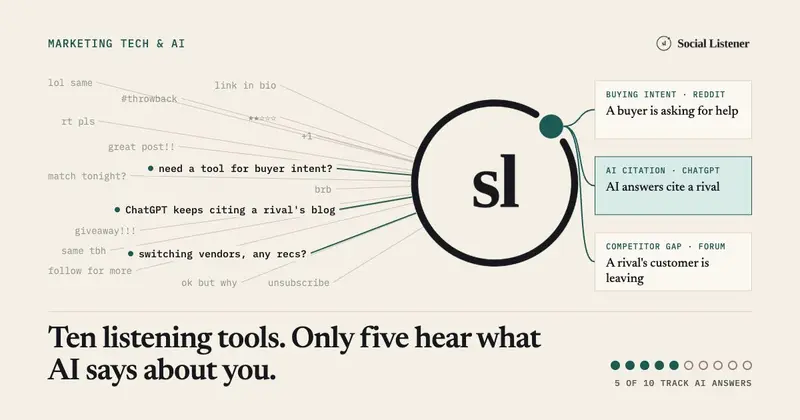
Five of the ten tools now track what AI assistants say about your brand, and three of them also show which sources those answers cite. The other five use AI inside the product but do not yet measure AI answers.
AI visibility tracking usually covers three things:
AI mentions: how often ChatGPT, Gemini, Claude, Perplexity and others name your brand when people ask questions in your category.
AI citations: which websites, articles, forums and review pages those answers draw on. This is the part you can actually influence.
AI share of voice: how often you appear compared with competitors, and in what light.
Here is where each tool stands.
Tracks AI answers and the sources behind them
Meltwater with GenAI Lens, an add-on covering ChatGPT, Gemini, Claude, Perplexity, Grok and DeepSeek.
Sprinklr with LLM Insights, which builds its questions from real customer conversations.
Brand24 with its AI Visibility add-on, from $99 a month, the lowest-cost option here.
Tracks AI answers
Talkwalker through Hootsuite's LLM Insights add-on, covering ChatGPT, Gemini, Claude and Perplexity, with a focus on narratives and misinformation.
Brandwatch, which now lists GenAI monitoring in its suite. Ask for detail on coverage and citations.
Uses AI inside the product, but does not track AI answers
Sprout Social (Trellis AI agent), YouScan (Insights Copilot and image recognition), Awario and Mention.
Takes a different route
Octolens does not measure AI answers. It helps you join the Reddit and community conversations that AI assistants often learn from.
Another quiet shift: Brand24, Sprout Social and Octolens now offer MCP connections, so you can query your listening data directly from AI assistants such as ChatGPT or Claude.
Two cautions. AI answers change from one run to the next, so treat these numbers as direction, not precision. And if AI visibility is your main concern, standalone AI visibility tools such as Profound, Peec AI and Otterly go deeper on that one job than any listening suite.
How to choose
Start with the decision you want listening to change, not the tool. Then match it to the right category.
If you need to understand a market or audience deeply, look at Brandwatch or Talkwalker.
If listening has to feed customer service and marketing at global scale, Sprinklr is built for that.
If your team lives in PR and earned media, Meltwater is the natural fit.
If you want one tool for publishing, inbox and some listening, Sprout Social keeps it all in one place.
If your customers talk in pictures, YouScan sees what text-only tools miss.
If you want solid monitoring with published prices, start with Brand24 or, on a tighter budget, Awario.
If you sell B2B software and want to find buyers asking for help, Octolens is built for exactly that.
If you need to see what AI assistants say about you, Meltwater and Sprinklr lead at the enterprise end, and Brand24 is the affordable way in.
Four questions are worth asking every vendor before you sign:
Where does your data come from, and what happens if a platform changes its API terms? Reddit and X have both changed access and pricing repeatedly. A tool is only as good as its data rights.
What will this cost in year two? Add-ons, extra seats and renewal increases often matter more than the entry price.
Can I trial it on my own keywords? A demo built on a vendor's favourite example tells you very little.
Do you track what AI assistants say about us, and can you show the sources they cite? Mentions alone tell you the score. Citations tell you what to fix.
The bigger point
The category is consolidating fast. Cision owns Brandwatch, Hootsuite owns Talkwalker, Agorapulse owns Mention, and Brand24 now sits inside Adobe through Semrush. At the same time, a new wave of small, focused tools is appearing for specific jobs.
That tells you something about where the value is moving. Collecting mentions is becoming a commodity. What remains scarce is judgment: knowing which three conversations this week actually matter, and what to do about them.
AI is speeding that up. For many buyers, the first description of your brand they read is now written by a machine, drawing on forums, reviews and articles you may never have looked at. Listening tools are racing to show you that description, and the sources behind it. No tool hears for you. The best ones just make it harder to miss what matters.
Sources
Company details, prices, AI features and ownership were checked on 1 November 2026 and can change. Prices are in US dollars as listed by vendors or reported by independent reviewers.