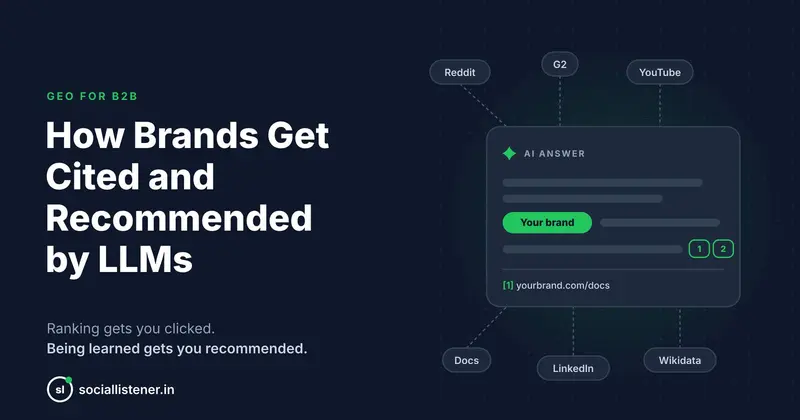
Ranking gets you clicked. Being learned gets you recommended.
Ask an AI assistant for an open-source alternative to Firebase, and Supabase is very likely to be in the answer. Ask how to connect two SaaS apps without code, and Zapier appears. Neither brand bought that position. It was assembled from what the model learned in training and what it retrieved from the web seconds before answering.
That is the new discovery layer in B2B. Between your buyer and your website now sits a system that rewrites the query, retrieves passages from dozens of sources, reranks them, writes an answer, and decides which brands to name and which pages to credit. Classic SEO optimised one step of that pipeline: ranking. Generative engine optimisation (GEO) has to work across all of them.
This piece breaks down how that pipeline works, what being cited and being mentioned actually look like, where models get their evidence, and why some brands appear in almost every answer in their category.
How an AI answer is assembled
Most assistants combine two knowledge paths. A GEO strategy has to address both, plus the access layer underneath them.
Path 1: parametric memory
During pre-training, a model compresses statistical associations between tokens, and therefore between entities, categories and attributes. If "Figma" co-occurs with "collaborative," "interface design" and "prototyping" across thousands of independent documents, that association is encoded in the weights. When the model answers without searching, it draws on this memory. You can't edit this layer directly. It lags reality by the training cutoff and only updates when the model is retrained. The only lever is the volume, consistency and diversity of what the web says about you over time.
Path 2: retrieval-augmented generation
For commercial and time-sensitive queries, assistants increasingly search before they answer. The pipeline typically runs like this:
Query rewriting and fan-out. The model expands one prompt into many sub-queries. Google has described this "query fan-out" in AI Mode, where complex questions can trigger dozens or hundreds of background searches.
Retrieval. Sub-queries hit a web index, either the provider's own or a partner search engine, and return candidate pages.
Chunking and reranking. Pages are split into passages, scored for relevance to each sub-query (typically with embeddings and a reranking model), and the top chunks are loaded into the context window.
Synthesis. The model writes an answer conditioned on those chunks and on its own parametric knowledge.
Attribution. Chunks that materially support a claim are surfaced as citations.
Two implications follow. First, the unit of competition is the passage, not the page. A self-contained passage that answers a sub-query cleanly beats a 3,000-word page with the answer buried in paragraph nine. Second, you're optimising for queries you never see: the buyer asks one question, and the model asks ten on their behalf.
The access layer
None of this works if the retriever can't reach you. AI providers run separate crawlers for training and for search. OpenAI, for example, documents GPTBot (training), OAI-SearchBot (inclusion in ChatGPT search) and ChatGPT-User (fetches triggered by a user's request), each controlled independently in robots.txt. Disallow OAI-SearchBot and you drop out of ChatGPT search answers, even if you still allow training.
Rendering matters too. Many AI crawlers fetch raw HTML and don't execute JavaScript, so content that only appears after client-side rendering may be invisible to them. Server-side rendering for key pages is now a GEO requirement, not just a performance nicety.
Cited vs mentioned: what each looks like
An AI answer can include your brand in two ways, and they come from different parts of the pipeline.
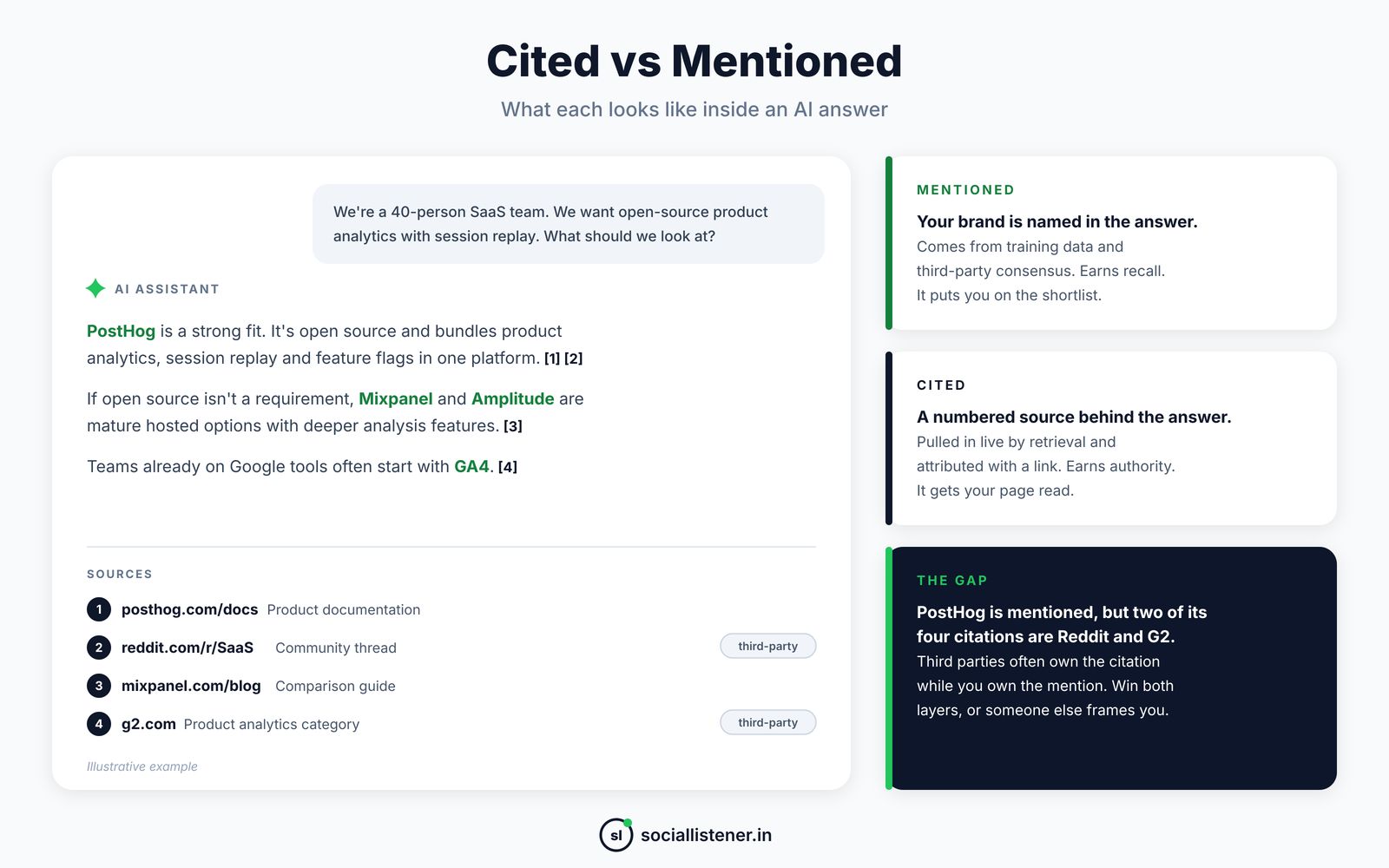
A mention is your brand named in the generated text: "PostHog is a strong fit." It's driven mainly by parametric memory and by how consistently third parties describe you. Mentions decide whether you make the shortlist.
A citation is a numbered or linked source behind the answer: "[1] posthog.com/docs." It comes from the retrieval path, when one of your passages survives reranking and supports a claim. Citations decide whose framing the buyer reads when they click through. The revealing cases are the mismatches:
Mentioned, not cited. The model knows you, but the evidence comes from someone else: a Reddit thread, a G2 category page, a competitor's comparison post. You're on the shortlist, but a third party controls the narrative.
Cited, not mentioned. Your blog explains the category so well that it's used as a source, yet the answer recommends three other vendors. You've built authority for your competitors.
Both. You're named, and the supporting evidence is your own page or a favourable third-party source. That's the goal.
Cited for authority + mentioned for recall = learned, trusted and recommended.
The signals LLMs seem to reward
No AI provider publishes its selection criteria, so treat these as consistently observed patterns, not documented ranking factors. Together they determine what we can call entity confidence: how sure a model is about who you are, what category you belong to and what you're good at.
Diversity of mentions: Your brand appears across many independent domains: analysts, media, forums, partners and review sites. Why LLMs prefer it: cross-domain agreement reads as broad validation and strengthens entity confidence. Ten mentions across ten domains outweigh a hundred on your own site.
Quality over volume: A few trusted, contextually relevant mentions beat hundreds of weak ones. Why LLMs prefer it: retrieval and reranking weigh source authority and topical relevance, not raw counts. Low-quality mentions rarely survive reranking.
Unlinked mentions: Your brand is named in text without a hyperlink, such as in a podcast transcript or a forum reply.
Why LLMs prefer it: models learn entities from text, not links. Unlinked mentions still feed the model's picture of who you are, something link-based SEO always ignored.
Machine-readable identity: Schema.org Organization and Product markup, Wikidata and Crunchbase entries, and steady branded search interest. Why LLMs prefer it: structured data helps resolve your brand as a distinct entity and ties your profiles together, reducing confusion with similarly named companies.
Reviews, UGC and forums: Genuine user experiences and comparisons on review sites, Reddit and community forums.
Why LLMs prefer it: they supply the human context that recommendation queries ("best tool for X," "X vs Y") need, which vendor pages can't credibly provide.
Media and analyst coverage: Coverage in respected publications and analyst reports. Why LLMs prefer it: authoritative sources act as truth anchors, long-term credibility signals that carry weight in both training data and retrieval.
Niche ownership: What it means: owning one specific sub-category instead of competing in a broad one. Why LLMs prefer it: models tend to name a clear leader per sub-topic. A tight brand-to-topic mapping is easier to learn and shows up in answers faster.
Original insight: What it means: data-backed research, benchmarks and named frameworks. Why LLMs prefer it: models cite sources that add new information. Original data is the most reliable path to citations, and others quoting it turns those citations into mentions.
The source layer: where models find their evidence Models don't read the web evenly. A March 2026 analysis by Peec of around 30 million sources cited in AI answers found the top domains differ by engine, but the same types of site dominate:
Reddit ranked first for Perplexity and Gemini, and second for ChatGPT, Google AI Mode and AI Overviews.
YouTube ranked first in Google's AI Mode and AI Overviews.
Wikipedia was the most-cited domain for ChatGPT.
LinkedIn made the top five for ChatGPT, Perplexity and both Google surfaces, and G2 made Perplexity's top five.
For B2B, that points to three source clusters worth managing deliberately.
Review and listing platforms
G2, Capterra, TrustRadius, Gartner Peer Insights, SourceForge, Product Hunt and AlternativeTo matter for two reasons. Their category and comparison pages ("best X software," "X alternatives," "X vs Y") are near-perfect retrieval targets: dense, comparative, frequently updated and organised around exactly the sub-queries a model fans out into. And their review text supplies the context models need to match vendors to prompts: company size, industry, integrations, implementation time.
The practical work is unglamorous: complete and consistent profiles on every relevant platform, correct category placement (the wrong category trains the wrong association), reviews that mention specifics rather than star ratings, and presence on long-tail directories like SourceForge and AlternativeTo that often rank for "alternatives to [competitor]" queries.
Reddit, forums and the social web
Reddit is the most important third-party source in many engines' citation sets, and access to it is formalised: Google and OpenAI both signed data agreements with Reddit in 2024. Engines lean on forum threads because they contain what vendor pages don't: unfiltered comparisons, failure stories and "what we actually switched to" advice.
The same logic extends to YouTube (tutorials and comparisons, heavily cited by Google's AI surfaces), LinkedIn (practitioner posts), GitHub and Stack Overflow (for developer tools), Hacker News and Quora.
You can't astroturf this layer, and shouldn't try. Communities spot it quickly, and the backlash becomes the evidence models retrieve. What works is genuine participation: product and engineering staff answering questions under their own names, customers encouraged to share real stories, and community spaces where users help each other in public, indexable places.
Reference and knowledge sources
Wikipedia and Wikidata anchor entity resolution, which helps explain why Wikipedia tops ChatGPT's citation list. Most B2B companies won't qualify for a Wikipedia article, and writing one promotionally breaks Wikipedia's rules. But a Wikidata entry, consistent Crunchbase and LinkedIn data, and accurate trade-media coverage all feed the same entity graph.
Teardowns: why some brands show up everywhere
The brands that dominate AI answers in their categories didn't set out to optimise for AI. They built assets that happen to match how parametric memory and retrieval work.
Figma: the community-generated entity
Figma is the default answer to most questions about collaborative interface design, and very little of the evidence behind that comes from Figma's own marketing.
Figma Community. Users publish files, UI kits, templates and plugins in a public, indexable gallery. Each one is third-party content that names Figma in context.
A tutorial economy. Designers teach Figma on YouTube, Medium, Reddit and bootcamp curricula. That steady stream of how-to content trains the association between Figma and "UI design," "prototyping" and "design systems."
Embedded in other people's workflows. Developer docs, design-system sites and job descriptions treat Figma as a given, which reinforces it as the category's reference entity.
Its own conference. Config talks and recaps create a yearly burst of media coverage and practitioner content.
The result is both layers at once: mentioned through a consensus Figma barely authored, and cited through help docs that answer the long tail of "how do I…" sub-queries.
Zapier: the long-tail citation machine
Zapier shows the other route, programmatic coverage of the long tail.
A page for nearly every integration. Zapier's directory lists more than 9,000 connected apps (9,938 as of August 2026), with dedicated pages for specific app-to-app connections. When a model fans out "how do I connect X to Y," Zapier often has the most direct passage on the web for that exact sub-query.
Years of category content. Its "best apps for X" roundups and how-to guides answer comparison queries well beyond automation, so Zapier gets cited even when the user never asked about automation.
Ubiquity in other people's content. Countless SaaS help centres document "connect via Zapier," which embeds the brand in third-party text and cements its association with no-code integration.
Other patterns worth studying
HubSpot: glossary, academy and template content built for definitional queries ("what is a sales pipeline") earns citations on top-of-category questions, while the brand itself is mentioned whenever CRM or inbound marketing comes up.
Supabase: long positioned as "the open-source Firebase alternative," with deep docs and an active GitHub presence. That one repeated phrase makes "Firebase alternative" queries an easy match.
PostHog: a public company handbook and candid, opinionated product and engineering posts give models specific, quotable material, while consistent "open-source product analytics" positioning anchors the entity.
Ahrefs and Semrush: original data studies, including research on which domains AI answers cite, get quoted by other publishers, turning one study into hundreds of downstream citations and mentions.
Notion: a template gallery and an active Reddit community produce a steady stream of user-generated, indexable use cases.
The common thread: none of them relies on its homepage. Each has a structural asset (open-source code, programmatic pages, original data or community templates) that generates evidence at a scale no content team could write by hand.
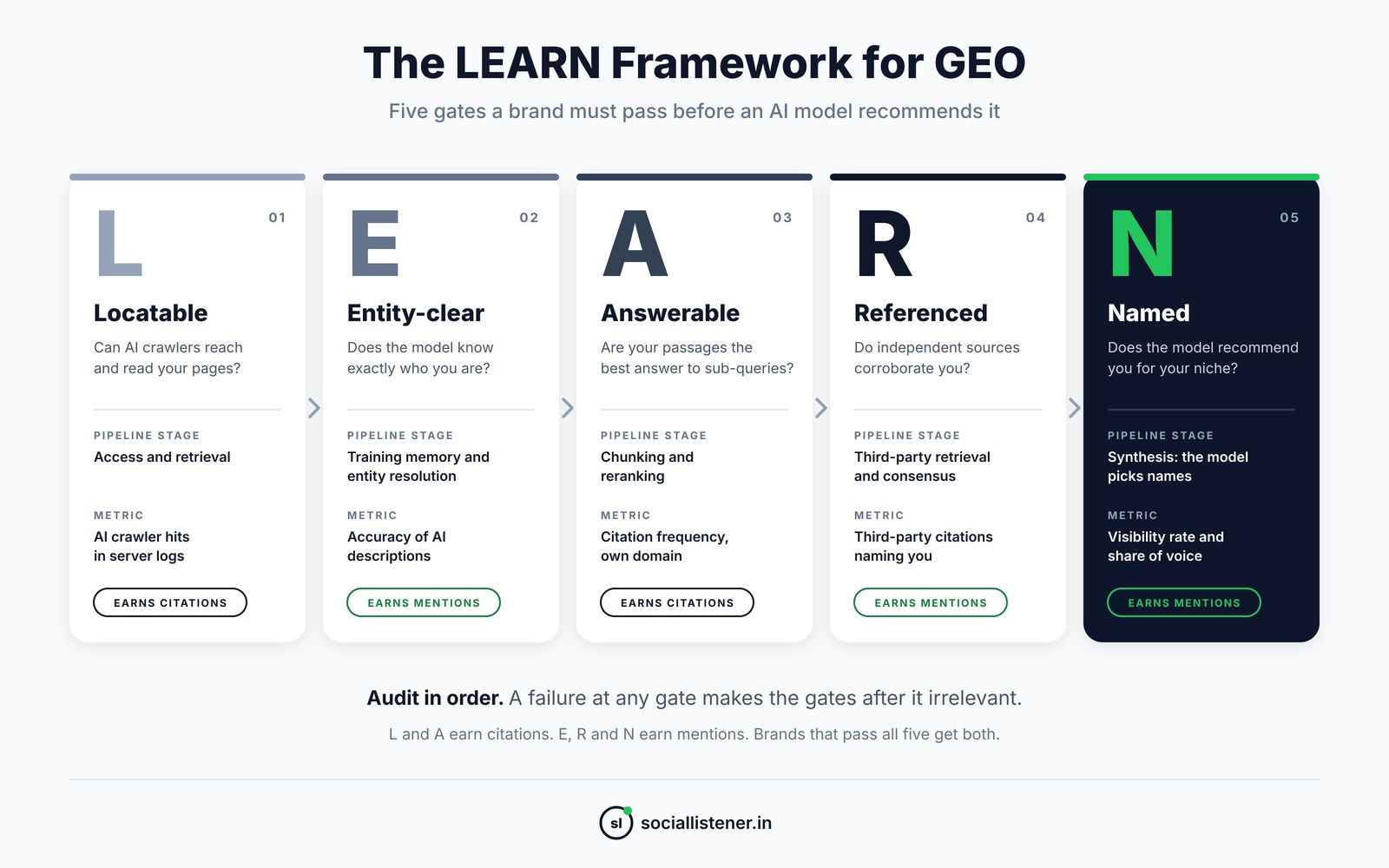
Ranking gets you clicked. Being learned gets you recommended. LEARN turns that idea into five gates a brand must pass, each mapped to a stage of the answer pipeline, with a typical failure and a metric to track. The gates are sequential. A failure at any one makes the rest irrelevant, so audit in order and fix the first broken gate before investing further down.
L: Locatable. Can the model reach you?
Pipeline stage: access and retrieval.
Typical failure: search crawlers such as OAI-SearchBot or PerplexityBot blocked in robots.txt, often by a blanket "block AI bots" rule; key pages that only render with client-side JavaScript; important answers locked behind gated PDFs.
What to do: write separate robots.txt rules for training and search crawlers, server-render key pages, and keep core product, pricing and docs content in crawlable HTML.
Metric: AI crawler hits in your server logs, by bot and by page.
E: Entity-clear. Does the model know who you are?
Pipeline stage: training memory and entity resolution.
Typical failure: five different category descriptions across your website, LinkedIn, G2, Crunchbase and press, so the model forms a blurry entity, or confuses you with a similarly named company.
What to do: pick one category phrase and use it everywhere. Add schema.org Organization and Product markup with sameAs links to your official profiles, create or correct your Wikidata entry, and align every directory listing.
Metric: description accuracy, meaning how often models describe your category, strengths and fit correctly.
A: Answerable. Are your passages the best answer?
Pipeline stage: chunking and reranking.
Typical failure: answers buried deep in long pages, adjectives instead of specifics, and content written for keywords instead of the sub-queries a model fans out into.
What to do: build question-led, self-contained passages that each answer one sub-query. Lead with the answer, include concrete specifics (integrations, limits, pricing logic, who you're not for) and keep one idea per section. Zapier's integration pages show the pattern at scale.
Metric: citation frequency for your own domain, and which pages earn it.
R: Referenced. Do independent sources corroborate you?
Pipeline stage: third-party retrieval and consensus in training data.
Typical failure: a thin or missing presence on G2 and other review sites, no genuine discussion on Reddit or YouTube, and no place in third-party comparisons.
What to do: complete review and listing profiles, reviews with specific context, staff and customers participating openly in communities, and original data other publishers want to quote. Figma's community-generated footprint is the benchmark.
Metric: the share of third-party citations, on prompts in your category, that name your brand.
N: Named. Does the model recommend you for your niche?
Pipeline stage: synthesis, where the model picks names.
Typical failure: broad positioning that makes you one of fifty, so the model defaults to category leaders.
What to do: own a defensible sub-category and repeat it relentlessly, the way Supabase owned "open-source Firebase alternative" and PostHog owns "open-source product analytics." Publish decision content (pricing logic, implementation timelines, security documentation) so the model has concrete reasons to recommend you, not just name you.
Metric: visibility rate and share of voice across your prompt panel.
How LEARN maps to cited vs mentioned: L and A are citation work, getting your pages retrieved and attributed. E, R and N are mention work, getting your brand named. Brands that pass all five get both.
How to track it
Click-based analytics undercounts AI influence, because most answers produce no visit. Instead, build a panel of 50 to 100 real buyer prompts and run it at least quarterly across ChatGPT, Gemini, Perplexity, Claude and Copilot. Answers vary between runs, so test each prompt several times and track rates, not screenshots.
Watch four numbers: visibility (how often you're mentioned), share of voice (against named competitors), citation frequency (how often your pages are the source) and accuracy (whether the model describes you correctly). The goal is the same for every prompt: are you both cited and mentioned?
The compounding advantage
AI SEO looks a lot like early SEO: the metrics are messy, the rules are unwritten and most competitors are waiting for clarity. That's exactly why it pays to start now. Whoever shapes how a model describes a category today gains framing power that compounds as AI usage grows and today's answers feed tomorrow's training data. The brands that win won't be the ones publishing the most. They'll be the ones the models have learned to trust: discoverable, cited, mentioned and, finally, recommended.
Also read: Is AI Replacing the Top of the B2B Marketing Funnel?