Most GTM stacks are built backwards. A company raises money, hires a sales leader, and within a month someone is demoing an intent-data platform. Six months later there are fourteen logins, three dashboards that disagree, and a pipeline that looks exactly like it did before. The tools weren't wrong. The order was.
Over the years, across very different industries and markets, I've watched the same pattern repeat. The teams that won weren't the ones with the biggest budgets or the most tools. They were the ones that respected the order in which buyers come to trust a company. Get the order right, and modest tools perform. Get it wrong, and the best stack in the world just makes noise faster.
Here is what most stack diagrams forget: your buyer doesn't care about your tool categories. They experience you as a sequence. They find you. They form an impression. They hear from you. You learn more about them. You meet. And if you've done it well, they stay, grow and tell others. A list of tools is a shopping list. A sequence is a strategy. So this is how I approach GTM, and how I'd urge anyone building one to approach it:
Get found before you go looking. A buyer who receives your email will check your website and your reviews before replying. If those aren't credible, your outreach is noise.
Build the brand before you build the list. Reaching out to people who've never heard of you is the most expensive way to sell.
Reach accounts with intent, not volume. Ten right conversations beat a thousand sends.
Enrich once accounts respond. Spend on data where there's a signal worth acting on.
Convert with speed and context. The first rep to respond with something relevant usually wins.
Retain and grow. Your best customers are your next marketing channel.
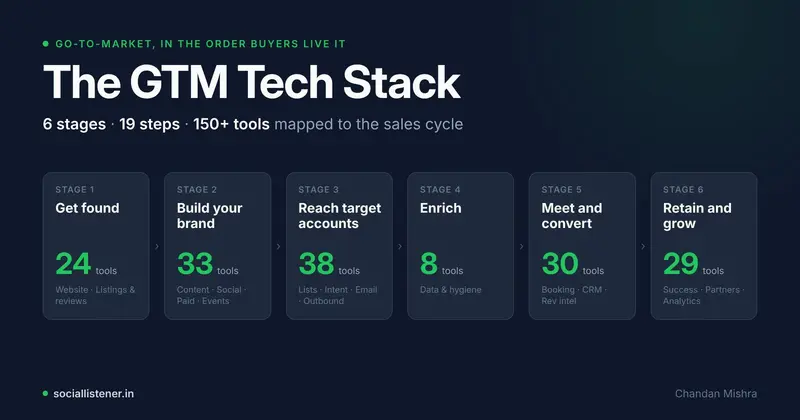
What follows is the stack, stage by stage: 19 steps and nearly 160 tools. I haven't ranked them or bundled them by company size. A ten-person startup and a 2,000-person scale-up will make different choices, and they should. Pick what fits your market, your team and your budget. But follow the order. The order is the strategy.
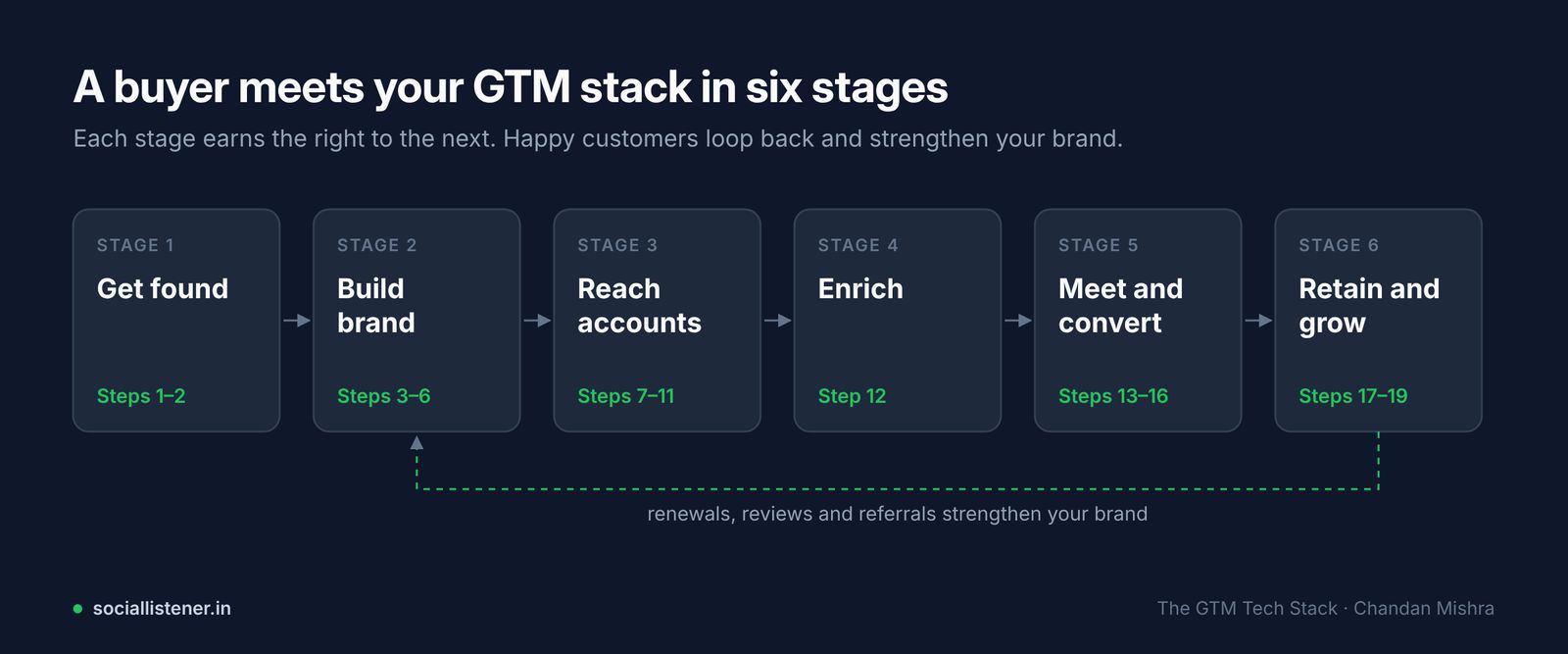
Each stage builds on the one before it. Happy customers loop back as reviews and referrals, which strengthens your brand for the next buyer.
Stage 1: Get found
Every buyer journey now starts with a silent check. Before anyone replies to an email, takes a call or books a demo, they look you up. They open your website, scan your review profiles, and judge whether the company looks real, current and credible. Most of this happens without you ever knowing. That makes your digital presence your first salesperson, working around the clock. A thin website, an empty review profile or a listing that hasn't changed in two years quietly disqualifies you before the conversation starts. Get this stage right before spending anything on outreach.
What good looks like: wherever a buyer finds you, they can understand what you do, who it's for and why you're credible within a minute.
1. Website, landing pages and product demos
Your website is the first proof that you're credible. Build pages around specific use cases, show the product, and give visitors a clear next step.
Webflow — visual website builder for marketing teams
WordPress — the most widely used CMS, with a large plugin ecosystem
Framer — fast, design-led websites and landing pages
Contentful — headless CMS for multi-language, multi-site setups
Unbounce and Instapage — campaign landing pages and A/B testing
Mutiny — personalises website content by account or industry
Storylane, Navattic and Consensus — interactive product tours and demo automation
2. Listing, review and marketplace presence
Buyers shortlist vendors on review sites and directories before they ever talk to sales. Claim your profiles, collect reviews and keep listings current.
G2 — the leading B2B software review site, with category grids and buyer intent data
Capterra, GetApp and Software Advice — Gartner Digital Markets' software directories
Gartner Peer Insights — verified enterprise reviews that analysts and large buyers read
TrustRadius — in-depth B2B reviews and intent data
Clutch — reviews and rankings for agencies and services firms
Product Hunt — launch visibility with early adopters
AWS Marketplace, Microsoft Azure Marketplace and Google Cloud Marketplace — listings that let enterprises buy through existing cloud budgets
Google Business Profile, LinkedIn Company Page and Crunchbase — the basic profiles buyers check to confirm you're real
Why reviews and familiar names carry so much weight with enterprise buyers: Nobody Gets Fired for Buying IBM.
Stage 2: Build your brand
Being findable is not the same as being remembered. At any given moment, only a small share of your future buyers are actively in the market. The rest will buy later, and when they do, they'll start with the names they already know. Brand is how you get onto that shortlist before it's written. It's built through useful content, a clear point of view, consistent presence where your buyers spend time, and showing up in the rooms, physical or virtual, where they gather. It's slower than outbound and harder to measure. But it makes every later stage cheaper: emails get opened, calls get returned, and deals face fewer objections.
What good looks like: when your team reaches out, the reply is "I've seen your work" rather than "Who are you?"
3. Content, SEO and AI visibility
Answer the questions buyers ask on search engines and AI assistants such as ChatGPT and Perplexity.
Semrush — keyword research, content ideas and rank tracking
Ahrefs — content gaps, backlinks and competitor content
Clearscope and Surfer — optimising content for search intent
Profound and Otterly.AI — tracking how AI assistants mention your brand
Conductor and BrightEdge — enterprise SEO and content performance
Google Search Console — how Google indexes and ranks your site
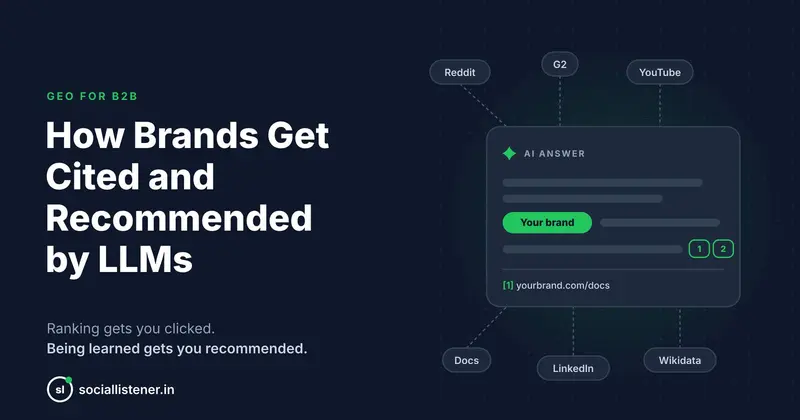
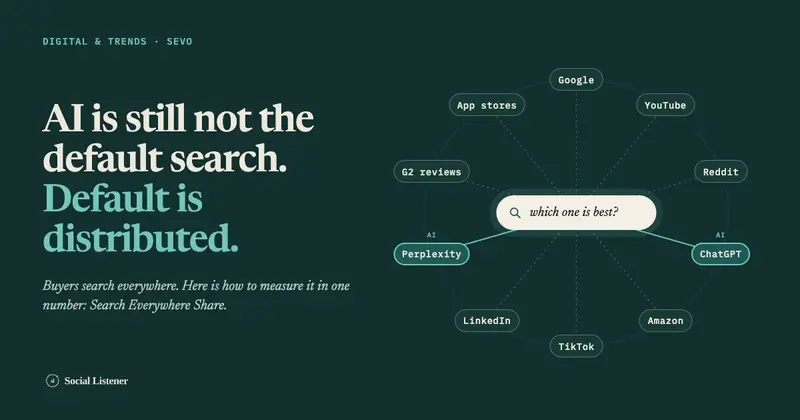
Go deeper: How Do Brands Get Cited and Recommended by LLMs? and AI Is Still Not the Default Search. Default Is Distributed.
4. Social media and PR
Build visibility on LinkedIn and in the media through company, founder and employee voices.
Sprout Social and Hootsuite — social publishing, listening and reporting
Buffer — simple social scheduling for small teams
Taplio — LinkedIn content creation and scheduling for founders and leaders
EveryoneSocial — employee advocacy, so your team shares company content
Muck Rack and Cision — media databases, pitching and coverage tracking
Prowly — press releases and newsrooms at a lower cost
Qwoted — connects experts with journalists looking for sources
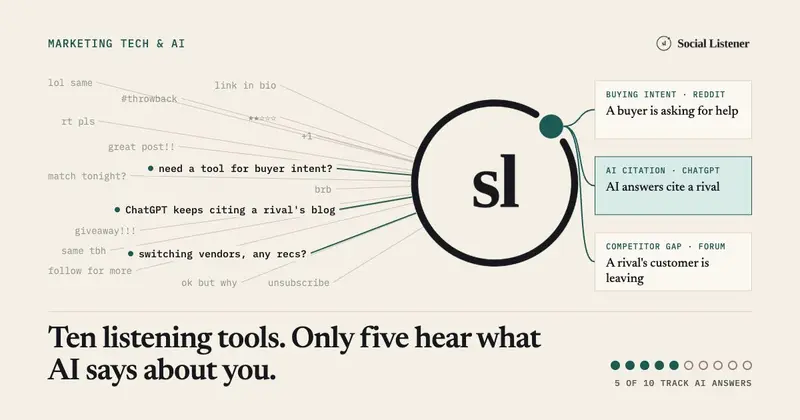
To hear what buyers say about you, not just what you say about yourself: Top 10 Social Listening Tools for the AI Era.
5. Paid advertising and retargeting
Capture existing search demand and keep your brand in front of the right roles and companies.
LinkedIn Campaign Manager — targeting by company, role, seniority and matched account lists
Google Ads — paid search for high-intent queries
Microsoft Advertising — Bing search plus LinkedIn profile targeting
Meta Ads Manager — retargeting and reach on Facebook and Instagram
StackAdapt — programmatic B2B display, video and native ads
The Trade Desk — large-scale programmatic buying
6. Events, webinars and community
Webinars, roundtables and communities build trust faster than ads, especially in enterprise sales.
Zoom Webinars — reliable, familiar webinar hosting
Livestorm — browser-based webinars with built-in follow-up
ON24 — engagement scoring and analytics for digital events
Goldcast — B2B events plus repurposing event content into clips
Cvent and Bizzabo — in-person and hybrid event management
Luma — simple event pages and RSVPs for meetups
Circle and Bevy — online communities and chapter-based events
Where to start: Top 10 Marketing Communities and Groups You Should Join.
Stage 3: Reach target accounts
Now you go looking, and precision matters more than volume. The temptation is to buy a big list and send a lot of emails. It rarely works anymore. Inboxes are filtered, buyers are wary, and a poorly targeted message damages the brand you just built. Start with a clear picture of the companies you serve best and the people inside them who decide. Then look for signs of timing: an account researching your category, a new leader, fresh funding, expansion, or a contract coming up for renewal. Reach those accounts across a few channels with something relevant to their situation, not a generic pitch.
What good looks like: fewer messages, more replies, and conversations that start with a problem the buyer already recognises.
7. Market and competitor research
Understand which segments have demand, how competitors position themselves, and which messages resonate.
Similarweb — competitor traffic, channel mix and audience overlap
Google Trends — changes in search interest by topic and region
SparkToro — where your audience reads, listens and follows
Wynter — message testing with panels of real B2B buyers
Klue — competitive intelligence and sales battlecards
Crayon — automated tracking of competitor website, pricing and product changes
8. Account lists and buying committees
Build a named list of target companies and identify the decision-makers at each one.
LinkedIn Sales Navigator — finding stakeholders and tracking account changes
ZoomInfo — company and contact database with org charts
Apollo — prospect search with built-in outreach
Cognism — B2B contact data with strong European coverage
Crunchbase — funding, growth and company signals
D&B Hoovers — firmographics and corporate hierarchies
9. Intent signals and account-based marketing
Spot accounts that are actively researching your category, then focus ads and outreach on them.
6sense — intent data, buying-stage prediction and account prioritisation
Demandbase — account targeting, ABM advertising and buying-group insights
G2 Buyer Intent — accounts comparing you or competitors on G2
RollWorks — ABM advertising and account identification
Factors.ai — website account identification and journey analytics
Warmly and RB2B — identify companies and people visiting your site
Common Room — signals from community, social, product and web activity
No budget for an intent platform? Use the 7-Signal B2B Intent Score Framework, and read why high-intent buyers are harder to find than vendors claim.
10. Email marketing and nurture
Send newsletters, nurture leads by role and interest, and follow up after webinars and events.
HubSpot Marketing Hub — CRM-based email, nurture and lead scoring
Marketo Engage — advanced automation for large, global programmes
Salesforce Marketing Cloud Account Engagement (formerly Pardot) — B2B automation inside Salesforce
ActiveCampaign — segmented automation at a lower cost
Customer.io — behaviour-triggered messaging using product data
Brevo and Mailchimp — newsletters and simple campaigns
11. Outbound and sales engagement
Run short, multichannel sequences for each buyer role across email, phone and LinkedIn.
Outreach — sales sequences, deal management and analytics
Salesloft — cadences, conversation intelligence and forecasting (now including Clari)
Apollo — prospect data and sequences in one tool
HubSpot Sequences — outreach inside the HubSpot CRM
Lemlist, Instantly and Smartlead — cold email at scale with deliverability tools
Nooks and Orum — AI-assisted parallel dialers for SDR teams
Stage 4: Enrich
Enrichment comes after engagement, not before it. Many teams buy deep data on thousands of accounts that will never respond. It's far more effective to invest in depth once an account has shown interest: a reply, a site visit, a webinar attendance, a demo request. At that point, fuller data pays off. Who else sits on the buying committee? What tools do they use today? How large is the team, and what has changed recently? Clean, verified records also protect your email reputation and stop reps wasting time on wrong numbers and bounced emails.
What good looks like: every rep walks into a first conversation already knowing the account.
12. Data enrichment and hygiene
Once accounts start responding, fill in missing details, verify contacts and remove duplicates so sales works from accurate records.
Clay — combines dozens of data sources and automates account research
HubSpot Breeze Intelligence (formerly Clearbit) — enrichment inside HubSpot
ZoomInfo — CRM enrichment and ongoing data refresh
Lusha — contact enrichment from a browser extension or CRM
ZeroBounce and NeverBounce — email verification before you send
Openprise — data cleansing, normalisation and deduplication
Syncari — keeps data consistent across CRM, marketing and product systems
Stage 5: Meet and convert
This is where interest becomes pipeline, and pipeline becomes revenue. It's also where most deals leak. A buyer who waits two days for a reply, or who has to repeat their story to three different people, quietly moves on. Speed matters: make it easy to book time, and route each lead to the right person straight away. Context matters: the seller should know what the buyer read, attended and asked about. Preparation matters: complex deals involve several stakeholders with different concerns, and each needs the right material.
What good looks like: the buyer feels understood in the first meeting and never has to explain themselves twice.
13. Meeting booking and website chat
Let interested buyers book a meeting instantly, and route them to the right rep.
Chili Piper — instant booking and routing straight from web forms
Calendly — simple scheduling links for reps and teams
Default — inbound form routing, qualification and scheduling
LeanData — lead-to-account matching and routing inside Salesforce
Qualified — live and AI chat for website visitors from target accounts
Intercom — chat, AI agent and help desk on your site
14. CRM and deal management
Keep one system of record for every contact, conversation and deal, and manage quotes and approvals.
Salesforce Sales Cloud — the most customisable CRM for complex sales organisations
HubSpot Sales Hub — easy-to-run CRM tied to marketing
Microsoft Dynamics 365 Sales — CRM for Microsoft-centric companies
Pipedrive, Attio and Zoho CRM — lighter, lower-cost CRMs
DealHub and Salesforce Revenue Cloud — quoting, pricing and approvals (CPQ)
DocuSign and PandaDoc — proposals and e-signatures
15. Conversation and revenue intelligence
Record and analyse sales calls, flag at-risk deals and forecast more accurately.
Gong — conversation intelligence, deal risk and forecasting
Clari Forecast (now part of Salesloft) — pipeline inspection and forecast roll-ups
Avoma — meeting notes, call analysis and coaching
BoostUp and Aviso — AI forecasting and pipeline analytics
Fireflies, Fathom and tl;dv — lightweight call recording and AI notes
16. Sales enablement
Give reps the right battlecards, decks and case studies at each stage of the deal.
Highspot — content management, guidance and training for sellers
Seismic — enterprise content automation and personalisation
Showpad — sales content and buyer engagement
Mindtickle — onboarding, coaching and readiness scoring
Guru — knowledge base surfaced inside Slack, the browser and CRM
Loom — quick video walkthroughs for reps and buyers
Tools help, but deals close on confidence: Why GTM Teams Struggle to Convert Trust Into Revenue.
Stage 6: Retain and grow
The sale isn't the finish line. In most B2B businesses, a large share of long-term revenue comes from customers who stay, renew and expand, and keeping a customer usually costs far less than winning a new one.
Retention starts with onboarding: help customers reach their first real result quickly, then watch adoption and health so problems surface early. Happy customers become your most credible marketing through reviews, referrals and case studies, which feed straight back into Stages 1 and 2. Partners extend that reach further, and measurement ties it all together by showing which stages and channels actually create revenue.
What good looks like: your customers are selling for you.
17. Customer onboarding, success and expansion
Get customers to their first result quickly, track account health, and spot renewal and expansion opportunities.
Gainsight — health scores, renewals and customer success playbooks
Totango — customer journeys and success workflows
ChurnZero — churn risk alerts and in-app engagement
Planhat and Vitally — modern customer success platforms
Pendo — product analytics and in-app guides
Userpilot — onboarding flows and product adoption
Influitive — customer advocacy, references and reviews
18. Partners and co-selling
Grow through system integrators, resellers and technology partners who already serve your buyers.
Crossbeam — account mapping to find customer and pipeline overlap with partners
PartnerStack — partner, affiliate and referral programmes
Impartner — partner relationship management, deal registration and portals
Salesforce Partner Relationship Management — partner portals inside Salesforce
Tackle.io — co-selling with AWS, Azure and Google Cloud sales teams
Clazar and Suger — alternative cloud marketplace and co-sell platforms
19. Analytics and attribution
See which channels and campaigns create pipeline and revenue across the whole cycle.
Dreamdata and HockeyStack — multi-touch B2B attribution tied to revenue
Adobe Marketo Measure (formerly Bizible) — attribution for Marketo and Salesforce users
Google Analytics 4 — website and campaign analytics
Mixpanel, Amplitude and PostHog — product analytics
Snowflake and Databricks — data warehouses that unify GTM data
Hightouch and Segment — move data between the warehouse and GTM tools
Tableau, Looker and Power BI — dashboards and reporting
How to choose your stack
There is no single right stack. Before buying any tool, ask these questions:
Does it connect to your CRM? A tool that can't write data back becomes another silo.
Do you already have a tool doing this job? Two tools in the same layer usually means neither gets used well.
Who will run it? A tool without an owner is cost, not capability.
Does its data cover your markets? Contact and intent coverage varies widely by region, so pilot before you sign.
Can you tie it to pipeline or revenue? If you can't measure its impact, you can't defend renewing it.
Vendors in this space merge, rebrand and reprice often. Check a vendor's current status, roadmap and pricing before you commit.
The order is the strategy
Every few months, a new tool promises to fix go-to-market. Some of them are genuinely brilliant. None of them can fix a sequence that's broken. Buyers don't experience your company as a stack of software. They experience a story that unfolds in order. They find you. They come to trust you. They hear from you at the right moment. They feel understood when you meet. And they keep getting value long after they've signed. Each stage earns the right to the next. Skip one, and everything after it becomes expensive and fragile.
So start where buyers start. Make yourself findable and credible. Build a brand people remember. Reach the right accounts with something worth hearing. Learn about them before you sell. Meet them prepared. Then keep earning their trust, because today's customer is tomorrow's best introduction.
The tools in this guide will change. New ones will appear, and some of today's leaders will merge or fade. The order won't change, because it was never about technology. It's about how people decide to trust and buy.
Choose your tools freely. Respect the order. Don't over complicate it. Use the tools you think are necessary.
Read next
Sources
Clari vs Gong: 2026 pricing, forecasting and AI compared (Cirrus Insight, Oct 2026)
Clari after the Salesloft merger (Weflow)