Over the last few years, go-to-market teams built bigger and bigger machines. More tools, more data, more automated touches. And buyers got quieter. They ignore the sequences, skip the demos, and increasingly ask an AI assistant for a shortlist before they ever speak to a salesperson.
That is why GTM engineering is entering its second act. The first act was about automating the playbook. The second is about something simpler and harder: understanding buyers well enough to meet them at the right moment, whether they come looking for you or you go looking for them.
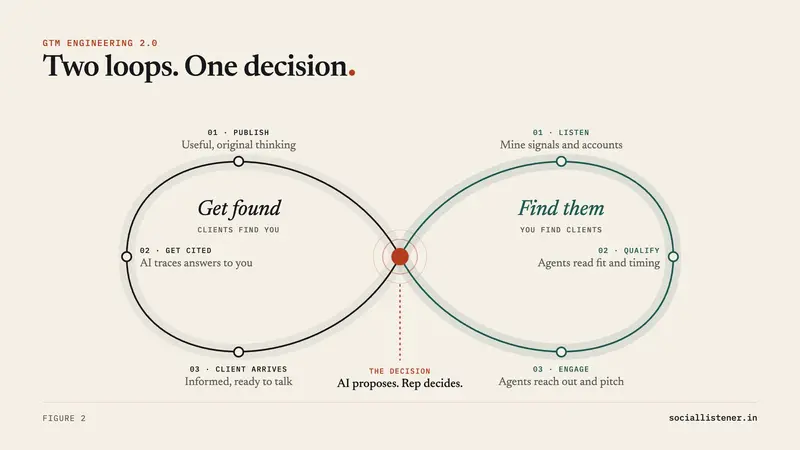
This article lays out a framework for GTM engineering 2.0 called Two Loops, One Decision. It has two loops, one where clients find you and one where you find clients, a single decision at their centre, and a stack underneath that powers both.
From noise to signals to behaviour
Go-to-market has moved through three stages, and each one changed what teams paid attention to.
First came noise. Reach was the goal: more emails, more ads, more calls. Volume was cheap, so everyone used it, and buyers learned to tune it out.
Then came signals. GTM engineering 1.0 taught teams to watch for triggers like a funding round, a new hire, a pricing page visit or a tech change. Tools multiplied to capture each one, and automation acted on them at scale. It worked, until everyone was watching the same signals and acting on them the same way.
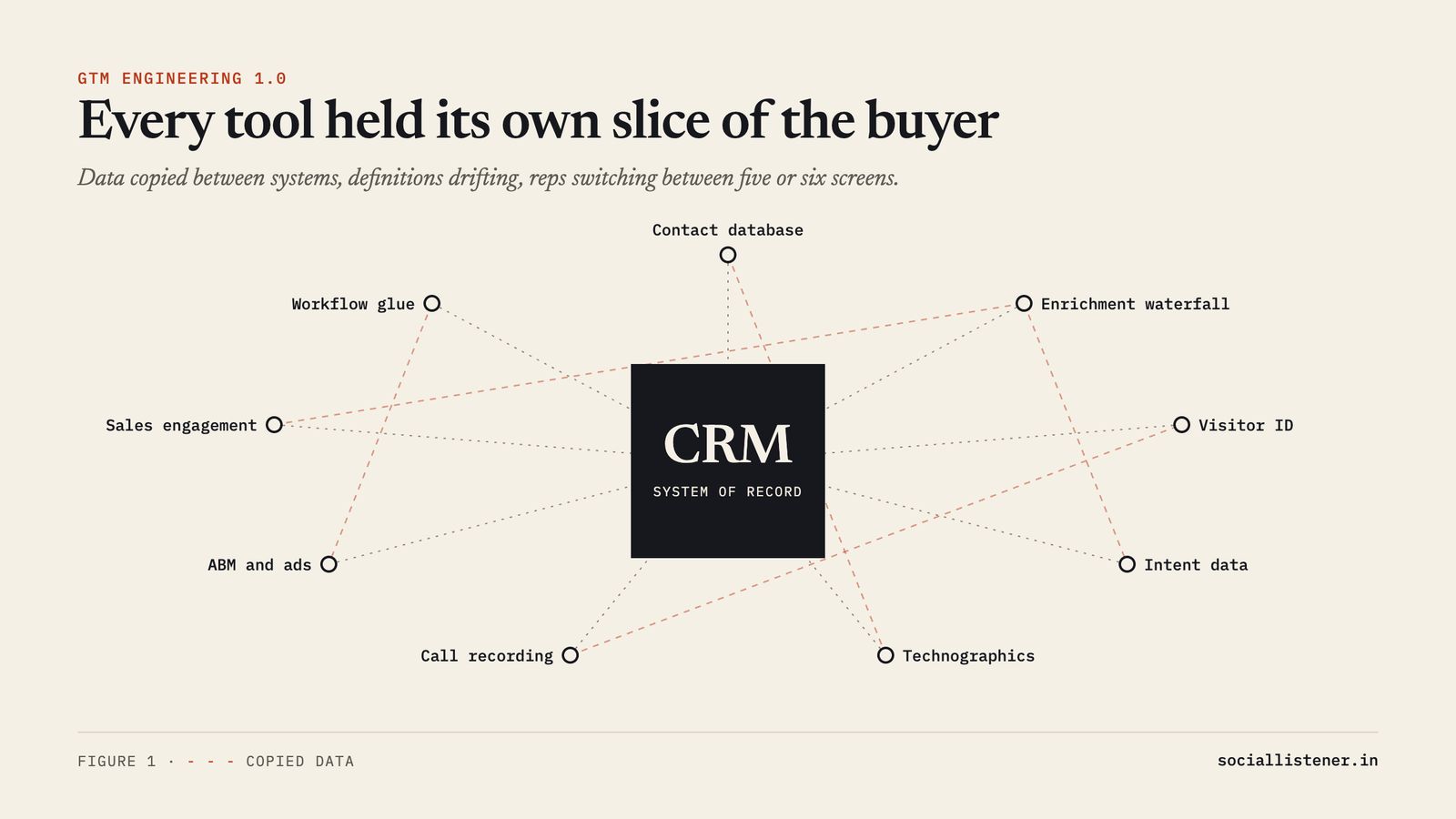
The GTM 1.0 stack reflected that thinking. A typical team ran a separate tool for almost every job, all stitched together with integrations. The CRM sat at the centre as the system of record, surrounded by a contact and company database for building prospect lists, enrichment tools chained in a waterfall to fill missing fields, intent data providers tracking research activity across the web, and visitor identification to unmask anonymous website traffic. Technographic and firmographic feeds added more detail, sales engagement platforms ran the email and call sequences, conversation intelligence recorded and analysed calls, and ABM and ad platforms handled targeted campaigns. Holding it all together were workflow and orchestration tools whose main job was moving data between everything else.
Each tool solved a real problem. Together they created a new one. Every tool held its own slice of the buyer, with its own logic and its own definitions. Data was copied between systems and drifted out of sync. Reps logged into five or six interfaces to piece together what to do next, and the cost of the stack kept climbing while response rates kept falling.
Now we are moving to behaviour. A signal tells you something happened. Behaviour tells you why, and what the buyer is likely to do next. A pricing page visit means one thing from a champion building a business case and something entirely different from a competitor doing research. GTM engineering 2.0 is built around reading that difference.
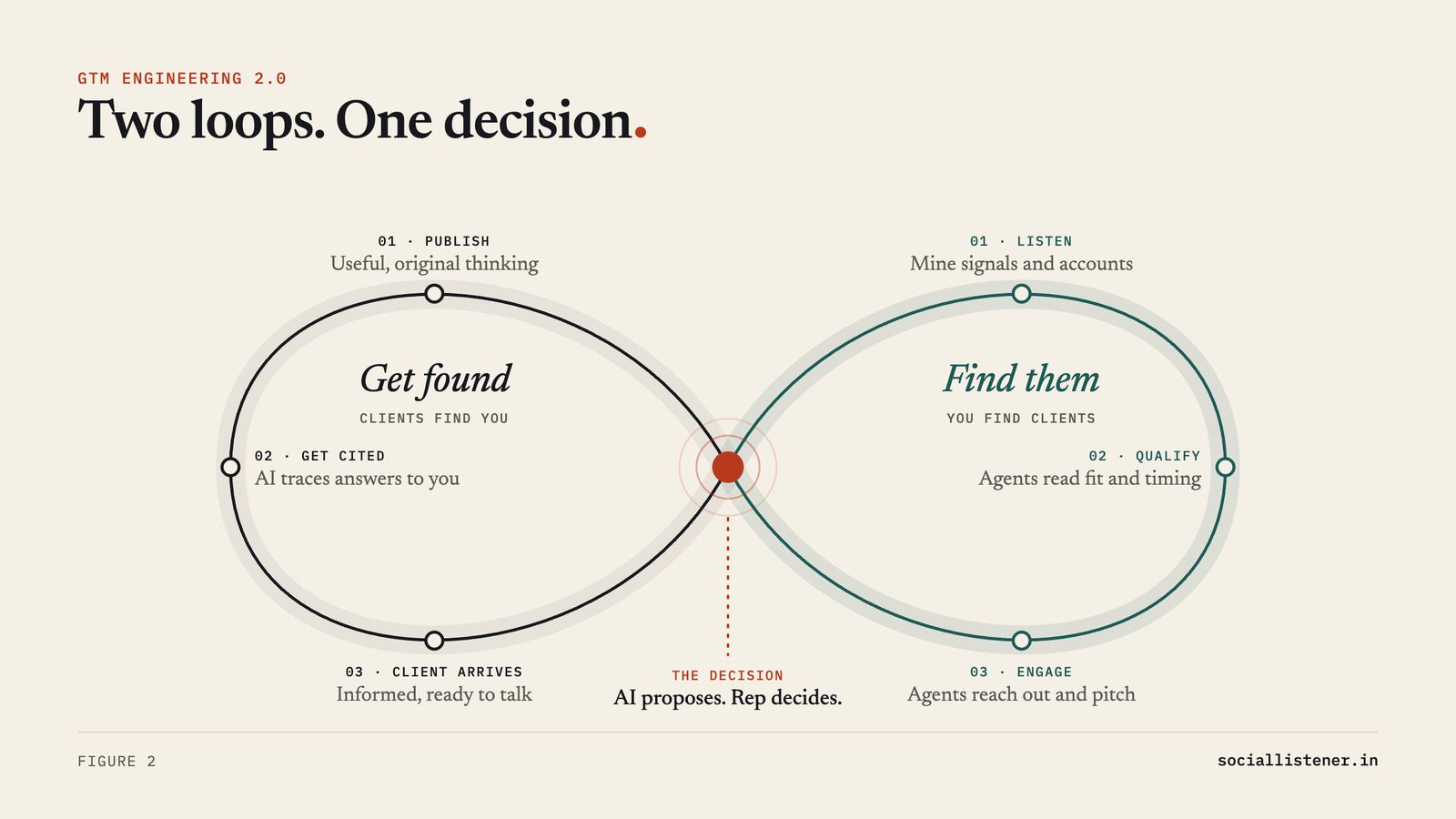
Loop one: Get found (clients find you)
The first loop is about being found by buyers who are already looking. It has three steps.
Publish. You put out useful, original thinking: frameworks, research, honest points of view on the problems your buyers face. Not content for its own sake, but material worth citing.
Get cited. Buyers increasingly start their research by asking an AI assistant. When that assistant answers, it draws on what it has read and traces the answer back to its sources. If your thinking is the clearest explanation of a problem, the AI names you, and often names your product as part of the solution.
Client arrives. The buyer, or an AI agent working on their behalf, reaches you already informed. They know what you think, why it matters and how you might help. The conversation starts further along.
This is not the same as search optimisation. Optimisation is about ranking for a keyword. Getting cited is about earning attribution: being the source an AI trusts enough to repeat. You cannot trick your way into it. You earn it by being specific, original and consistent over time.
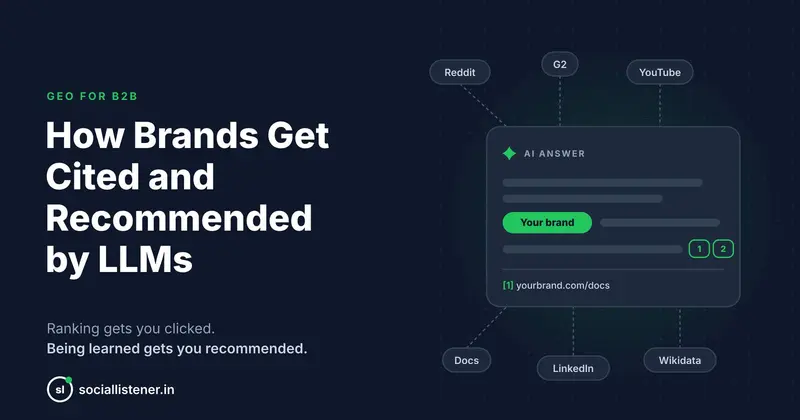
A useful way to check whether you are citable is the LEARN framework from our guide on how brands get cited and recommended by LLMs. It asks five questions. Locatable: can AI systems actually reach and retrieve your content? Entity-clear: does the model know who you are and which category you belong to? Answerable: are your passages the strongest self-contained answers to specific questions? Referenced: do independent sources back up what you say about yourself? Named: does the model recommend you for a niche you clearly own?
The same guide draws a distinction worth keeping in mind. Being mentioned means the AI names your brand in its answer, which decides whether you make the shortlist. Being cited means your page sits behind a claim as a source, which decides whose framing the buyer reads when they click through. The Get found loop needs both. New channels make this loop bigger every month. AI answers, agent marketplaces, MCP servers and plugins are all becoming places where buyers discover what to use. Teams that only plan for search, social and email will miss where an increasing share of discovery happens.
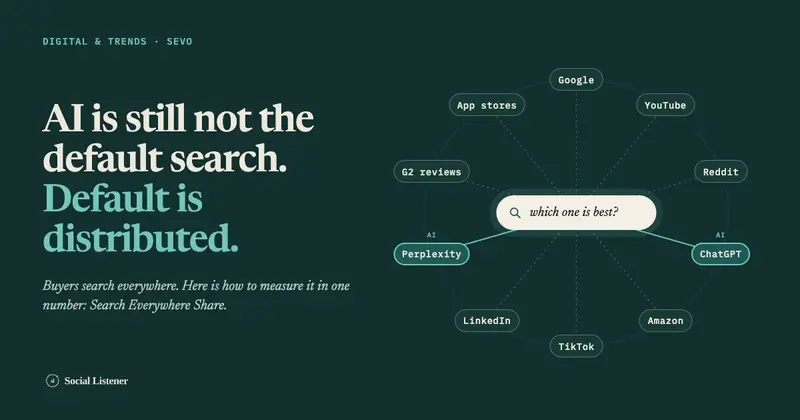
Keep this in proportion, though. AI assistants are growing fast, but they are still one channel among many. As we argued in AI is still not the default search, standalone AI tools took under 2% of US desktop activity in Q2 2026, against more than 10% for traditional search engines. Buyers move between search, AI assistants, video, social, communities and marketplaces. Getting found means showing up across all of them, not betting everything on one.
Loop two: Find them (you find clients)
The second loop runs the other way. Instead of waiting to be found, you go looking for the accounts that are quietly moving towards a purchase.
Listen. AI agents read public signals across the web and combine them with what you already know about each account: hiring patterns, technology changes, community conversations, content consumption, partner moves. The goal is not to collect more signals but to understand behaviour, spotting accounts that are acting like buyers before they raise their hand.
Qualify. Agents assess fit and timing. Is this account a match for what you sell? Is the behaviour consistent with an active buying process, or just curiosity? Only accounts that pass move forward.
Engage. Agents reach out, start the conversation and make the first pitch, timed to what the account is actually doing rather than to a sequence calendar. When the conversation needs trust, nuance or negotiation, a human steps in.
One principle keeps this loop honest: listen at the account level, using public or consented signals. Understanding that a company is moving is useful and respectful. Profiling individuals is neither, and it will not survive privacy rules in most markets. The best listening is quiet, not invasive.
The decision: AI proposes, the rep decides
The two loops cross at a single point, and it gives the framework the second half of its name: the decision. Everything both loops surface, from an inbound buyer who arrived through a citation to an outbound account that agents qualified, lands in front of a person who decides what happens next.
The sales rep's role changes here. Reps no longer spend their week logging into a CRM, a call recorder, a sequencer and a stack of dashboards to work out what to do. The system brings them a short, clear view: which accounts matter now, why, and what the recommended next move is. The rep's job is to judge, adjust and own the relationship.
The phrasing matters. AI proposes; it does not decide. Reps stay accountable for the relationship and the number, so they must be able to see why a recommendation was made and override it when their judgement says otherwise. A system that hides its reasoning will lose the rep's trust the first time it is wrong, and then nobody will use it. The loops also feed each other. What agents learn while engaging accounts shows you what to publish next. The questions inbound buyers arrive with show agents what to listen for. Every outcome makes both loops sharper.
The GTM intelligence stack
Both loops run on the same foundation. Instead of a dozen disconnected point tools, GTM engineering 2.0 organises the ecosystem into three layers.
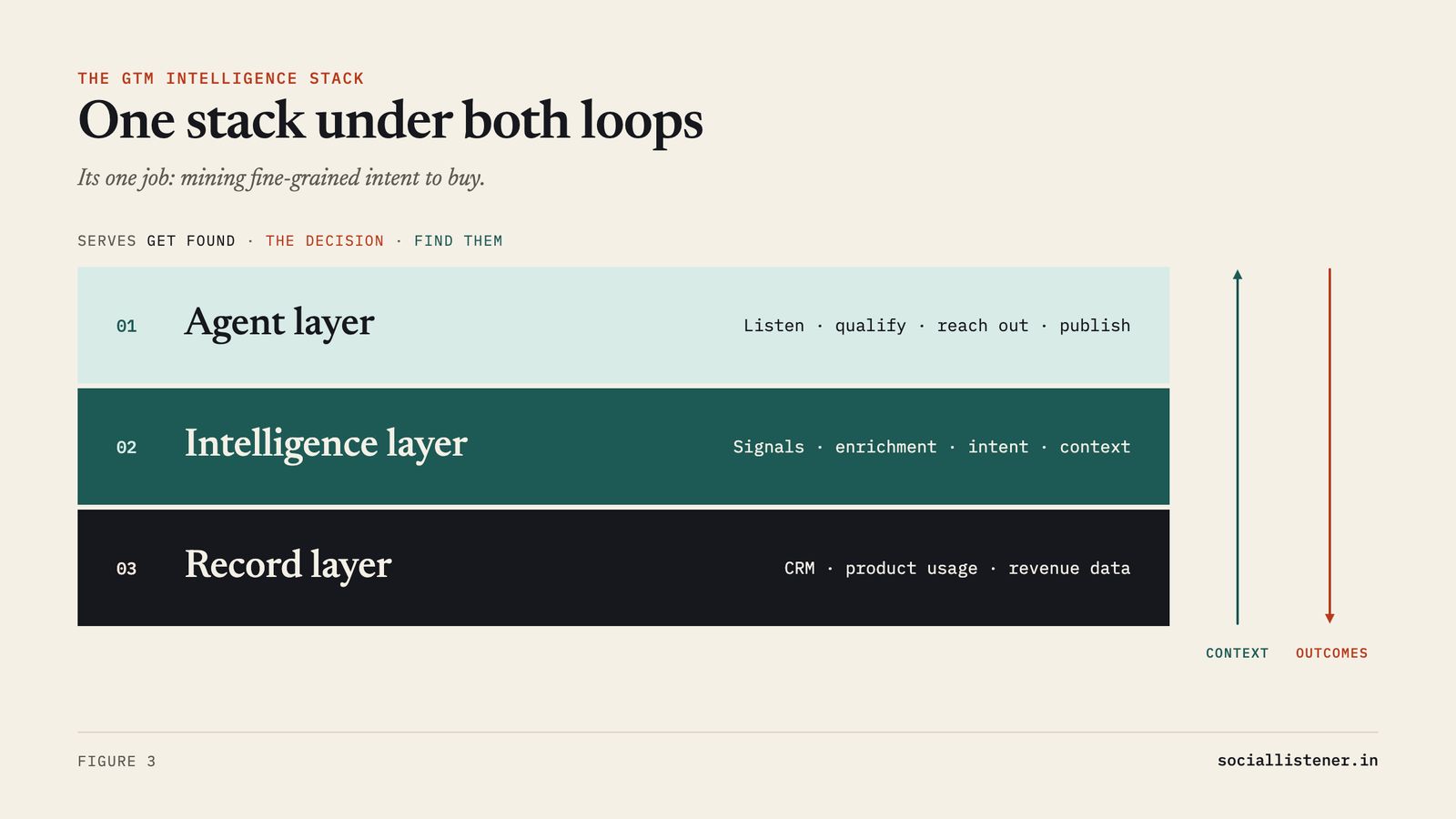
Put simply, the stack has one job: mining fine-grained intent to buy. Not the coarse intent of 1.0, where a single trigger like a funding round or a page visit put an account on a list, but the small, quiet patterns of behaviour that, taken together, show an account is genuinely moving towards a purchase. A new hire in the right role, a change in the tools they use, a shift in the questions their team asks in public, a renewal coming up on a competitor's contract. No single signal is decisive. Read together, against your own history with that account, they tell you who is ready and why.
Layer 3, the record layer. This is the base: the CRM, plus product usage and revenue data. It holds what no outside tool can, which is your own history with every account. Every deal, renewal, objection and conversation lives here. The CRM is not going away. If anything, it becomes more important, because it is where every outcome from both loops is written back.
Layer 2, the intelligence layer. This is where signals, enrichment, intent data and buyer context come together into one shared understanding of each account. Today this work is spread across many specialist tools. Some of it will move inside the CRM, but CRMs have historically been poor at reading the outside world. So specialist intelligence tools are likely to stay, not as standalone workflows, but as the layer that feeds context to everything above it.
Layer 1, the agent layer. This is new. Agents sit on top of the intelligence and do the work: listening for behaviour, qualifying accounts, reaching out and even helping publish. They act on the context the intelligence layer provides and write their results back to the record layer.
The point of the stack is not fewer tools for the sake of it. It is a single, consistent picture of each buyer that every agent and every rep works from. When sales, marketing and customer success each see a different story about the same account, no amount of automation will fix it.
The market is already moving
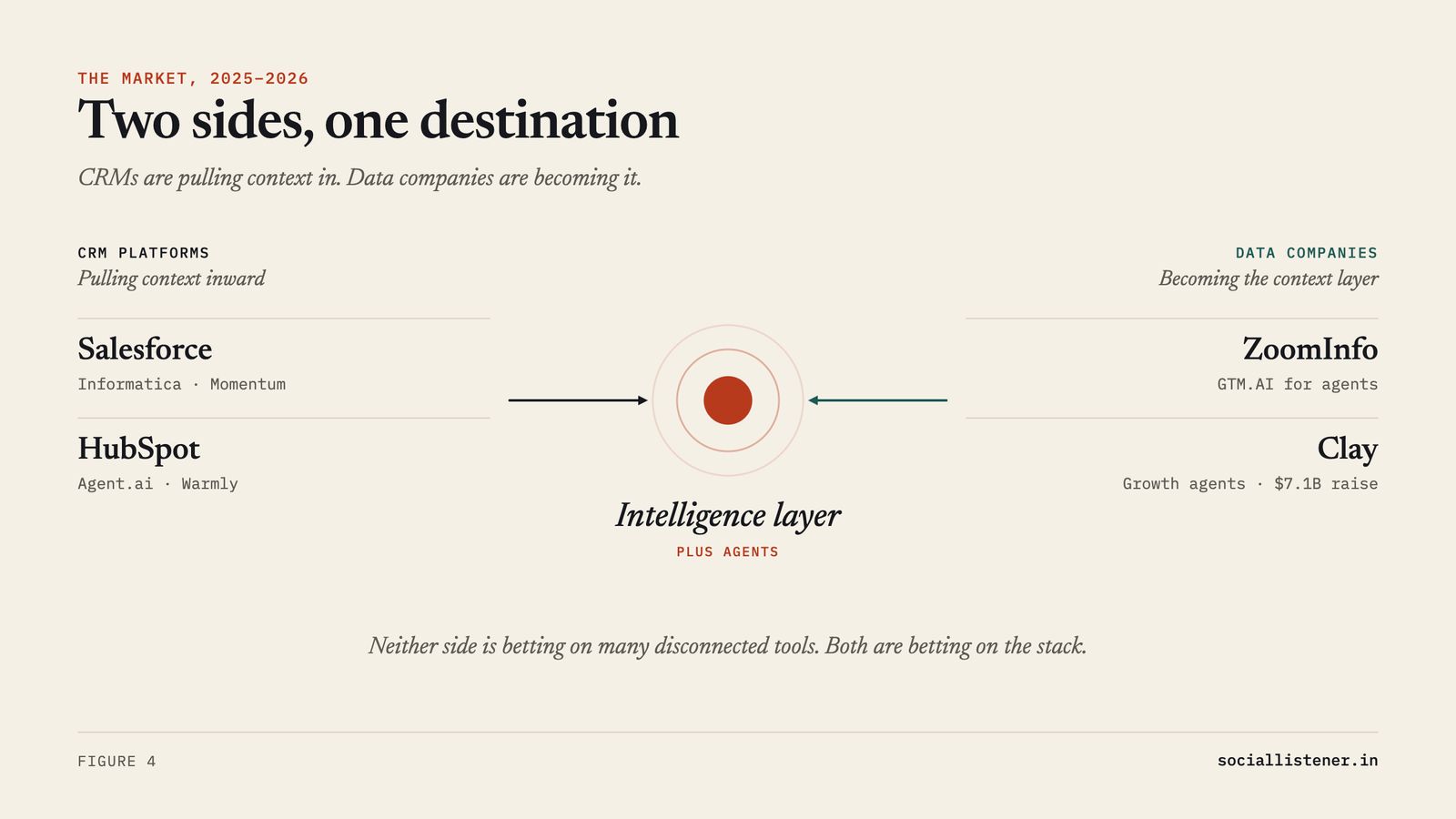
This is not a prediction about some distant future. The biggest players are already rebuilding around this stack, and their moves split into two clear bets.
CRM platforms are buying context. Salesforce agreed to acquire Informatica for about $8 billion in May 2025, saying autonomous agents need the fullest possible understanding of a company's data (source). In February 2026 it agreed to acquire Momentum, a platform that captures what is said in sales meetings and feeds it into agent workflows, so its agents work from conversations as well as records (source). HubSpot made a similar move in July 2026, folding its standalone Agent.ai project into the CRM core so agents are built where the customer data already lives (source). A month earlier it agreed to acquire Warmly, which identifies website visitors by intent and runs inbound and outbound AI agents (source).
Data and enrichment companies are becoming the intelligence layer. ZoomInfo launched GTM.AI in June 2026, positioning its data as a headless context layer that plugs into agents such as Claude, ChatGPT, Copilot and Agentforce through APIs and MCP (source). Clay raised $115 million at a $7.1 billion valuation in September 2026, describing itself as a layer beneath CRM and sales engagement tools, with growth agents that combine a company's own data with outside signals (source).
Read together, the pattern is clear. CRMs are pulling context and agents inward, towards the record layer. Data companies are pushing outward, aiming to be the context every agent draws on. Neither side is betting on the old model of many disconnected tools. Both are betting on the stack.
Doing more with less
The practical payoff of the two loops and the stack is that smaller teams can cover more ground. The early data supports it. ICONIQ's 2026 report on GTM organisation design found that companies with high AI adoption generate about $640,000 in net new ARR per GTM employee, against about $370,000 for low adopters, and that the most AI-forward high performers run teams 20 to 30 percent leaner than their peers (source). The same report describes one company where a single AI customer success agent covers the workload of roughly 20 human CSMs, and another where a voice AI SDR handles more than 90 percent of inbound volume in a region before a person gets involved.
In the framework, that leverage comes from three places:
Agents take the repetitive work in both loops: listening, qualifying, first outreach and routine follow-up.
The stack removes duplicated effort, because every agent and rep works from the same picture of each account instead of rebuilding it.
People concentrate where judgement matters most: at the decision, in the relationship, and in creating thinking worth citing.
Leaner does not have to mean fewer people for its own sake. The better reading is that each person spends more of their week on the work only a person can do.
What this means for jobs
Any shift this large changes who does the work. The honest picture is not mass replacement but a steady reshaping: execution work shrinks, while judgement, system-building and relationship work grow.
Roles under the most pressure. These are the jobs built around tasks that agents in both loops now handle:
Volume prospecting: SDR and BDR work that is mostly list building, first-touch emails and follow-up sequences.
Manual data work: researching accounts, enriching records and cleaning lists by hand.
Single-tool administration: roles that exist mainly to run one point tool in the 1.0 stack.
Commodity content: high-volume, low-originality writing produced to fill a calendar.
The data shows pressure, but not collapse. In a January 2026 survey by Metadata.io and VPofMarketing.com, nearly 40 percent of companies said they had cut marketing headcount in the previous year, more than a quarter of respondents tied those cuts to AI, and almost eight in ten named content roles as the most disrupted (source). Yet 6sense's 2026 State of the BDR report found only 8 percent of organisations cut BDR headcount this year, while 58 percent grew their teams. What changed was the job itself: inbound work rose from about 15 to 31 percent of BDR activity, and more BDR teams now report into marketing (source).
The Social Listener view
The headcount debate misses the real shift. The jobs under the most pressure are largely the ones that produced noise: more emails, more lists, more content for its own sake. The jobs that grow are the ones that cut through it, held by people who can read behaviour, decide which signals matter and turn them into context that agents and buyers can trust. AI is not so much removing go-to-market work as removing the parts of it that buyers had already learned to ignore. The teams that come out ahead will not be the smallest. They will be the ones that listen best.
FAQ
What is the Two Loops, One Decision framework? A framework for GTM engineering 2.0. One loop is where clients find you (publish, get cited, client arrives) and the other is where you find clients (listen, qualify, engage). Both meet at a single decision where AI proposes and the rep decides, powered by one GTM intelligence stack.