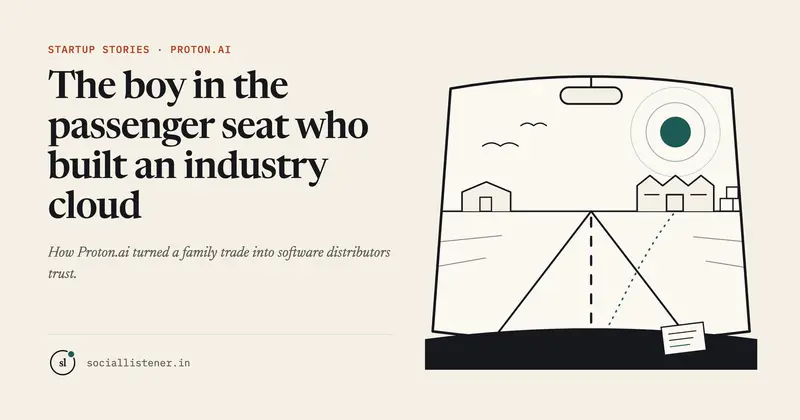
Proton.ai wasn't born in a hackathon.
It was born in the passenger seat.
A boy riding along with his father on business trips. Customer visits. Long drives between accounts. The family business was dental supply, and it had been in the family since his great-grandfather started it in 1930.
Most kids get bored on trips like that. This one was quietly learning how an entire industry works.
Not the version in a consulting deck. The real one. The rep who remembers that a customer always reorders before the holidays. The phone call that saves an account. The relationship that outlasts most marriages.
The boy was Benj Cohen. And in 2018, he noticed something that worried him.
The industry he grew up in was falling behind on technology.
Distributors weren't slow. The software was simply never built for them.
So he started Proton.ai.
Then came the twist: Proton didn't try to fix everything. It fixed one thing.
Here's what most founders would have done. Raise money, promise a revolution, build a giant platform.
Proton started small. Almost suspiciously small. One job. Help a sales rep know who to call, what to offer and when. The AI read years of order history, the data distributors already had sitting in their systems, mostly ignored, and turned it into a simple nudge. Call this customer. They usually buy this. They haven't in a while.
That's it. No grand vision on the box. Just a better Monday morning for a sales rep.
It worked well enough that in January 2022, Felicis Ventures led a $20 million Series A.
Then the pieces started to connect. In 2023, Proton partnered with Infor, one of the big software names in distribution, so it could sit beside the systems distributors already trusted instead of asking them to rip anything out. It brought the same intelligence to distributors' websites, so each buyer saw recommendations based on how they actually buy. In 2025 came an AI assistant to take on the admin that eats a rep's day: emails, notes, logging.
Each step was small. Each step earned a little more trust.
And in distribution, trust is the whole currency.
And then Proton named the real enemy
This part is my favorite.
For years, distributors had been buying software the way you'd furnish a house from five different shops. A CRM from here. An ecommerce engine from there. A product data tool from somewhere else. Nothing matched. And somewhere along the way, the distributor was quietly handed the job of making it all fit.
In March 2026, Proton said the quiet part out loud. Distributors, Cohen said, had been sold point solutions and "told it's their job to make them work together."
Notice what that sentence does.
It doesn't attack a competitor. It takes the blame off the customer.
Every operations head who had privately wondered is it us? suddenly heard: no, it was never you.
That same month, Proton launched what it called the first industry cloud built for distribution. CRM, product information, ecommerce recommendations and quote-and-order automation, all sitting on one shared foundation of data. Pricing, sourcing and inventory AI on the way. Not another tool. A home.
The final moment: when customers tell your story for you
At the launch, the CEO of MSC Industrial Supply, a large, publicly listed industrial distributor, said its bet on Proton's AI five years earlier had "paid off."
Five years. Anyone can collect logos. A five-year customer standing up in public is something else entirely. It says: we tried this, we stayed, and we'd do it again. Another distribution sales leader described Proton in the words every founder dreams of hearing. Right out of the box, he said, it "speaks our language."
Not "it's powerful." Not "it's innovative." It speaks our language.
That is the whole Proton story in four words. The boy from the passenger seat grew up and built software that sounds like the people in the car. Of course, the story isn't finished. "First" is a big word, and big software companies are racing into the same space. Whether the industry cloud becomes the standard will be decided by distributors over the next five years, not by a launch announcement. But the foundation is unusual. And it is very hard to copy.
Proton doesn't sell software to distributors. It sells understanding, and the software comes with it.
What Marketers Can Learn From Proton.ai
Your origin is a signal. A founder who has lived the customer's problem makes a promise no agency can manufacture. Find the part of your story that would be expensive for a competitor to fake, and tell it.
Earn the big claim. Proton spent years doing one job well before it called itself a platform. The same words mean nothing on day one and everything after the proof.
Take the blame off the buyer. People change faster when change doesn't require admitting a mistake. Give your customer a story where they were let down, not wrong.
Speak their language, literally. Familiar words feel trustworthy before a product has proven anything. If your homepage sounds like your engineers, it isn't talking to your buyer.
Let time do the selling. One customer who stayed five years says more than fifty who signed last quarter. Tell people how long they stayed.
Enjoyed this story? Sign up for the Social Listener newsletter and we'll update you when the next one goes live.