Look at any tech ecosystem today. Cloud. Data. CRM. Commerce. Cybersecurity. Developer tools. AI.
Each one has thousands of companies in it. Thousands of products, thousands of pitches, thousands of founders certain theirs is the one.
Will they all survive? Not a chance. Most won't reach their fifth birthday. A few will become unicorns. A handful will become billion-dollar businesses.
So what separates the handful from the rest?
It's rarely the product.
Picture a new tech company. Its product is genuinely extraordinary: faster, smarter, cheaper than what the market runs today. It solves a real problem, and that makes it a problem for the incumbent.
And yet nobody trusts it.
Nobody gives it a chance. The big buyers won't take the meeting. Procurement asks how many customers it has. Security asks whether it will be around in five years. Only a few early believers listen.
Meanwhile, the giants don't stand still. They see the same opportunity, and they have the engineers, the customers and the money to chase it. Every quarter they ship features that close the gap. The clock is running, and it's running against the new company.
So what does it do?
It stops trying to beat the giants, and partners with them.
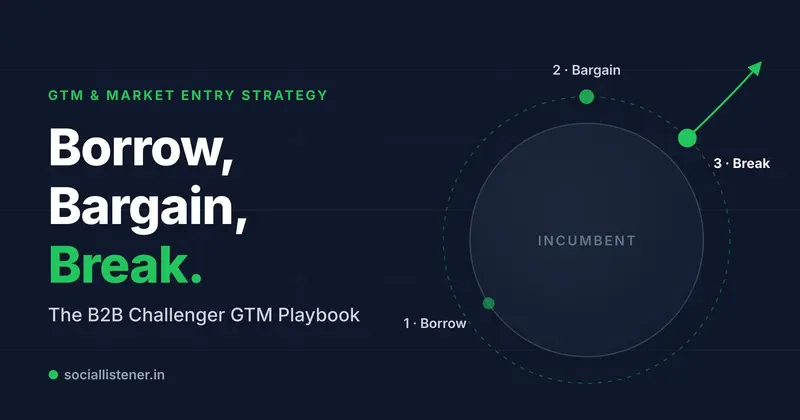
It builds on their platforms, sells through their marketplaces and rides on the trust buyers already give them. It borrows that credibility until it's big enough to stand on its own. Then, and only then, it starts to break away. That is the playbook behind many of the fastest-growing companies in B2B tech. Here's how it works.
Riders in Every Ecosystem
This isn't a one-off, and it isn't confined to one market. The same arc plays out in every tech ecosystem with a dominant platform: cloud, CRM, commerce, developer tools and, now, AI models. Here are seven companies, each at a different point in the journey.
Snowflake on AWS: borrowing from a direct competitor
While Snowflake was still building its product, Amazon launched Redshift, its own cloud data warehouse, at rock-bottom prices. Investors assumed AWS would crush the startup. Instead, Snowflake built on AWS, joined Amazon's partner network in 2013, and let Redshift do the hard work of convincing companies that a data warehouse could live in the cloud. When customers hit Redshift's limits, Snowflake was waiting, inside the AWS estate their security teams had already approved.
Once it had customers, it bargained. It launched on Microsoft Azure in 2018 and announced Google Cloud in 2019, becoming the neutral layer across all three clouds, even though around 80% of its business still ran on AWS in 2022. For its fiscal year ending January 2026, Snowflake reported about $4.5 billion in product revenue. It now competes with every cloud it runs on.
Databricks on Azure: wrapping a startup in Microsoft's contract
Databricks started with open-source Spark, a UC Berkeley research project, so engineers trusted the technology long before any salesperson called. Then in 2017 it became a first-party service on Microsoft Azure: Microsoft sold it, marketed it, supported it and billed for it. For a cautious enterprise, buying Azure Databricks meant signing with Microsoft.
In 2023 Microsoft launched Fabric, its own data platform, which by 2025 had 21,000 customers and competes head-on with both Databricks and Snowflake. By then it was too late to switch either of them off. In August 2026, Databricks said its revenue run-rate had passed $7 billion, growing more than 80% a year.
Veeva on Salesforce: the full cycle
Veeva built its life-sciences CRM on the Salesforce platform in 2007. In 2014 the two extended their deal through 2025, with Salesforce naming Veeva its preferred partner for pharma and biotech. Riding Salesforce let a young company sell enterprise-grade software to the world's largest drugmakers, and by 2019 Veeva served roughly 47 of the top 50 pharma companies.
Then it broke away. Veeva built its own platform, let the Salesforce agreement expire in September 2025, and is moving customers to Vault CRM, which had more than 180 customers live by August 2026. Every CRM customer will now run on Veeva's own stack instead of paying platform fees to Salesforce. The break had a price: Salesforce re-entered the market with its own life-sciences CRM and has won some of Veeva's accounts. But Veeva now owns its platform, its margins and its roadmap.
Klaviyo on Shopify: borrowing with eyes open
Klaviyo grew up as the email and SMS engine for Shopify merchants. In 2022, Shopify made it the recommended email solution for Shopify Plus and invested $100 million in the company. In 2025, Klaviyo passed $1.2 billion in revenue, up 32%, with more than 193,000 customers.
Klaviyo is mid-journey, and it knows it. Most of its customers still run their stores on Shopify, so it is building its own gravity: larger enterprise brands, revenue in Europe and Asia-Pacific growing more than 40% a year, and a 2026 partnership with Google. The goal isn't to leave Shopify. It's to make sure Shopify is one strong channel rather than the only one.
MongoDB on all three clouds: partner with your competitor
When Amazon launched a MongoDB-compatible database of its own in 2019, MongoDB could have treated AWS as the enemy. Instead it made its own managed service, Atlas, the best place to run MongoDB, and sold it through co-sell partnerships with AWS, Microsoft and Google. Atlas now makes up roughly three-quarters of MongoDB's revenue and passed a $2 billion run-rate in early 2026. When a giant copies your product, compete on what it can't copy, and keep using its marketplace to sell.
Fivetran and dbt on Snowflake and Databricks: when the host moves into your layer
Riders can have riders. Fivetran (which moves data into the warehouse) and dbt Labs (which transforms it there) grew by making Snowflake and Databricks more useful; both platforms' venture arms joined dbt Labs' 2022 funding round. But as the platforms grew, they moved into pipelines and transformation themselves, and Snowflake even launched native support for running dbt projects. In October 2025, Fivetran and dbt Labs announced an all-stock merger, creating a company with close to $600 million in annual recurring revenue. When the host starts eating your layer, joining forces with your neighbours is one way to become a layer of your own.
Cursor on VS Code and frontier models: the cycle at AI speed
Cursor didn't build an editor from scratch. It forked Visual Studio Code, Microsoft's open-source editor, so developers kept their extensions and habits, and it ran on frontier models from labs such as Anthropic and OpenAI. That double borrowing meant almost zero switching friction. Its annual recurring revenue went from about $100 million in January 2025 to $2 billion by early 2026, and a reported $4 billion by mid-2026.
Then it began breaking away. In late 2025 Cursor shipped Composer, its own coding model, to reduce its dependence on the labs, which were by then building coding tools of their own. In June 2026, SpaceX agreed to acquire Anysphere, Cursor's maker, in an all-stock deal reported at $60 billion. What took Snowflake a decade took Cursor about three years.
The common thread
Seven companies, five ecosystems, one arc. Each borrowed distribution and credibility from a platform its buyers already trusted. Each then built a second channel and a brand of its own. And each broke away, or got bought, once it owned a layer the host couldn't easily copy.
The 3B GTM Ride: Borrow, Bargain, Break
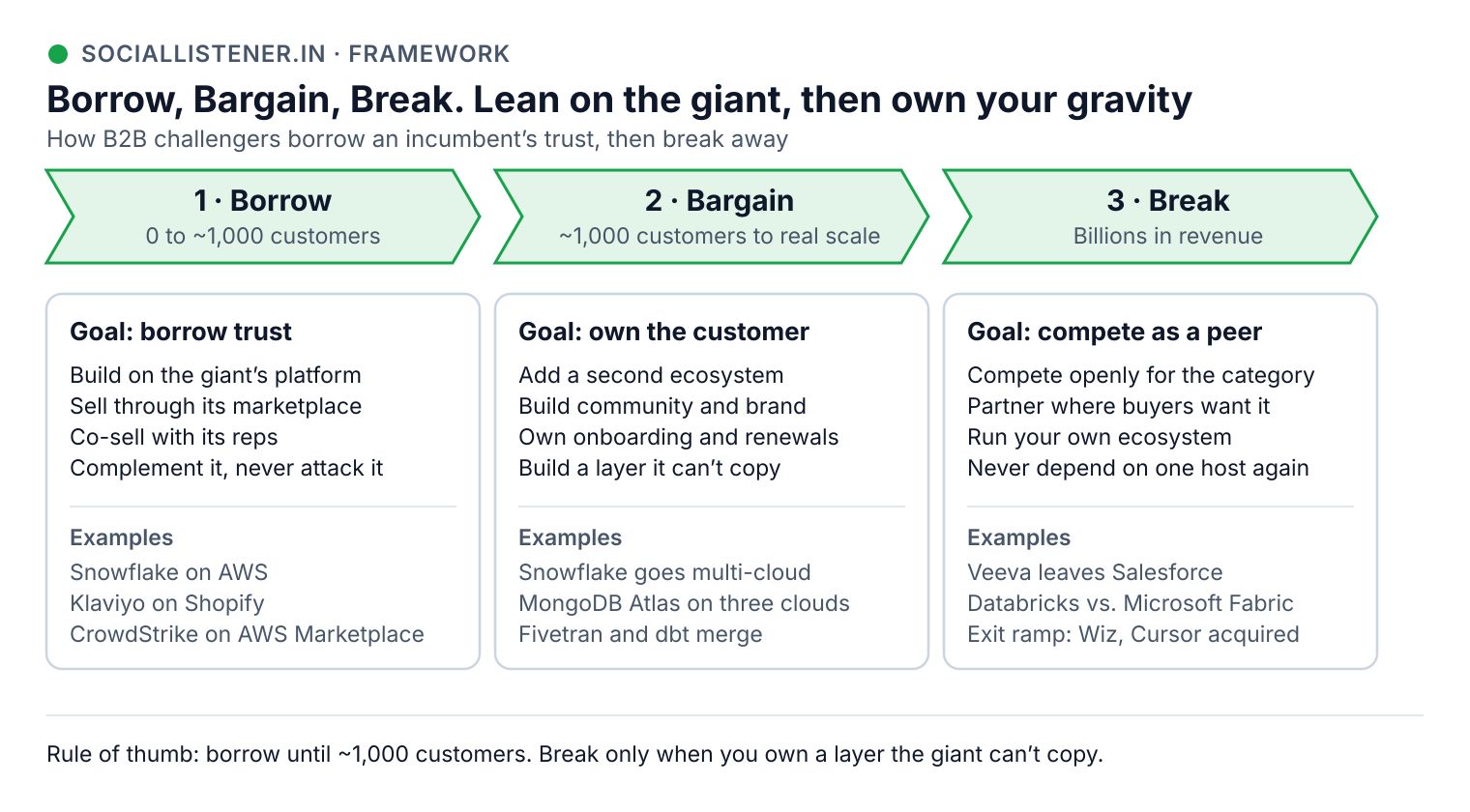
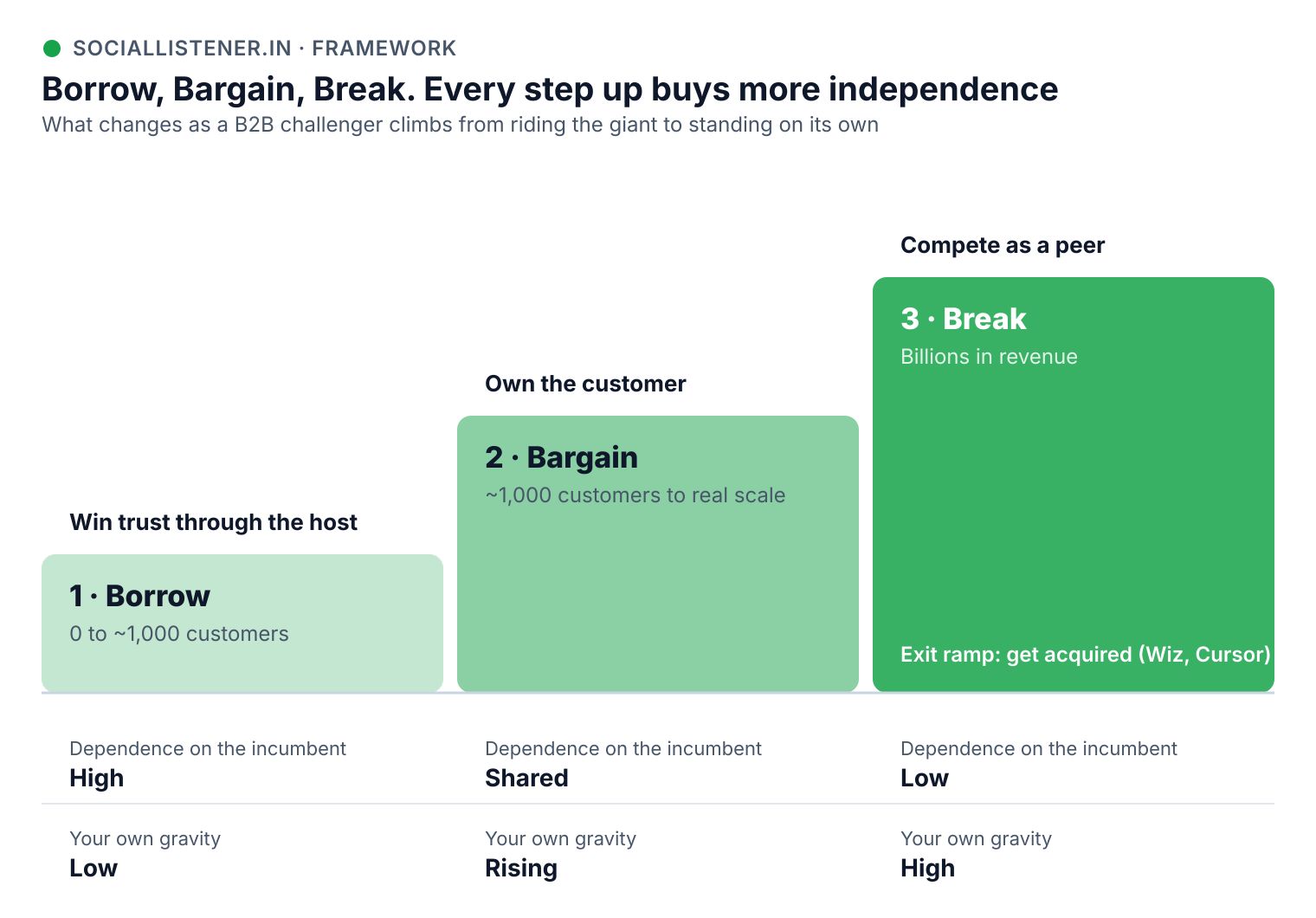
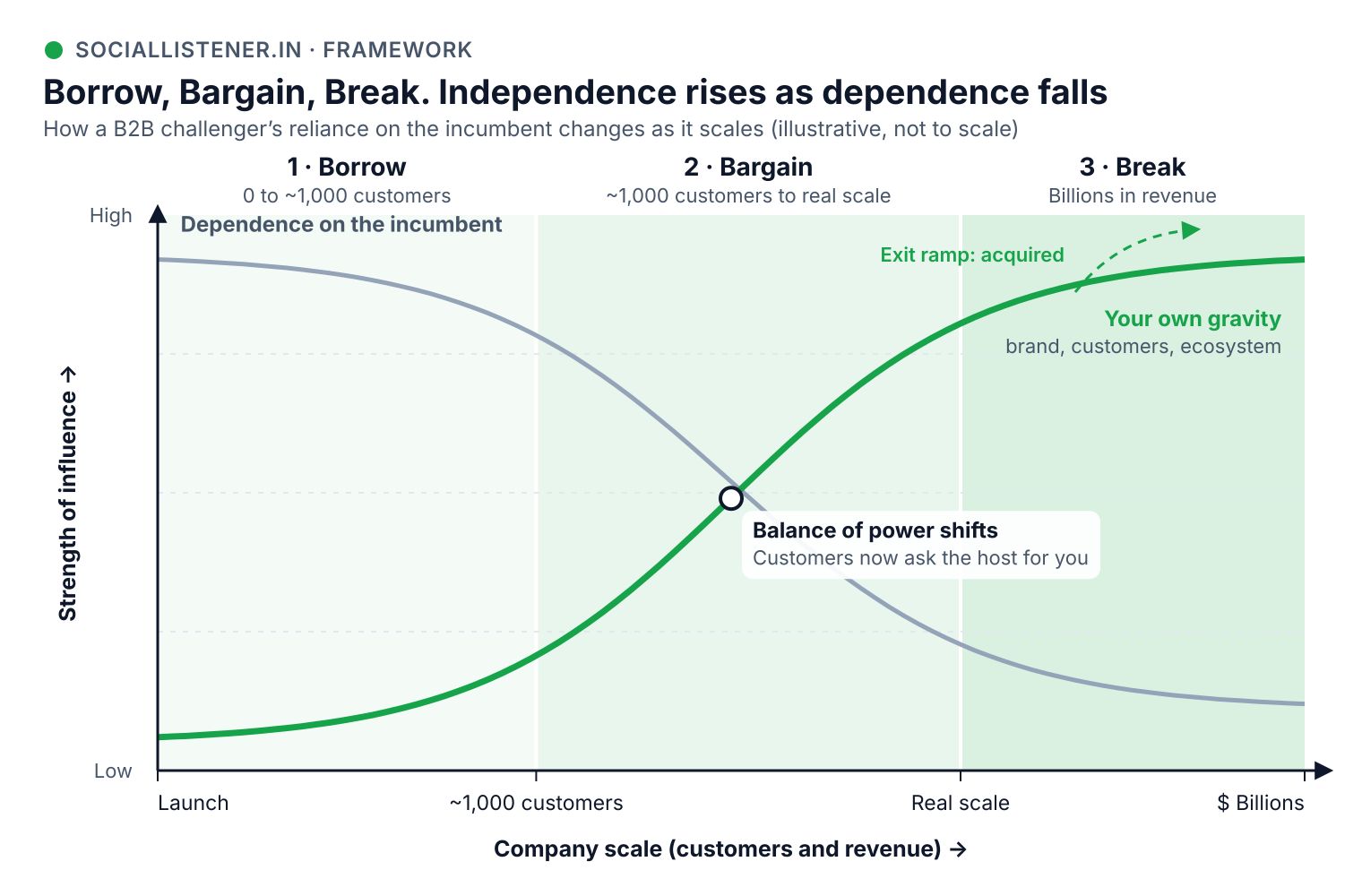
That arc is the 3B Ride, and it has three phases. Borrow the incumbent's trust and distribution while you are small. Bargain for independence once customers start asking for you by name. Break away only when you own something the giant can't copy. As a rule of thumb, borrow until you have roughly 1,000 customers, bargain until you have real scale, and break, if you break at all, somewhere in the billions.
The Oldest Play in Tech
In 1980, IBM needed an operating system for its first personal computer. A young Microsoft supplied one, MS-DOS, and made one decision that shaped the industry: it kept the right to license the software to other manufacturers. IBM's brand made the PC safe for corporate buyers. Microsoft rode that trust into offices everywhere, and once the clone makers had made its software the standard, it no longer needed IBM at all. Within a decade, the supplier had become the power.
The same play runs through modern B2B software. The details change. The shape doesn't.
Phase 1: Borrow (Zero to ~1,000 Customers)
Objective: remove the buyer's fear of choosing an unknown vendor by showing up inside a platform they already trust.
Strategy: at this stage your real competitor isn't the incumbent. It's the buyer's hesitation. Position as the product that makes the incumbent's platform more valuable, never as its replacement. "Makes your cloud better" opens doors. "Cloud killer" closes them.
Execution plays
Pick one host. Choose the platform where your buyer's trust and budget already sit, not simply the biggest one, and go deep there before going wide.
Hire a partner leader early. Most startups hire their first alliances person after their twentieth salesperson. Flip that. The person who gets you into the host's marketplace, co-sell programme and reference architectures unlocks a sales force you don't have to pay for.
Become transactable on the marketplace. Let buyers purchase you through a contract and budget they already have with the host.
Enable the host's sellers as if they were your own. Give their reps a one-page "how this helps your number" sheet, a joint demo and fast technical help on their deals. They carry quotas, and they will prioritise the partner who makes their quarter easier.
Integrate deeply. One-click setup, billing through the host and data flowing both ways, so you appear in its solution guides and reference architectures.
Write messaging that sits next to the giant. Every page, deck and launch should answer one question: what does this make better? Save comparison pages for later.
Example: CrowdStrike listed on AWS Marketplace in late 2017. In 2024 alone it sold more than $1 billion through that channel, and its marketplace deals averaged four times the size of its direct ones. When the purchase runs through a contract the customer already has, procurement moves faster and deals get bigger.
Metrics to watch: marketplace revenue, co-sold pipeline, partner-sourced versus partner-influenced deals, deal size through the channel versus direct, and win rate when the host's rep is involved.
Move to Phase 2 when: you are approaching roughly 1,000 customers, the host's reps bring you into deals unprompted, and customers start asking for you by name.
Phase 2: Bargain (~1,000 Customers to Real Scale)
Objective: make sure no partner owns your customer.
Strategy: somewhere around a thousand customers, the balance of power shifts. You are no longer asking the host for credibility; your customers are asking the host for you. Use that leverage carefully. You aren't leaving your partner. Keep the infrastructure dependency where it's efficient, and remove the relationship dependency. The customer's data, contract, roadmap requests and loyalty should run to you, not through someone else.
Execution plays
Add a second ecosystem. A second host gives you leverage with the first and protects you if the relationship cools.
Build your own gravity. Invest in a direct brand, a practitioner community and your own events, so demand reaches you without the host in the middle.
Own the customer, whoever owns the invoice. Even when a deal is transacted through a marketplace, your team runs onboarding, success and expansion. The renewal conversation must be yours.
Build the layer the host can't copy. Data, workflow, an ecosystem of your own, or a pace of innovation the giant can't match. This is the asset that later turns a rider into a peer.
Set your breakpoints in advance. Agree as a leadership team on the signals that trigger diversification: one host delivering most of your pipeline, the host launching a product in your category, its reps being paid to sell their own product instead of yours.
Example: Datadog has worked with AWS for more than a decade, offers over 100 integrations unique to AWS, and signed a new strategic collaboration agreement in December 2025, all while Amazon sells monitoring tools of its own. Partnership and competition can coexist for years, as long as you stay worth more to the giant as a partner than as a target.
Metrics to watch: direct versus partner share of pipeline (the direct share should rise even as partner pipeline grows), share of revenue tied to a single host, net revenue retention, and the number of customers running you on more than one platform.
Move to Phase 3 when: you have real scale, you own a layer the host can't easily replicate, and the host has started treating you as a competitor.
Phase 3: Break (Billions in Revenue)
Objective: compete as a peer, and never again depend on one partner for survival.
Strategy: at some point the incumbent stops treating you as a partner and starts treating you as a competitor. That moment isn't a failure of the strategy. It's the proof that it worked. Breaking is rarely a dramatic divorce. More often it's a permanent, uneasy coexistence: cooperate where customers want you together, compete everywhere else.
Execution plays
Compete openly for the category. Publish the comparisons, name the alternatives and define the category on your terms.
Keep the door open. Keep the joint customers, integrations and marketplace listings that still serve buyers. The best challengers never fully burn the bridge they crossed.
Become a host yourself. Build your own marketplace, partner programme and developer ecosystem, so the next generation of startups rides on you.
Spread your revenue. Make sure no single host accounts for enough of your business to threaten it.
Metrics to watch: revenue through your own ecosystem and partners, win rate against the host's competing product, and retention of customers the host is actively targeting.
When the Ride Goes Wrong, and the Other Ending
Not every ride ends in a clean break. Elastic built Elasticsearch as open source, and AWS offered it as a managed service. In 2021, Elastic changed its licence to stop cloud providers doing that without collaborating with it. Within three months, AWS forked the code into OpenSearch, turning Elastic's own product into a permanent competitor. Elastic later added an open-source licence back and says its AWS partnership is now stronger than ever, but the fork isn't going away.
The lesson isn't "never fight." It's that you can only break from a giant once you own something it can't simply copy: the customer relationship, a data network, an ecosystem, a pace of innovation. If the giant can repackage your product, sooner or later it will.
There is also a third ending. Some companies never break away, because they become so valuable to the giants that one of them buys it. Wiz built a cloud security platform that worked across AWS, Azure and Google Cloud, passed $1 billion in annual recurring revenue in 2025, turned down a reported $23 billion offer from Google, and then agreed to a $32 billion deal that closed in March 2026. Staying neutral across every incumbent made it the asset all of them wanted.
The View From the Giant's Side
Flip the table. Imagine you run marketing and strategy at one of the big clouds. The riders aren't a threat to manage. They're a strategy.
Every rider is revenue. A rider running on your cloud pays for compute and storage, even when it competes with one of your own products. That's why Google brought Snowflake onto Google Cloud in 2019 while still selling BigQuery. A giant can lose the application layer and still win the infrastructure beneath it.
The marketplace is a radar. Co-sell programmes and marketplace data show the giant which partners are growing, which categories customers buy most and where its own products are losing.
Every category gets a decision: partner, build or buy. Partner while the rider drives consumption of the core platform. Build when the category becomes large and strategic, as Microsoft did with Fabric. Buy when a rider becomes a control point across rival platforms, as Google did with Wiz.
The trigger is the switch from complement to substitute. The day a rider starts replacing the giant's revenue rather than adding to it, the partnership changes character.
For the challenger, this points to three ways to stay safe, and they map neatly onto the 3B Ride. Make sure the host wins every time you win (Borrow). Become too costly to copy before the host decides to build (Bargain). Become valuable enough that buying you beats competing with you (Break, or the other ending).
When the 3B Ride Doesn't Fit
This is a powerful playbook, not a universal one. Three conditions decide whether it applies.
There must be an incumbent that owns your buyer's trust. In a genuinely new category, nobody does, and the winners build their own distribution. Developer-first and designer-first products have grown bottom-up through communities, not through anyone's marketplace. Figma never rode Adobe. It competed with Adobe until Adobe tried to buy it for $20 billion, in a deal abandoned in 2023.
Your growth must be good for the host. Riding works when you complement the host's core business. When you threaten it, the host can change the rules overnight. Zynga built its business on Facebook and suffered when Facebook changed its platform policies. Meerkat, a live-streaming app, lost access to Twitter's network within weeks of its launch.
You must have a plan to own something. Riders that never build their own customer relationship, data or ecosystem remain features in someone else's product.
And remember the survivorship bias. For every company in this document, many riders were copied, absorbed or squeezed out. The 3B Ride improves the odds. It doesn't guarantee the outcome.
The Mistakes That Kill This Strategy
Picking the fight too early. Positioning as the incumbent's replacement in year two shuts the doors you need most.
Being a feature. If the giant can build your product in a quarter, it will, the moment you matter enough to notice.
Letting the partner own the relationship. If customers think of you as "that thing in the AWS console," you have no leverage when the terms change.
Staying dependent on one channel too long. A single partner that delivers most of your pipeline is a single point of failure.
Confusing partner activity with progress. Joint press releases and partner awards don't count. Co-sold deals, marketplace revenue and partner-sourced pipeline do.
Closing Thought
Trust is the hardest thing a young company has to sell, and the one thing it can't manufacture quickly. The giants spent decades building it. The smartest challengers don't try to outbuild them. They rent it. Borrow the incumbent's credibility while you're small. Bargain for independence once customers start asking for you by name. Break away only when you own something the giant can't copy. Done right, the company you once depended on ends up having to compete with you. And by then, you're the one other startups are riding on.
Every challenger’s ride is different. If you’re working out which ecosystem to borrow from, when to bargain, or whether you’re ready to break away, I’d like to hear your story and including into this every refreshing article and study. Do share with us.
Sources
Fortune, book excerpt on Snowflake vs. AWS Redshift (Sept 2025): https://fortune.com/2025/09/29/snowflake-amazon-web-services-david-goliath
SiliconANGLE, Frank Slootman on the Snowflake–AWS partnership (Nov 2022): https://siliconangle.com/2022/11/30/frank-slootman-snowflakes-blossoming-partnership-aws/
Snowflake, general availability on Microsoft Azure (Sept 2018): https://snowflake.com/news/snowflake-announces-general-availability-on-microsoft-azure
Google Cloud, announcing Snowflake on Google Cloud (June 2019): https://cloud.google.com/blog/products/data-analytics/announcing-snowflake-on-google-cloud-platform
Snowflake FY2026 10-K: https://www.sec.gov/Archives/edgar/data/1640147/000164014726000008/snow-20260131.htm
TechCrunch, Microsoft makes Databricks a first-party service on Azure (Nov 2017): https://techcrunch.com/2017/11/15/microsoft-makes-databricks-a-first-party-service-on-azure/
The Next Web, Databricks closes $5bn round at $190bn valuation (2026): https://thenextweb.com/news/databricks-closes-5-billion-round-at-190-billion-valuation
CrowdStrike, $1B in annual AWS Marketplace sales (Feb 2025): https://ir.crowdstrike.com/news-releases/news-release-details/crowdstrike-first-cloud-native-cybersecurity-isv-exceed-1
IT Brief, Datadog and AWS expand partnership (Dec 2025): https://itbrief.com.au/story/datadog-aws-expand-partnership-to-boost-cloud-observability
DevClass, Elasticsearch open source again (2024): https://devclass.com/?p=6917
IT Daily, Microsoft Fabric grows and competes with Snowflake and Databricks (2025): https://itdaily.com/news/business/microsoft-fabric-grows-rapidly
Dataconomy, Google completes $32B Wiz deal (Mar 2026): https://dataconomy.com/2026/03/11/google-completes-its-largest-ever-acquisition-with-32-billion-wiz-deal/
IntuitionLabs, Why Veeva split from Salesforce (updated Oct 2026): https://intuitionlabs.ai/articles/veeva-vault-vs-salesforce-life-sciences-crm
Klaviyo, FY2025 results (Feb 2026): https://s25.q4cdn.com/801988311/files/doc_news/Klaviyo-Delivers-Outstanding-2025-Results-32-Revenue-Growth-Record-Fourth-Quarter-and-Raised-Fiscal-Year-2026-Outlook-2026.pdf
Klaviyo, strategic partnership with Shopify (Aug 2022): https://klaviyo.com/blog/shopify-strategic-partnership
MongoDB, Q4 fiscal 2026 earnings call: https://www.webull.com/news/14469639774249984
Tomasz Tunguz, on the Fivetran–dbt merger (Oct 2025): https://tomtunguz.com/fivetran-dbt-merger-bundling-phase/
DataNorth, SpaceX acquires Cursor maker Anysphere (2026): https://datanorth.ai/news/spacex-acquires-cursor-maker-anysphere
Dealroom, Cursor tops $4B annualized revenue (June 2026): https://dealroom.co/news/134107-cursor-tops-4b-annualized-revenue/