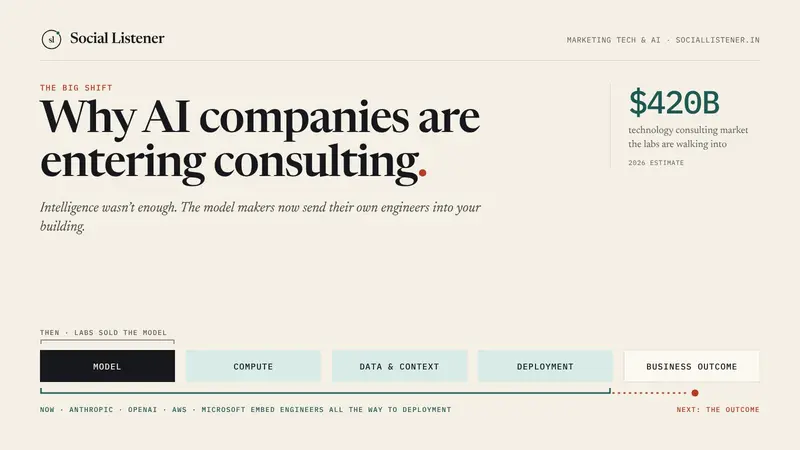
In six months, every major AI lab and hyperscaler has put its own engineers inside customer businesses. The model is no longer the product. The deployment is.
In 2026, the companies that build AI stopped waiting for others to install it. Anthropic, OpenAI, AWS and Microsoft have each launched units that embed engineers directly inside client organisations, between them committing billions of dollars. The move puts them into a $420 billion technology consulting market long held by the Big 4, Accenture and Indian IT. It also changes the ground under data platforms and the cloud providers that host them.
What happened
Anthropic went in through partners. In May it announced a new services firm with Blackstone, Hellman & Friedman and Goldman Sachs, later launched as Ode, to deploy Claude in mid-sized companies alongside Anthropic's own applied AI engineers. In September it added a venture with Hg to deploy agentic AI across Hg's portfolio. In October it committed $100 million to a Claude Frontier Academy to train deployment engineers.
OpenAI went in directly. Its Deployment Company launched in May with more than $4 billion of initial investment, majority-owned by OpenAI, and bought London consultancy Tomoro for around 150 forward-deployed engineers. Its backers include McKinsey, Bain and Capgemini, so the consultants are inside the tent.
The hyperscalers followed within weeks. AWS set up a Forward Deployed Engineering organisation backed by $1 billion on 30 June. Microsoft followed with a $2.5 billion Frontier Company that it says will embed around 6,000 people inside customers.
The template for all of them is Palantir, which has embedded engineers with customers for two decades. Its US commercial revenue reached $764 million in Q2 2026, up 149% year on year.
Why this shift is happening
The official reason is capacity: enterprise demand for frontier AI is outrunning what partners can deliver. That is true, and it is the least interesting part of the story. The real reason is that the value of AI has moved from the model to the last mile, and the companies that built the models have realised they cannot afford to leave that mile to someone else.
1. The model is no longer the bottleneck. Context is. Two years ago, the question was whether a model was smart enough. Today, frontier models are good enough for most enterprise work. What fails is everything around them: data scattered across systems, metrics that mean different things in finance and sales, and processes written for people rather than machines. An AI that cannot see why revenue fell cannot help a CEO decide anything.
2. Pilot purgatory threatens the labs' own business. Most enterprises have run AI pilots. Far fewer have scaled them. When a pilot stalls, the client rarely blames its data. It concludes the AI "didn't work". For companies whose valuations rest on enterprise consumption, that verdict is existential. Sending engineers is cheaper than losing the account.
3. Deployment is how consumption gets switched on. Every engineer placed inside a client turns into tokens and compute billed every month, for years. Analysts at Info-Tech describe free or subsidised deployment as the customer acquisition cost, with consumption as the payback. It is the cloud migration playbook, run a second time.
4. Nobody wants to repeat the cloud mistake. AWS, Azure and Google built the infrastructure of the last decade, then watched integrators capture the strategy layer and the boardroom relationship. The cloud became plumbing. The labs studied that history closely. They intend to own the relationship from day one.
5. Whoever wires the workflow owns the switching cost. Models change every few months. Integrations do not. IBM found that 71% of executives already consider switching their primary AI vendor difficult. Building the plumbing is the surest way to stay the default, whatever next quarter's benchmarks say.
6. Deployment is the best R&D money can buy. An engineer inside a hospital billing team or a bank's credit desk learns what the next model must do better than any benchmark can. Consulting becomes the lab's listening post.
7. Buyers want reassurance, and the maker offers the strongest kind. Enterprises have never bought consulting purely for expertise. They buy cover: nobody gets fired for hiring the best-known name. The model maker offers an even stronger alibi. If its own engineers cannot make it work, nobody could. That is a powerful, mostly unspoken reason clients will say yes.
What it means for consultants
Big 4 and Accenture are most exposed, because implementation is exactly where the labs are heading. For now it is coexistence: Anthropic says large-enterprise work still runs through partners such as Accenture, Deloitte and PwC, and Ode starts in the mid-market. But habits formed in the mid-market travel upward.
MBB is hedging rather than fighting. McKinsey and Bain backing OpenAI's Deployment Company says it all: if you cannot beat the model maker, own a piece of its services arm. Strategy work survives. The research-and-slides middle of the engagement does not.
The warning signs are already visible in adjacent knowledge businesses. Gartner's shares fell almost 48% in 2025 amid fears that AI could replace parts of its research and advisory work. Chegg's homework business all but collapsed as students switched to chatbots. Any firm that sells access to knowledge is now competing with a model that gives it away. The smarter firms are changing how they get paid. McKinsey's UK managing partner has said roughly a quarter of the firm's global fees are now tied to outcomes. When you are paid for results rather than hours, AI stops eating your margin and starts expanding it.
Indian IT faces the hardest maths. TCS, Infosys, Wipro and Cognizant are built on large delivery pyramids and billable hours. Forward-deployed teams of a few engineers plus AI invert that model. Their defence is ERP and legacy depth that no lab has yet.
What it means for hyperscalers and Snowflake
AWS, Azure and Google Cloud are partner, channel and rival at once. Claude is sold through Amazon Bedrock, Google Vertex AI and Microsoft's platforms, and OpenAI runs heavily on Azure. Every lab deployment still burns hyperscaler compute, so they win either way on infrastructure. What they risk losing is the customer relationship. That is why AWS and Microsoft launched their own embedded-engineering units within weeks of OpenAI's: the team inside the building chooses the stack.
Snowflake has bet on bringing the model to the data. Its $200 million, multi-year deal with Anthropic, signed in December 2025, puts Claude inside Snowflake for more than 12,600 customers across all three major clouds, with a joint go-to-market. The logic is that enterprises will not move governed data to the AI; the AI must come to it.
The risk for data clouds is subtle. A forward-deployed engineer from a lab is optimising for model usage, not for which warehouse wins. Data platforms that become the default place agents run will gain. Those treated as storage will be commoditised.
What it means for data platforms
This is where the shift matters most, and where it is least discussed. Every lab engineer who walks into a client hits the same wall within a week: the data is scattered, metrics mean different things in different departments, and nothing explains why the numbers move. The deployment rush is, underneath, a rush for business context.
Databricks has made itself the neutral venue. It signed a five-year deal with Anthropic in March 2025 and a $100 million partnership with OpenAI that September, and offers Gemini too. Its bet: whichever lab wins a deployment, the agents run on Databricks.
Palantir wrote the playbook the labs are now copying, and now faces them on its own turf. Its moat is the ontology, a model of how a business actually works, built in by its own engineers. The labs have engineers. They do not yet have that.
Atlan sits in metadata and cataloguing, increasingly pitched as the context layer AI agents read from. Demand for that layer rises with every agent deployed.
SCIKIQ works in the same layer from the business side. It connects data where it already lives, with no migration, and builds the semantic layer that lets leaders and AI ask why the numbers moved. Its Enterprise 360 approach inverts the traditional sequence. Rather than fixing data before delivering value, it puts CXO-level answers in front of leadership in the first 30 days and fixes the data continuously underneath.
The pattern across all four is the same. Models are converging. The scarce asset is a governed, machine-readable picture of the business. Labs can send engineers. Someone still has to supply that picture.
Our view: the sequence of enterprise AI is being reversed
Strip away the deal sizes and one idea sits underneath every announcement in this story. Value has to arrive first. For two decades, enterprise data and AI followed a fixed order. Fix the data, migrate it, govern it, then build the intelligence on top. Boards waited six to twelve months, often longer, before a single useful answer reached the CEO. Many programmes ran out of patience or budget before they got there.
The forward-deployed model breaks that order. It starts with what the business already has, puts something useful in front of leadership within weeks, and fixes the foundations underneath while people are using it. Palantir proved the approach. The labs and hyperscalers are now industrialising it. That has three consequences we think the market is underestimating.
First, consulting is unbundling. It always sold three things together: knowledge, labour and reassurance. AI has made knowledge nearly free and labour far cheaper. The fight now is over reassurance, meaning who the board trusts to make it work. The model makers have a strong claim to it. So does anyone who can show results in month one.
Second, the mid-market is the real battleground. Large enterprises will keep their integrators for years. But community banks, regional hospitals and mid-sized manufacturers never could afford a 40-person consulting team. They are exactly who Ode, the Hg venture and private equity portfolios are built to reach. Whoever wins there sets the norms the rest of the market follows.
Third, the context layer becomes the most valuable real estate in the stack. Models are converging. Engineers can be hired. What cannot be shortcut is a governed, machine-readable picture of how a specific business works, including why its numbers move. Whoever owns that layer will outlast any model cycle. Expect the data platforms and the labs to compete hardest for it.
The companies that built AI have stepped into consulting because they found out the hard way that intelligence alone does not change a business. Context and speed do. The rest of the industry now has to show it can deliver both.
What to watch
Neutrality. Will enterprises accept advice from a lab that also sells the model? Multi-model platforms gain if they do not.
Pricing. Outcome-based fees are spreading. Hourly billing for AI work will get harder to defend.
Upmarket creep. Ode and its peers start mid-market. Watch for the first large-enterprise wins that bypass a systems integrator.
The context layer. Whoever owns the business context agents read from may matter more than which model they use.
Sources