Here is a number worth sitting with: $9.1 billion a day.
That is roughly what the world will spend on artificial intelligence every single day of 2027. Gartner forecasts the full-year figure at about $3.3 trillion, up roughly a third on 2026. It is the kind of number that stops meaning anything, so try it another way. By the time you finish this article, the world will have spent something like $55 million more on AI.
Most marketers hear numbers like that and think about content. Faster blog posts. Cheaper ads. A thousand variations of a headline before lunch.
That is the least interesting part of what is happening.
The real change is quieter and much bigger. AI is turning marketing from a series of campaigns into a system that runs all the time. It is shrinking audiences from broad segments into individual moments of intent. And it is flooding the world with so much content that the scarcest thing in marketing is no longer attention. It is belief.
This article is about what that means for the companies doing the marketing, and for the customers on the receiving end.
Where the money is going (and why marketers should care)
Very little of that $9.1 billion a day is going into clever creative tools. Most of it is going into plumbing. Gartner's forecast breaks it into four broad buckets:
Infrastructure: the chips, data centres, storage and networks that AI runs on.
Services: the consultants, integrators and trainers who help companies put AI to work.
Software: AI built into the apps and platforms companies already use, including agents that act on their own.
Security: protecting the models, the data and the actions AI takes.
This matters for marketing because of what plumbing does. Nobody gets excited about electricity, but once it arrives, everything that runs on it changes. Cloud computing did the same a decade ago: it was boring infrastructure, and it rebuilt how almost every business worked.
AI is becoming that kind of utility. And when the cost of making, testing and personalising marketing falls close to zero, the job of marketing itself changes shape.
The framework: machine-speed in the middle, human-led at the edges
If you remember one idea from this article, make it this one.
Every piece of marketing has three parts. At one edge, someone decides what to say and why. In the middle, the work gets made, tested, personalised, delivered and measured. At the other edge, someone decides whether it is true, whether it is safe, and whether the brand can stand behind it.
In 2027, the middle goes to machine speed. The edges stay human.
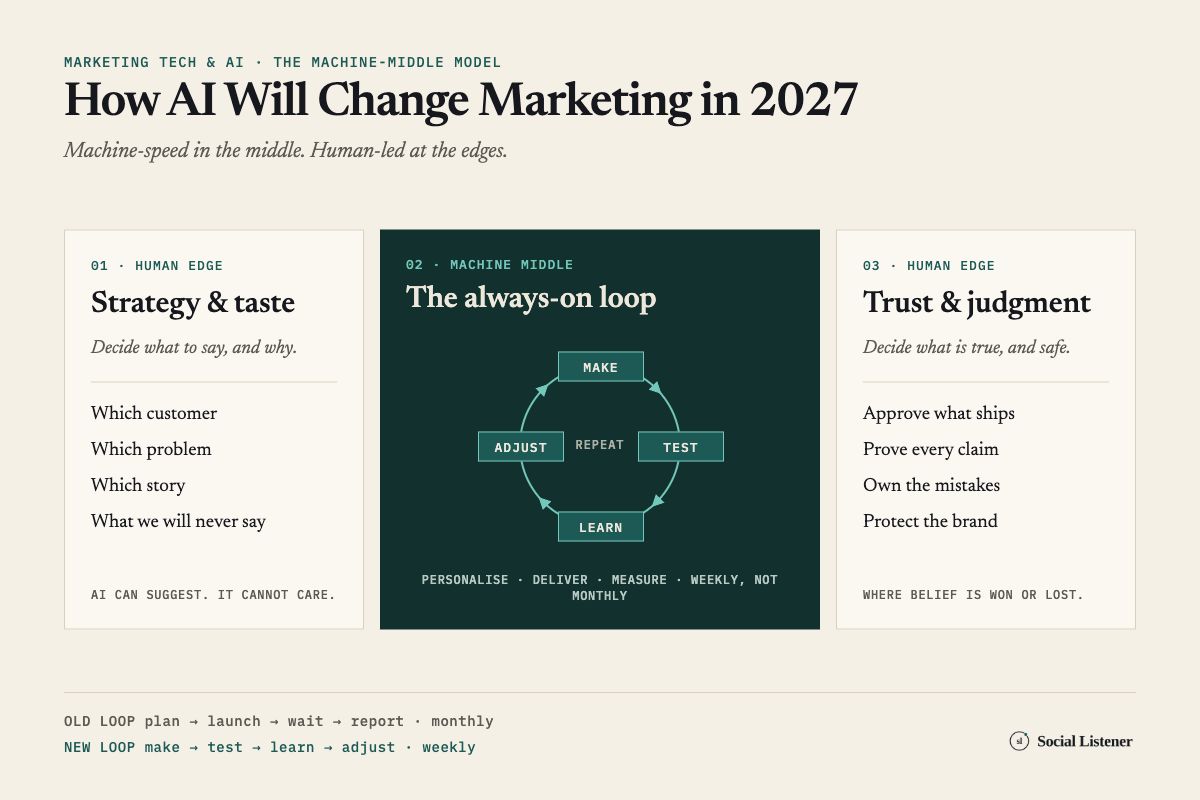
The first edge is human: strategy and taste. Which customer, which problem, which story, and what the brand will never say. AI can suggest. It cannot care.
The middle runs at machine speed: make, test, learn, adjust, repeat. The old loop was plan, launch, wait and report, with a campaign review a month later. The new loop runs weekly, sometimes daily. Copy, offers and landing pages assemble themselves around the person looking at them.
The last edge is human: trust and judgment. Approving what goes out, proving every claim, owning the mistakes. This is where brands win or lose belief.
This changes what a marketer is. Less a maker of things, more an orchestrator of a system: someone who sets the prompts, the guardrails, the approvals and the feedback loops, and then steers. The mistake to avoid is automating the edges. Brands that let machines decide what they stand for, or let machines publish without a human check, will be fast. They will also be forgettable, and occasionally dangerous.
Six shifts companies will feel this year
1. From segments to signals
The old audience was a demographic: men aged 25 to 35 in big cities. The new audience is a moment: people showing buying signals right now. What someone searches, watches, saves, compares and asks an AI assistant tells you far more than their age or postcode. Segmentation stops being a quarterly exercise and becomes always-on, with copy, offers and pages that change by intent stage. To feed that, creative stops being a set of finished ads and becomes a library of building blocks: narratives, proof points and answers to real questions.
2. From attention to belief
When anyone can produce infinite content for free, content stops being impressive. Customers start asking three quiet questions about everything they see: Is this real? Is this exaggerated? Did someone who actually used it write this? The brands that answer those questions win. That means investing in proof: reviews, customer outcomes, honest demos, before-and-after results and transparent pricing. The scarce resource is no longer attention. It is believability.
3. From clicks to quality of intent
Buyers now research in places you cannot track: communities, private chats and AI answers. The result is a growing dark funnel, where attribution models give confident answers about journeys they never saw. The metrics that hold up are the ones closer to money: lead quality, pipeline speed, conversion by intent stage, retention and repeat purchase.
4. From a pile of tools to a few platforms
Many companies spent the last decade buying a separate tool for every job. AI accelerates the opposite trend. CRM, customer data, commerce, support and analytics platforms are all building AI in, and the standalone tools that did one small job are being absorbed or cut at renewal.
5. From data to shared meaning
AI reflects the definitions underneath it. If marketing says churn is 3 percent and customer success says it is 8 percent, an AI assistant will confidently give both answers to different people. The advantage goes to companies that agree on what their core words mean, such as customer, churn, lifetime value, revenue and qualified lead. Data is not the moat. Shared meaning is.
6. From marketing the product to the product as marketing
Onboarding, in-product guidance and the moments that make people recommend you are becoming marketing's most powerful channels. When every interaction can be personalised, the product itself does the persuading. AI turns the product into the campaign.
What customers will expect, in their own words
Customers will never read a trends report. But they are already setting new rules, and you can hear them in four sentences.
"Don't make me search. Help me decide." People increasingly ask a question and expect an answer, not a list of links to work through. Brands need to behave less like a shop window and more like a decision assistant: clear comparisons, honest trade-offs and a straight answer to "which one is right for me?"
"You should know what I need without me explaining it again." Personalisation is becoming the baseline. Once people are used to services that remember them, a generic experience does not feel neutral. It feels broken. The line to hold is between relevance and manipulation: reduce effort, never exploit it.
"Show me proof, not claims." When people suspect that anything might be machine-written, they look for evidence from other humans: communities, credible creators, independent reviews, and people who have actually used the thing. Your own claims count for less. Other people's experience counts for more.
"If you can't fix it fast, you don't respect my time." AI has made instant replies feel normal, so patience is falling. Customers expect quick answers, faster fixes through smart routing, and updates before they have to chase them. Slow support used to be annoying. Now it reads as indifference.
The dark side: your brand is now a target
The same technology that lets you make a hundred ads an hour lets a fraudster make a hundred fake versions of you. In 2027, brand impersonation stops being a rare annoyance and becomes a routine risk: fake ads using your logo, accounts pretending to be your support team, deepfake videos of your founder or a famous creator endorsing something you never sold, synthetic reviews, and payment scams that borrow your name. Every one of them spends the trust you spent years building. So a new job appears inside marketing: trust operations. It is not glamorous, but it is quickly becoming essential.
Verified, clearly signposted official channels, so customers know where the real you lives.
Simple authenticity markers on your own content.
Always-on monitoring for impersonation and fake promotions.
A ready takedown playbook, so you act in hours, not weeks.
Tighter rules for agencies, affiliates and partners who use your brand.
The brands that treat trust as something to defend, not just something to earn, will keep it.
What to do this quarter
You do not need a transformation programme to start. You need five decisions.
Draw your edges. Write down what humans in your team will always own: strategy, brand voice, final approval, and anything that makes a claim. Everything else is a candidate for automation.
Build a proof library. Collect your best customer outcomes, reviews, demos and numbers in one place, so every piece of AI-made content can draw on real evidence instead of adjectives.
Swap one vanity metric for an intent metric. Replace clicks or impressions in your weekly report with lead quality or conversion by intent stage.
Agree five definitions. Get marketing, sales, finance and customer success to sign off one meaning each for customer, churn, lifetime value, revenue and qualified lead.
Check who is pretending to be you. Search for fake accounts, copied ads and lookalike sites using your name, and set up a simple way to report and remove them.
From running campaigns to steering them
For most of marketing’s history, people ran campaigns by hand. They chose the audience, set the bids, split the budget, launched, then waited weeks for a report to tell them what had worked. By then the money was spent. That model is quietly ending. On the big ad platforms, AI already makes most of the decisions. Google’s Performance Max and AI Max, and Meta’s Advantage+ campaigns, decide who sees an ad, which version they see, how much to bid and where the next dollar goes. They watch the results in real time and adjust on their own, around the clock. The campaign is no longer something a team runs. It runs itself.
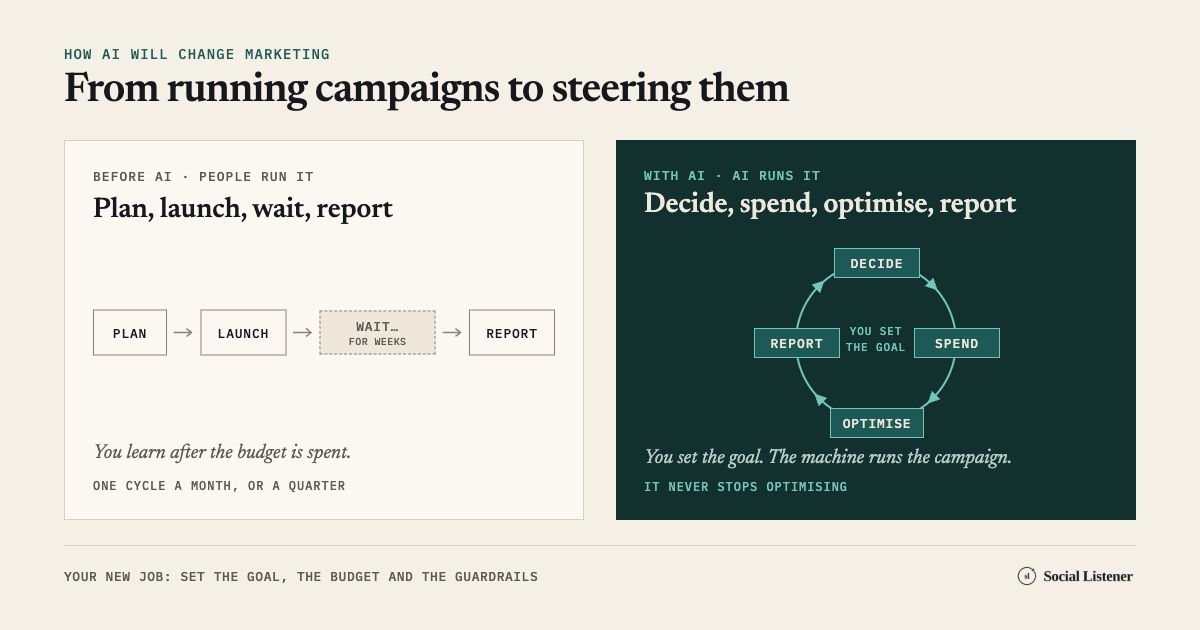
That changes the marketer’s job, not removes it. When the machine controls the levers, the human controls the goal. What counts as a good customer? How much is a sale worth? What will the brand never say, and where must it never appear? Get those inputs wrong and the AI will optimise, brilliantly and tirelessly, towards the wrong thing.
The new skill isn’t operating the campaign. It’s steering it: setting the destination, the budget and the guardrails, then judging whether the machine got you somewhere worth going.
The trust-and-speed era
Every wave of marketing technology has tempted brands to confuse output with progress. More emails. More posts. More ads. AI makes that temptation almost irresistible, because the cost of more has fallen to nearly nothing. But customers do not want more. They want to decide faster and to trust what they are told. That is the real brief for 2027.
The winners will not be the brands that use the most AI. They will be the ones that put it in the right place: machine-speed in the middle, where speed creates value, and human judgment at the edges, where trust is won or lost. Their marketing will feel faster and somehow more human at the same time.
In the end, good marketing in the AI era will deliver two things customers can feel: clarity when they decide, and confidence in who they are trusting.
https://sociallistener.in/post/the-next-job-skill-is-managing-ai-agents-not-just-people