Traditional SEO was built for a world where intent began on Google, discovery happened on ten blue links, and the website was the destination. That world is quietly collapsing. Not overnight, not with a dramatic “SEO is dead” headline, but with a slow behavioral migration that’s already visible in daily life. People don’t “go online” and search the internet anymore. They open an app and search inside the app because that app feels closer to the answer they want. Recipes? TikTok or YouTube. A product review? YouTube. A travel spot? Instagram. A “real” opinion? Reddit. A future plan or aesthetic inspiration? Pinterest. The search box moved from being a single universal gateway to becoming a hundred smaller doors, each leading to a different kind of truth.
That’s what “Search Everywhere Optimization” means: brands can’t optimize only for Google. They have to optimize for where intent live and intent now lives inside platforms. For Gen Z especially, social platforms are not just entertainment; they are discovery engines. Surveys and reporting have repeatedly shown that younger users increasingly turn to TikTok and Instagram for certain searches instead of Google.
The deeper point isn’t “Gen Z prefers TikTok.” The deeper point is that people are choosing the search engine that matches the format of certainty they need. If you want a quick “show me how it looks,” you want video. If you want “tell me the truth,” you want communities. If you want “give me a summary,” you increasingly ask an AI.
The three shifts that are replacing traditional SEO
1) Search is becoming visual-first, not text-first
Google trained us to type keywords. Social platforms trained us to ask in natural language and learn through visuals. A 30-second video often answers what a 1,500-word blog cannot: how the dish actually turns out, how the makeup looks on real skin, how the shoes fit on feet, how the hotel room really feels. This is why platforms like Pinterest are doubling down on visual search, explicitly positioning the future of search as visual and taste-led rather than keyword-led. When the user’s question is aesthetic (“what vibe is this?”) or experiential (“is it worth it?”), visuals win. And that means your “SEO assets” are no longer just pages; they are also videos, carousels, pins, and creator-friendly demos that can be discovered inside app search.
2) Search is becoming community-trust-first, not authority-first
The second shift is trust. For years, brands tried to “rank.” Now consumers try to “verify.” That’s why Reddit, comments, micro-creators, and niche communities are becoming part of the search journey, even when the original query started elsewhere. This is also why micro-influencer recommendations convert so hard: because they feel like a friend’s opinion, not a brand’s claim.
Traditional SEO assumed authority signals (links, domain strength, technical structure) would settle disputes. Search-everywhere behavior says: “I’ll believe what people like me say, in a place where they have no incentive to sell.”
This is also where the shift to private sharing changes the game. Adam Mosseri describes a paradigm shift away from public posting toward private sharing, DMs and group chats, meaning discovery and persuasion increasingly happen in places brands can’t observe directly. A lot of brand influence now travels as forwarded Reels, screenshots, private “you should buy this” messages, and small-group debates. The feed becomes the billboard. The DM becomes the sales floor.
3) Search is becoming answer-first, not click-first
The biggest structural break is that search is increasingly trying to end the journey at the answer. Google’s AI Overviews and AI Mode are designed to provide synthesized responses and enable follow-up questions in a conversational flow, meaning fewer users need to click ten links to get clarity. Google even has documentation for site owners about how AI features like AI Overviews and AI Mode work, because this is not an experiment anymore; it’s a product direction.
If the search journey becomes “ask → answer → follow-up,” then the new goal isn’t just ranking. It’s being included in the answer and cited as a source.
And this is already creating real-world tension. In February 2026, Reuters reported that European publishers filed an antitrust complaint against Google over AI Overviews, arguing the summaries use publisher content without adequate consent or compensation. Whether you agree with the publishers or not, the signal is loud: the economics of search are changing, and everyone can feel it.
Why traditional SEO gets replaced (not removed)
Traditional SEO won’t disappear. It becomes the basement. It still matters because every platform, every AI engine, every discovery surface ultimately pulls from somewhere. Your website is still your canonical source of truth. But it’s no longer the primary place where discovery begins. That’s the replacement: SEO becomes one layer of Search Everywhere, not the whole strategy.
In the old model, you built content to rank. In the new model, you build content to travel. You design assets that are discoverable inside multiple ecosystems: social search, marketplace search, YouTube search, app search, and AI answer surfaces. You stop treating your website like the only stage and start treating it like the reference library, while your content becomes the distribution network.
What “Search Everywhere Optimization” looks like in practice
Search Everywhere isn’t a buzzword. It’s a change in operating system. It means your brand works with a query-to-surface map:
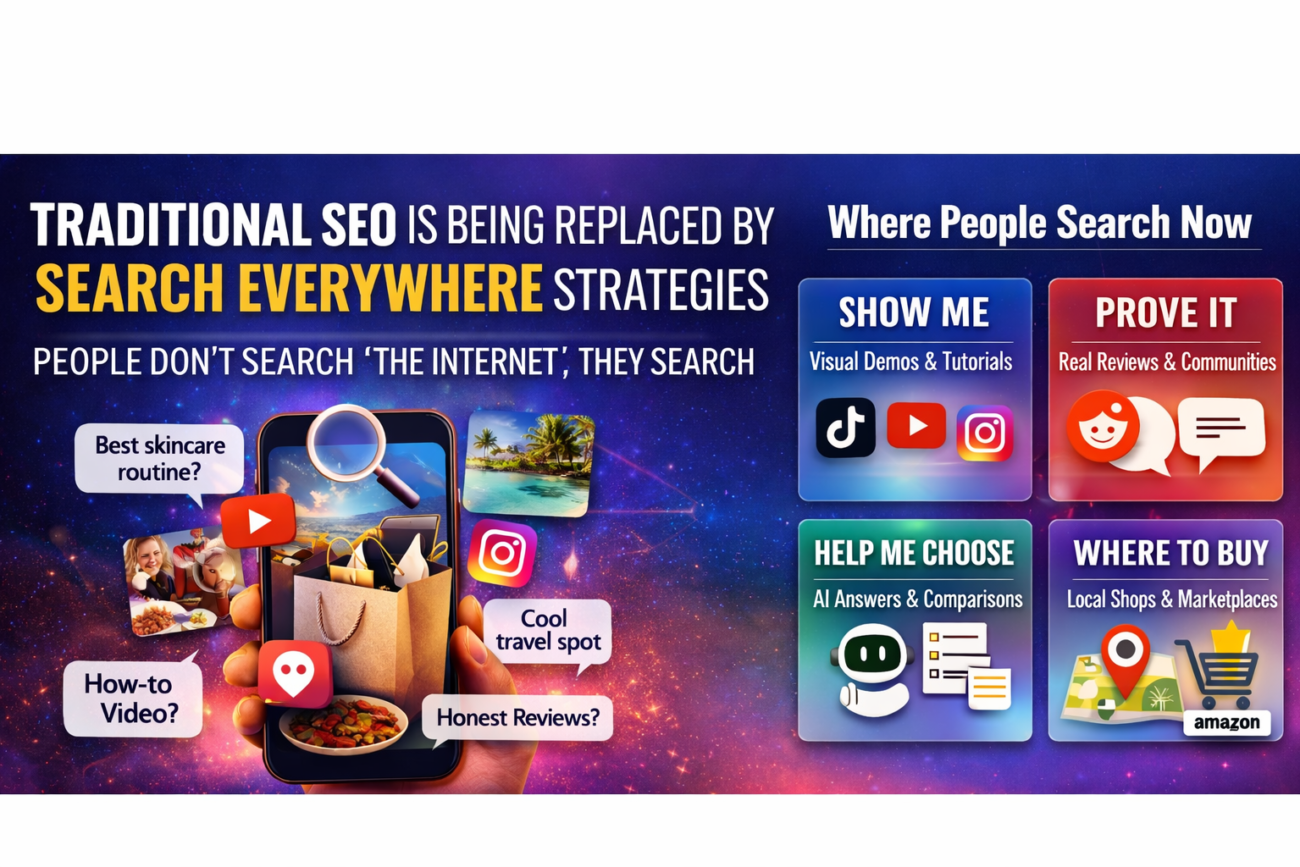
- “Show me” queries (how it looks, how it works) → TikTok, Reels, Shorts, YouTube
- “Prove it” queries (is it real, is it safe, is it worth it) → reviews, Reddit, creators, FAQs
- “Help me choose” queries (best under X budget, for my skin type, for my use case) → AI answers + comparison content
- “Where do I buy” queries → marketplaces, maps, store locators, social commerce
Then you build assets that match those surfaces. A skincare brand might win “show me” queries through routine videos, win “prove it” queries through ingredient transparency and dermatologist references, and win “help me choose” queries through comparison pages that AI engines can quote. A travel brand might win “show me” through creator itineraries, win “prove it” through authentic guest experiences, and win “where do I buy” through map-first presence and clean booking info.
The new KPI: not rank, but recall + citation + shareability
Search Everywhere requires new success metrics:
- Platform Search Visibility: do you appear when people search inside TikTok/YouTube/Instagram/Pinterest?
- AI Share of Answer: do AI summaries mention you for key category prompts?
- Citation Share: do AI engines cite your pages or cite third-party summaries about you?
- Dark Social Echoes: do you see spikes in branded search, direct traffic, and repeated questions after private sharing waves?
Because in this world, a user might never visit your website and still become your customer. Their decision could be made from a creator video, a comment thread, and an AI summary.
Read a Different version of this same thought. https://sociallistener.in/search-has-moved-from-google-to-social-media-ecosystems/
The future: marketing becomes multi-surface presence engineering
Search Everywhere Optimization is not about gaming new algorithms. It’s about accepting a simple reality: people don’t search the web, they search their favorite interfaces. Those interfaces are becoming more visual, more trust-driven, more private, and more answer-led. The brands that win will be the ones that stop treating “search” as a channel and start treating it as a behavior that happens everywhere.
And if you want the cleanest definition: Search Everywhere is the art of being findable wherever curiosity appears.
