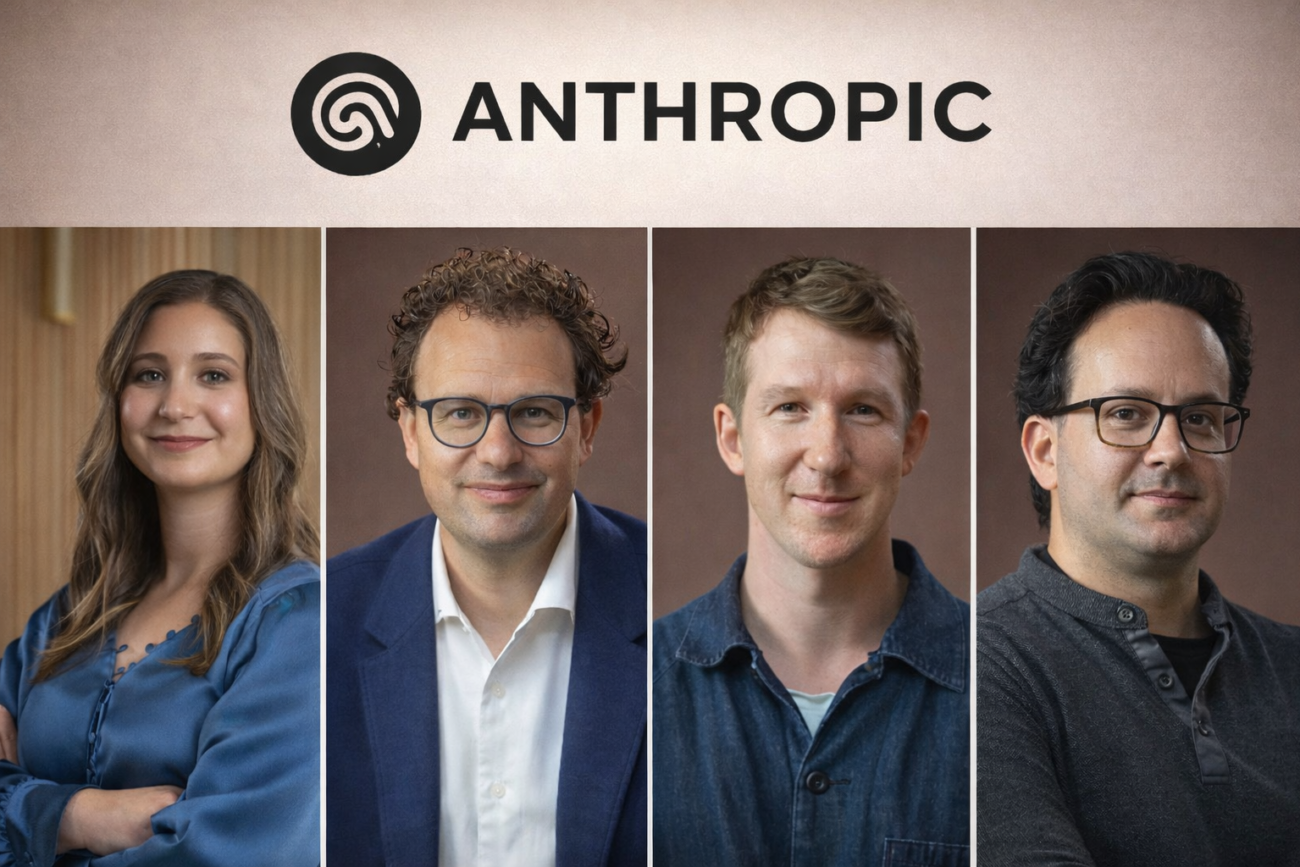
It begins in the world’s most famous AI castle: OpenAI. From the outside, everything looked perfect—breakthrough research, brilliant minds, and the feeling that the future was being written in real time. But inside, a tension was growing. A small group of senior researchers, including siblings Dario and Daniela Amodei, began to feel that something important was slipping: the balance between moving fast and staying safe. They weren’t worried about AI as a cool new app; they were worried about AI as a force that could reshape society before people had rules, guardrails, or understanding.
Over time, that disagreement became too big to ignore. According to multiple accounts, Dario left OpenAI around December 2020, and by 2021 the break turned into a new beginning: the siblings and other former OpenAI colleagues founded Anthropic, not as a typical startup, but as a Public Benefit Corporation, meant to bake “public good” into the company’s legal structure, not just its marketing
Why the Names Matter: “Anthropic” and “Claude”
The new company’s name wasn’t chosen to sound futuristic. It was chosen to sound like a reminder. Anthropic comes from a word linked to “human,” a quiet signal that this technology must stay human-centered, not ego-centered, not profit-centered, not race-to-win centered. And then there was the name of their model: Claude. It sounded gentle, almost old-fashioned, and that was the point, it didn’t feel like a weapon name. It was also widely described as a tribute to Claude Shannon, a pioneer of information theory, a way of saying: this is about communication, meaning, and signal, not hype.
3) The Constitution Idea (2022)
In 2022, while the public conversation around AI was getting louder, Anthropic was focusing on something quieter and harder: how to build a powerful model that could follow principles even when nobody was watching. That’s where their signature idea took shape, Constitutional AI. Instead of only training an AI by rewarding it when humans approve and punishing it when humans don’t, they experimented with giving the AI a written set of rules, a kind of “constitution”, and teaching it to judge its own answers against those rules, then revise itself. It’s easiest to imagine it like a student checking their own homework: the first draft might be messy or unsafe, but the second draft improves because the student had a clear rulebook and learned how to apply it. Anthropic published this approach in late 2022, turning what sounded like philosophy into something closer to engineering.
4) Claude Steps into the World (2023)
By March 2023, Claude was no longer just a lab experiment. Anthropic introduced Claude publicly as an AI assistant built around the idea of being helpful, honest, and harmless, and they began offering it through a chat interface and an API. This mattered because it showed the company wasn’t only talking about safety; it was trying to ship a real product while holding onto its principles.
Claude entered a world that was already getting crowded with AI assistants, but it carried a distinct personality: more careful with instructions, more likely to admit uncertainty, and less eager to invent confident-sounding nonsense. Whether people loved it or not, many could feel the difference: this model was being raised with a rulebook, not just trained to impress.
5) The Big Leap in Capability (2024)
Then came a major turning point in March 2024, when Anthropic announced the Claude 3 family, a clear signal that they weren’t going to stay a “safety-only” lab while others dominated capability. They were building frontier models too. And as the year went on, Claude became especially popular among people who read and write for a living, developers, analysts, researchers, lawyers, because it could handle long, complicated instructions and big documents without collapsing into confusion.
The story around Claude started to change from “the careful one” to “the careful one that’s also seriously powerful,” which is a rare combination in a fast-moving tech race.
6) From “Chat” to “Work” (2025)
By 2025, the whole industry’s question shifted. It was no longer “Can it talk?” It became “Can it do the job?” Anthropic leaned into that shift, especially in coding and developer tools. A key moment arrived in December 2025, when Anthropic announced it was acquiring Bun, a fast JavaScript toolchain, tying it directly to their push around Claude Code and developer productivity.
It was a signal that Anthropic didn’t just want Claude to be a clever assistant, it wanted Claude to become a real worker inside modern software teams, moving from advice to execution. And when Claude Code had issues, people noticed, because dependence had already started to form, exactly the kind of moment that tells you a tool has crossed from “interesting” to “important.”
As of early 2026, Anthropic has transitioned from a research lab to a financial juggernaut
- Users: Claude currently sees approximately 30 million monthly active users on its consumer platform. However, its real strength is in the enterprise, where it powers over 300,000 business customers (including giants like Salesforce and Snowflake).
- Revenue: Their financial growth has been staggering. After ending 2024 at a $1 billion run-rate, they hit $9 billion by the end of 2025. Current forecasts for 2026 suggest revenue could reach $18 billion to $26 billion, largely driven by the explosion of AI agents in the workplace.
7) The Public Promise (January 2026)
In January 2026, Anthropic did something that fit its origin story perfectly: it published Claude’s new constitution, a public document describing the values and behaviors they want Claude to follow. This wasn’t just a PR move; it was the company returning to its core thesis: if AI is going to grow into something incredibly capable, then society deserves to know what principles it is being trained to respect. In a world where AI companies often speak in vague promises, a written constitution is unusually concrete. It’s not perfect, and it won’t prevent every mistake, but it tells you what the builders believe the machine should become.
What Anthropic Story Really Is
When people hear “Anthropic,” they sometimes imagine a rivalry story, one company versus another, one model versus another. But the deeper story is simpler and more human. It’s about a group of researchers who looked at a powerful technology and decided that “move fast” was not enough. They believed the world needed an AI that could grow up with values, not just abilities. So they left the castle, built a new house, and tried to raise a machine with a rulebook, hoping that in the long run, the most important thing about the smartest mind we build won’t be how quickly it finishes a task, but whether it still understands that humans matter.
The Future: A “Parallel World”
The founders recently warned that by the summer of 2026, those using frontier AI will feel like they live in a “parallel world.” * Agentic Economy: The future isn’t about “chatting” with Claude; it’s about Claude “doing.” Anthropic is moving toward Claude Cowork, a system where AI agents handle entire departments’ worth of data analysis, legal reviews, and coding tasks invisibly in the background.
- The $350 Billion IPO? With a recent valuation surge to $350 billion, rumors of a 2026 Initial Public Offering (IPO) are swirling.
- Global Expansion: They are currently opening a massive hub in Bengaluru, India, tapping into the world’s largest developer pool to ensure Claude stays at the heart of the global coding economy.
Also Read https://sociallistener.in/the-inspiring-journey-of-duolingo/
