B2C marketing looks chaotic from the outside. Trends appear overnight. Products go viral for no obvious reason. Consumers jump brands without warning and then become fiercely loyal to another. For years, marketers tried to impose order on this chaos using funnels, attribution models, and increasingly complex dashboards. But the truth is simpler—and more uncomfortable.
Consumers don’t behave like funnels.
They behave like people.
In a world where attention is fragmented across platforms, decisions are faster, emotions are louder, and patience is lower, B2C buying has become instinctive rather than deliberate. Studies consistently show that over 90% of consumer purchase decisions are influenced by emotion, not logic. Add to that the fact that the average consumer now encounters 6,000–10,000 brand messages a day, and you start to understand why traditional “awareness-to-conversion” models feel outdated.
What has really changed isn’t consumer psychology it’s speed. Desire forms instantly. Validation happens quickly. Transactions must be effortless. And loyalty is earned not through persuasion, but through habit and convenience. According to multiple retail and e-commerce studies, nearly 70% of consumers expect brands to understand their needs and respond in real time, or they move on without hesitation.
That’s why modern B2C marketing isn’t a straight line from awareness to purchase. It’s a loop powered by triggers, social proof, frictionless buying, and identity signaling. Brands that understand this don’t try to control the consumer journey. They remove resistance from it.
This framework isn’t about theory. It’s about how buying actually happens in real life on phones, in group chats, while scrolling, comparing, hesitating, and finally deciding in seconds.
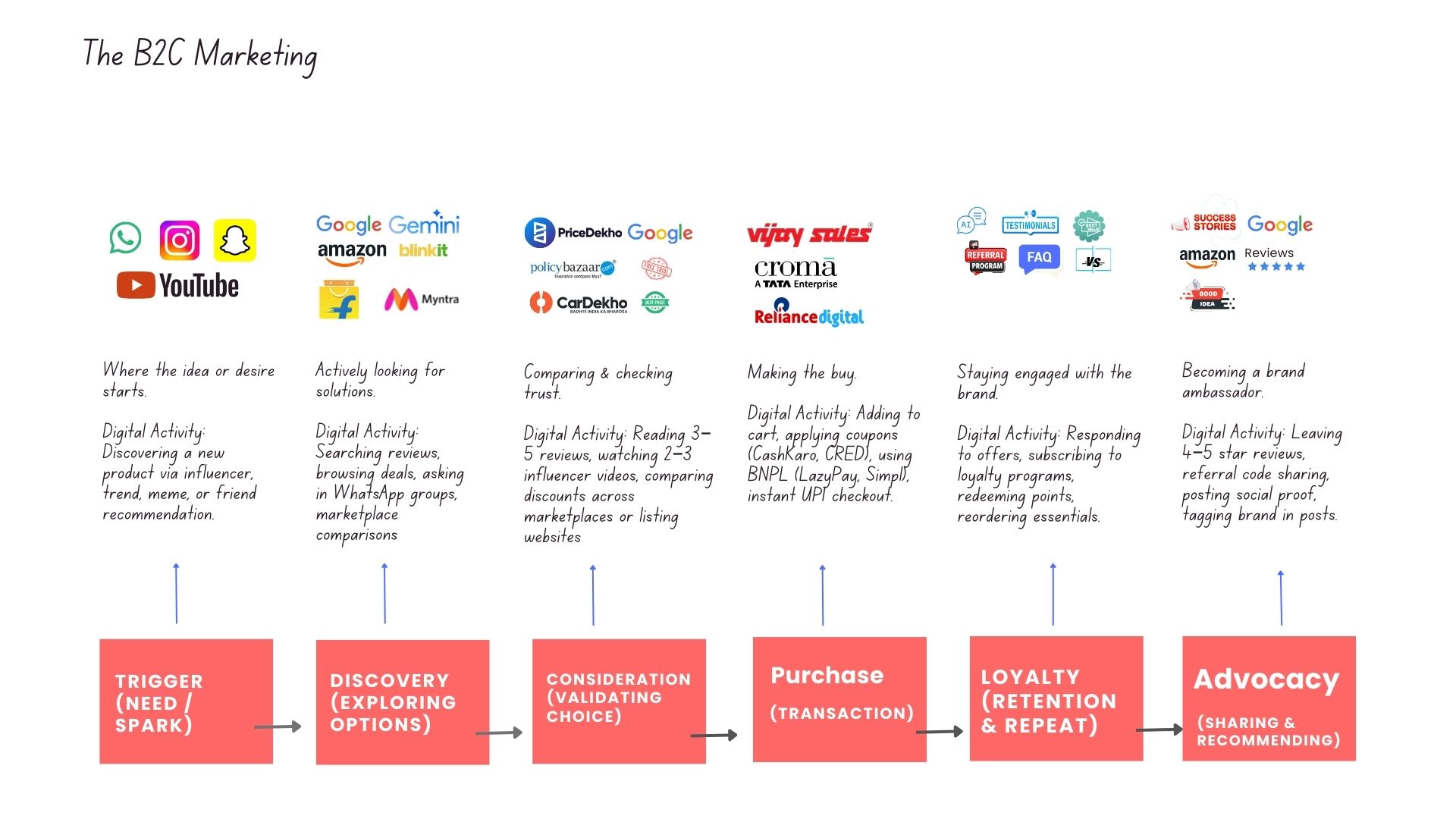
1. Trigger (Need / Spark)
This is where everything begins — not with a search, but with a moment.
A reel.
A meme.
An influencer story.
A friend’s recommendation.
A sudden realization: “I want this.”
Consumers don’t wake up wanting to shop. They stumble into desire.
What’s happening psychologically:
- Emotion precedes logic
- Identity and aspiration drive attention
- Social influence shapes curiosity
Why this stage matters:
If your brand doesn’t create triggers, you’ll always be dependent on discounts later.
Winning channels:
Instagram, YouTube, Snapchat, WhatsApp, creators, trends, culture.
2. Discovery (Exploring Options)
Once interest is sparked, consumers shift into exploration mode. This is not deep research — it’s scanning. People want reassurance quickly, without effort.
They search Google.
They check Amazon, Flipkart, Myntra.
They ask WhatsApp groups.
They compare prices and deals.
Key behavior:
Consumers want “good enough”, not perfect.
What matters here:
- Visibility across platforms
- Strong thumbnails, ratings, headlines
- Presence where comparisons happen
Hard truth:
If you’re not discoverable where people already look, you don’t exist.
3. Consideration (Validating Choice)
This is the trust checkpoint.
Before spending money, consumers pause — briefly — to validate their choice. They read 3–5 reviews. They watch 2–3 short videos. They compare prices across platforms.
Not to find the best option —
but to avoid regret.
What builds trust here:
- Reviews (especially negative ones that feel real)
- Influencer honesty
- Clear pricing and returns
- Familiar brand signals
Important insight:
Trust in B2C is fast, shallow, and emotional — but absolutely decisive.
4. Purchase (Transaction)
This is where most brands still lose customers.
Not because of pricing —
but because of friction.
Every extra step kills intent.
Winning purchase experiences:
- One-click checkout
- Instant UPI / BNPL
- Clear discounts
- No surprises
Consumers don’t want to think at this stage.
They want momentum.
The smoother the transaction, the higher the conversion.
5. Loyalty (Retention & Repeat)
B2C growth is not driven by acquisition.
It’s driven by habit.
Once someone buys, the real work begins.
Loyalty programs.
Personalized offers.
Subscriptions.
Reordering reminders.
Why this matters:
- Retained customers spend more
- Repeat buyers trust faster
- CAC drops dramatically
B2C brands don’t win by selling once.
They win by becoming the default.
6. Advocacy (Sharing & Recommending)
The final stage is where growth compounds.
When customers leave reviews, share referral codes, tag brands, or recommend products — they’re not doing marketing.
They’re signaling identity.
People recommend brands that make them feel smart, early, or in-the-know.
Advocacy feeds the very first stage again — triggering new consumers through social proof.
This is the loop.
The B2C Growth Loop (Not a Funnel)
Trigger → Discovery → Consideration → Purchase → Loyalty → Advocacy → back to Trigger
The best B2C brands don’t push consumers through this loop. They remove friction at every step.
B2C Growth Is About Reducing Effort, Not Increasing Pressure
The biggest mistake brands make in B2C marketing is assuming consumers need more convincing. They don’t. They need less friction. Less thinking. Less doubt. Less effort.
The strongest B2C brands don’t shout louder than everyone else. They show up at the right moment, feel familiar, and make the decision easy. That’s why brands with high recall and repeat usage generate up to 60–70% of their revenue from returning customers, even though acquisition gets most of the marketing attention. Loyalty, not reach, is what compounds growth.
When consumers recommend a product, leave a review, or share a referral code, they’re not acting as marketers. They’re expressing identity. They’re saying, “This fits who I am.” Research shows that word-of-mouth drives nearly 2x more sales than paid advertising in consumer categories, because trust travels faster between people than from brands to people.
This is why the B2C framework ends with advocacy but never really stops there. Advocacy feeds the next trigger. A review sparks curiosity. A post creates desire. A recommendation starts the loop again. Growth becomes organic not because the brand is perfect, but because it’s present, predictable, and easy to choose.
In the end, B2C marketing is not about manipulation or persuasion. It’s about designing for human behavior. Understanding that consumers don’t want to be sold to—they want to feel confident, rewarded, and understood.
The brands that win aren’t the ones that push hardest.
They’re the ones that remove the most resistance.
And in a world where choice is infinite, ease is the most powerful differentiator of all.
