
Social commerce isn’t “ads on social” anymore. It’s a complete shopping journey happening inside the feed where people discover products through creators and short-form demos, validate them through comments and community signals, and increasingly purchase without leaving the platform. That changes the economics of attention: trust is built in public, conversion happens faster, and the brands that win are the ones that are discoverable, shoppable, and shareable at the same time.
What’s most interesting is why this is compounding now. Social platforms have quietly solved three things at once:
(1) product discovery at scale (algorithmic distribution),
(2) social proof at the moment of consideration (comments/UGC), and
(3) reduced friction to purchase (native checkout, affiliate flows, shops).
The result is a new Social commerce retail loop
“search → site → checkout,” more “see → trust → buy.”
Below are the key stats that explain the shift, the trends hiding inside them, and a simple execution playbook you can use as a practical framework.
Key stats on social commerce (proof that the shift is real)
- Global social commerce is expected to reach ~$1.2T by 2025.
- US social commerce is expected to reach nearly ~$80B by 2025 (about ~5% of total US e-commerce).
- US retail social commerce sales are forecast to pass $100B in 2025, about ~22.4% growth YoY (EMARKETER forecast).
- US social buyers (14+) are expected to reach 108.3M in 2025, equal to 47.9% of social network users (EMARKETER).
- 7 in 10 global shoppers say they buy on social media.
- 71% of shoppers say social media could become their primary shopping channel by 2030.
- 29% of users report making purchases on Instagram (2025 Sprout Social Index™). ~200M Instagram users tap a shopping post or business profile daily.
- On Pinterest, 96% of top searches are unbranded, people search by idea/need, then discover brands.
- TikTok Shop scaled to an estimated ~$19B GMV in Jul–Sep 2025 (one quarter) (third-party estimate).
- US livestreaming e-commerce is projected to reach ~$68B by 2026 (Statista-cited projections).
Trends hiding inside these numbers
1) Social is becoming a default shopping channel, not a side experiment.
When the US is heading toward ~108M social buyers and nearly half of social users being buyers, “social commerce” isn’t a feature, it’s a retail behavior.
2) Discovery is increasingly unbranded—category first, brand later.
Pinterest’s “96% unbranded searches” is the cleanest signal of the new starting point: people begin with intent (“work bag,” “living room ideas,” “glow skincare”), not a brand name. That’s a massive opportunity for brands that show up early and consistently.
3) Creator-led demos are replacing product pages as the first conversion surface.
TikTok Shop’s scale is a reminder that the new product page is often a 15–45 second demo. It compresses explanation + proof + desire into a single moment.
4) Trust is built in public—and it compounds.
On social, validation doesn’t happen on a hidden review page. It happens in comments, stitches, duets, creator replies, and UGC. This is why brands that manage “social proof operations” outperform brands that only run performance ads.
5) Live and interactive commerce is real, but it wins in specific categories.
The growth projections for livestream commerce point to an important nuance: live shopping isn’t universal, but in categories where Q&A and demo matter (beauty, gadgets, fashion drops, home), it can be a high-conversion format when run like a repeatable program.
Execution playbook: how to win in social commerce
If social is becoming a store, you need a system not random posts. The clean way to think about it is a loop: unbranded intent → demo → proof → clarity → checkout → UGC → retarget → repeat.
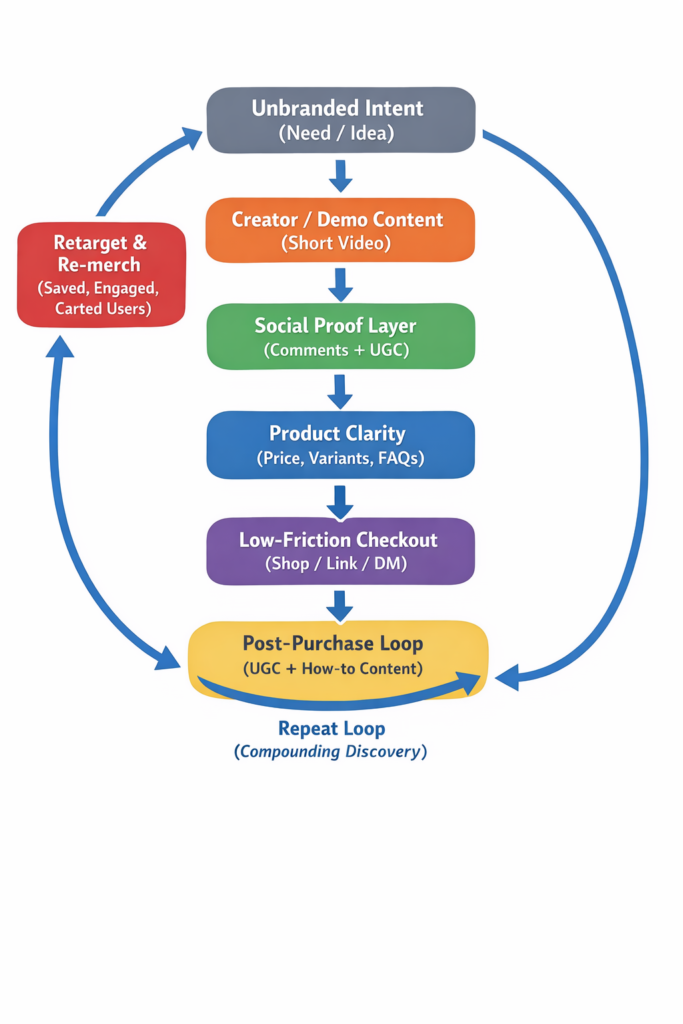
The practical takeaway: for every hero product, build a minimum viable “commerce kit”—5–10 demo videos, visible UGC, clear pricing/variants, and a checkout path that takes under 30 seconds.
Also read. How social media has changed Search
Social commerce is growing because it matches how humans actually buy: we copy what looks safe, we trust what feels real, and we move faster when the next step is frictionless. The brands that win won’t just “run social.” They’ll treat the feed like a storefront and engineer discovery, proof, and purchase as one connected experience.
If you’re navigating similar questions inside your organization, I’m happy to exchange notes.
