By 2026, social media is no longer just influencing discovery, it is where discovery starts. More than 50% of Gen Z now begin their search journey on platforms like TikTok, Instagram, or YouTube, not on traditional search engines. Across all age groups, nearly one in three consumers skip Google entirely when they want to look something up. Even more telling, 82% of people now use social media specifically to research products before making a purchase.
These are not vanity metrics. They signal a structural shift.
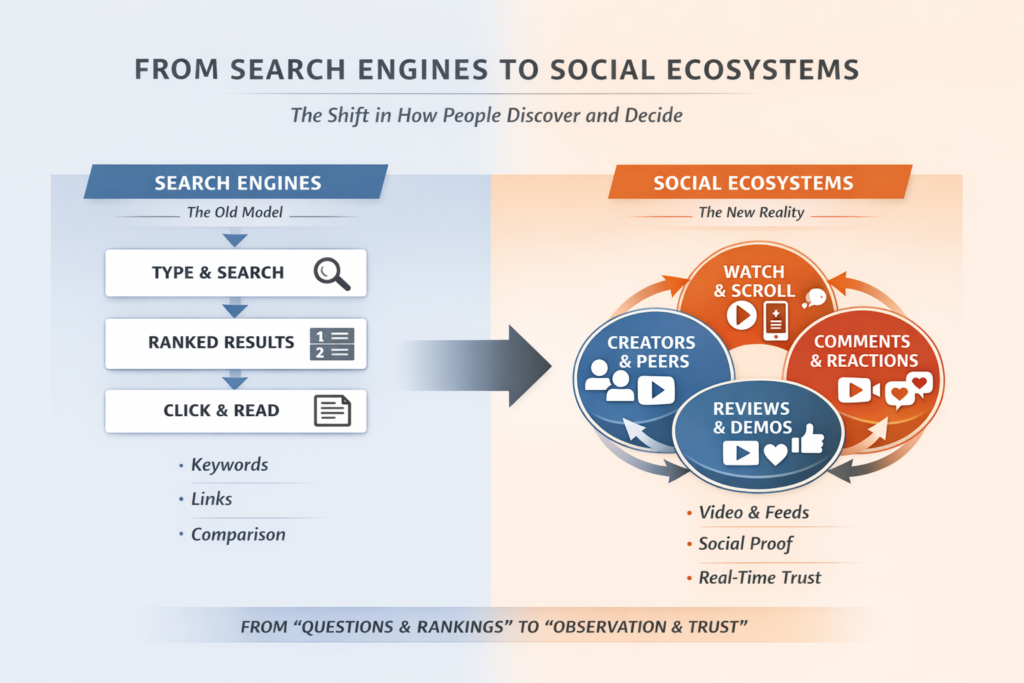
Search has moved away from typing questions into boxes and toward observing people, outcomes, and opinions in motion. What we are witnessing is not the decline of search, but the migration of search behavior into social ecosystems.
What We’re Actually Talking About (And What We’re Not)
This shift isn’t about social media replacing Google outright. It’s about how intent forms.
Traditional search assumed a rational sequence: question → answer → comparison → decision. Social search works differently. It surfaces context before clarity. People don’t start with a precise question — they start by watching what others are doing, using, recommending, or rejecting. In other words, discovery now happens before intent is fully articulated. That single change breaks many of the assumptions marketing has relied on for the last decade.
Why Google Is Starting to Lag Behind
Google isn’t failing because its technology is worse. It’s lagging because its core interaction model is outdated. Search results still prioritize:
- links over lived experience
- summaries over social proof
- authority over relatability
Meanwhile, users increasingly want:
- demonstrations, not descriptions
- reactions, not rankings
- credibility through people, not pages
AI summaries have accelerated this shift. When users can get a synthesized answer instantly, they no longer need to explore ten links. Google still plays a role, but it increasingly shows up late in the journey, often after opinions have already formed elsewhere.
Search engines answer what something is.
Social platforms answer whether it feels right.
That difference matters.
The Role Social Media Is Playing Now
Social platforms have quietly absorbed multiple layers of the buying journey at once.
They now function as:
- discovery engines
- research environments
- validation systems
- trust filters
On social platforms, people don’t just learn about products, they watch outcomes unfold. They see real usage, hear unprompted opinions, and read reactions in real time. The comment section has effectively become the new review page, except it’s public, dynamic, and impossible to fully control.
This is why 62% of shoppers say positive comments and peer reviews within social platforms are their top driver of trust. And it’s why 75% of consumers say they will switch brands if they can’t find enough information directly on social platforms.
Social media doesn’t just influence decisions.
It increasingly pre-decides them.
Which Social Media Platforms Are Winning And Why
Not all platforms are benefiting equally from this shift.
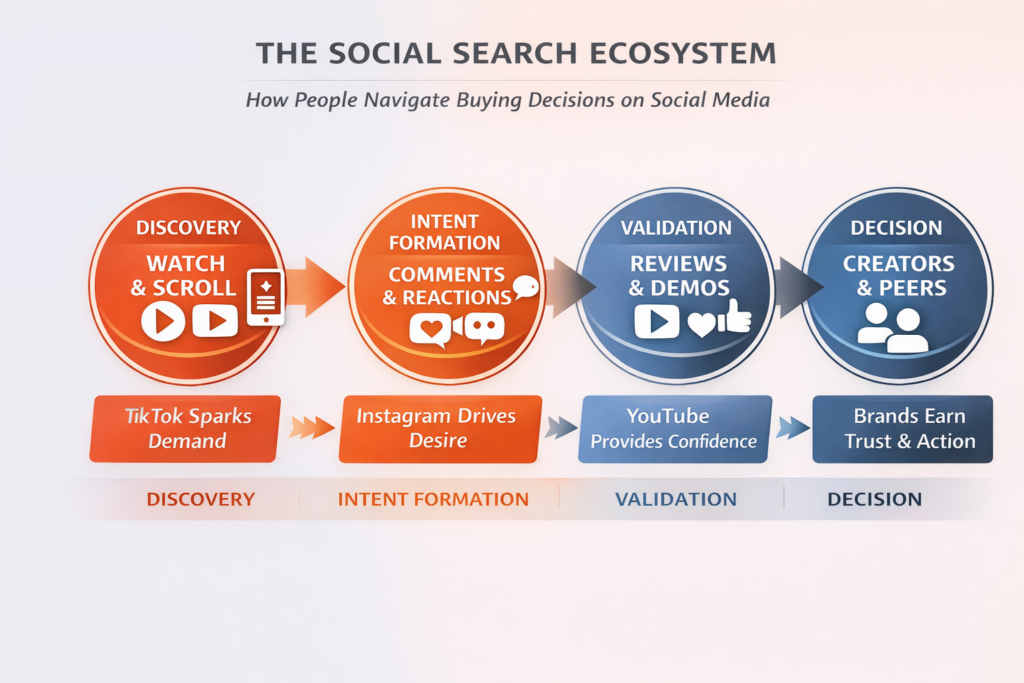
TikTok is winning early-stage discovery. It sparks demand before users even know what they’re looking for. Its strength lies in pattern recognition — users see something repeatedly and conclude, this must matter. For Gen Z, TikTok has effectively become a visual search engine.
Instagram is winning the mid-stage. It reinforces desirability and credibility. People use it to assess aesthetics, lifestyle fit, and social acceptance. This is where interest turns into intent.
YouTube has emerged as the final validation layer. Usage for product discovery continues to grow because YouTube allows deeper explanation. Buyers go there to justify decisions — often to themselves, sometimes to others.
Together, these platforms form a stacked journey: TikTok creates curiosity, Instagram builds confidence, and YouTube provides justification. This is not accidental. Each platform answers a different psychological question.
Why Short-Form Video Is Dominating (And Getting Longer)
Short-form video is not winning because attention spans are shrinking. It’s winning because decision-making has accelerated. People don’t want less information. They want faster context, denser signals, and fewer steps between curiosity and clarity. Video delivers all three at once.
The platform data makes this clear. TikTok, once known only for 15-second clips, now supports videos up to 10 minutes, and internal engagement data consistently shows that videos between 1–3 minutes often outperform ultra-short clips for topics involving learning, product discovery, or explanations. In the U.S., TikTok users are increasingly watching longer videos when the content helps them understand how something works, not just what it looks like.
Instagram followed the same pattern. Reels expanded from 15 seconds to 90 seconds, and Meta has openly stated that longer Reels drive higher watch time when the content provides utility or narrative depth. Instagram is no longer just about quick inspiration, it’s about contextual validation, especially for products, places, and lifestyle decisions.
YouTube’s evolution is even more telling. Shorts now support videos up to 3 minutes, and YouTube continues to dominate “decision validation” behavior. Recent usage trends show that YouTube is often the final stop before purchase, where users watch longer explainers, comparisons, and real-world usage videos to justify their choice. This is why YouTube remains the most trusted platform for product research, even as discovery shifts elsewhere.
Across platforms, the pattern is consistent: short-form is getting longer because people want substance without friction. In a world where search has become social and decisions are formed before intent is fully articulated, short-form video isn’t just content. It’s the fastest trust-building medium available.
That’s why platforms aren’t shortening it.
They’re letting it breathe.
The Bigger Implication for Brands
This shift forces a hard realization: brands no longer own their first impression. Your brand is discovered through:
- creators explaining it
- customers reacting to it
- comments debating it
- clips showing it succeed or fail
If that ecosystem doesn’t exist or exists without your participation growth becomes fragile.
In the social search era, visibility is not enough.
Credibility must be observable.
Conclusion: Google Search Has Moved From Engines to Ecosystems
Search hasn’t vanished. It has escaped the search box. It now lives across feeds, videos, comments, creators, and communities, shaped less by keywords and more by human behavior. People don’t arrive at decisions by asking a single question anymore. They arrive by watching, observing, comparing, and absorbing signals over time. Trust is formed quietly, socially, and often subconsciously before a brand is clicked, before a website is visited, and sometimes even before intent is clearly defined.
This is the uncomfortable shift most brands are still adjusting to. Visibility is no longer something you earn once through rankings. It’s something you maintain continuously through presence, proof, and participation. Your brand is no longer evaluated by what it claims, but by what people show, say, and experience around it, publicly.
The brands that win next won’t obsess over questions like, “How do we rank higher?”
They’ll focus on a harder one: “What do people discover when they encounter us socially—without us guiding the narrative?”
Because in an ecosystem-driven world, relevance isn’t decided by algorithms alone.
It’s decided by collective perception.
Search has moved from engines to ecosystems.
And marketing now has only one real job left: to align with how humans actually discover, trust, and decide not how we’re used to optimizing for them.
If you’re navigating similar questions inside your organization, I’m happy to exchange notes.

One thought on “Search has moved from Google to Social Media & ecosystems”
Comments are closed.