We are living in the most automated, data-rich, AI-accelerated era of go-to-market the world has ever seen. And yet, something feels off.
Despite better tools, sharper targeting, and faster content production, most GTM efforts today feel louder but not more effective. Pipelines take longer. Trust is harder to earn. Audiences skim, scroll, and disappear. Sales teams complain about “low-quality leads.” Marketing teams respond with more campaigns. AI produces more content. The cycle repeats.
The uncomfortable truth is this:
GTM isn’t failing because we lack technology. It’s failing because we’re modeling funnels instead of humans.
AI didn’t break GTM.
It exposed what was already broken.
The Core Mistake Modern GTM Makes
Most GTM strategies are built on a flawed assumption: that people behave logically.
We map linear journeys.
We define personas.
We score intent.
We optimize conversion paths.
But real decisions don’t happen that way. People don’t move through GTM like water through pipes. They move through it like humans under uncertainty emotionally, socially, and psychologically. They ask themselves questions they rarely say out loud:
- Is this safe
- Can I trust these people?
- Does this make me look competent?
- Is this aligned with who I am or who I want to become?
Logic comes later. Logic justifies what emotion already decided. This is the gap most GTM systems ignore.
Why AI Made the Problem Worse (and Clearer)
AI is extraordinarily good at scale. It can:
- Generate content
- Optimize keywords
- Predict behavior patterns
-
Personalize messaging
But AI operates primarily at the logic layer.
It accelerates what we say, not why people believe it.
It scales messages, not meaning.
It optimizes outputs, not trust.
When human layers are weak, AI doesn’t fix GTM, it amplifies noise. That’s why many AI-led GTM efforts feel efficient but hollow. Fast, but forgettable. Personalized, but impersonal.
The real question isn’t “How do we use AI in GTM?”
It’s “What should AI amplify and what must remain human?”
GTM Is Not a Funnel. It’s a Human Experience.
This realization is what led me to step back and rethink GTM from first principles not as tactics or tools, but as a human experience unfolding inside the mind of a buyer.
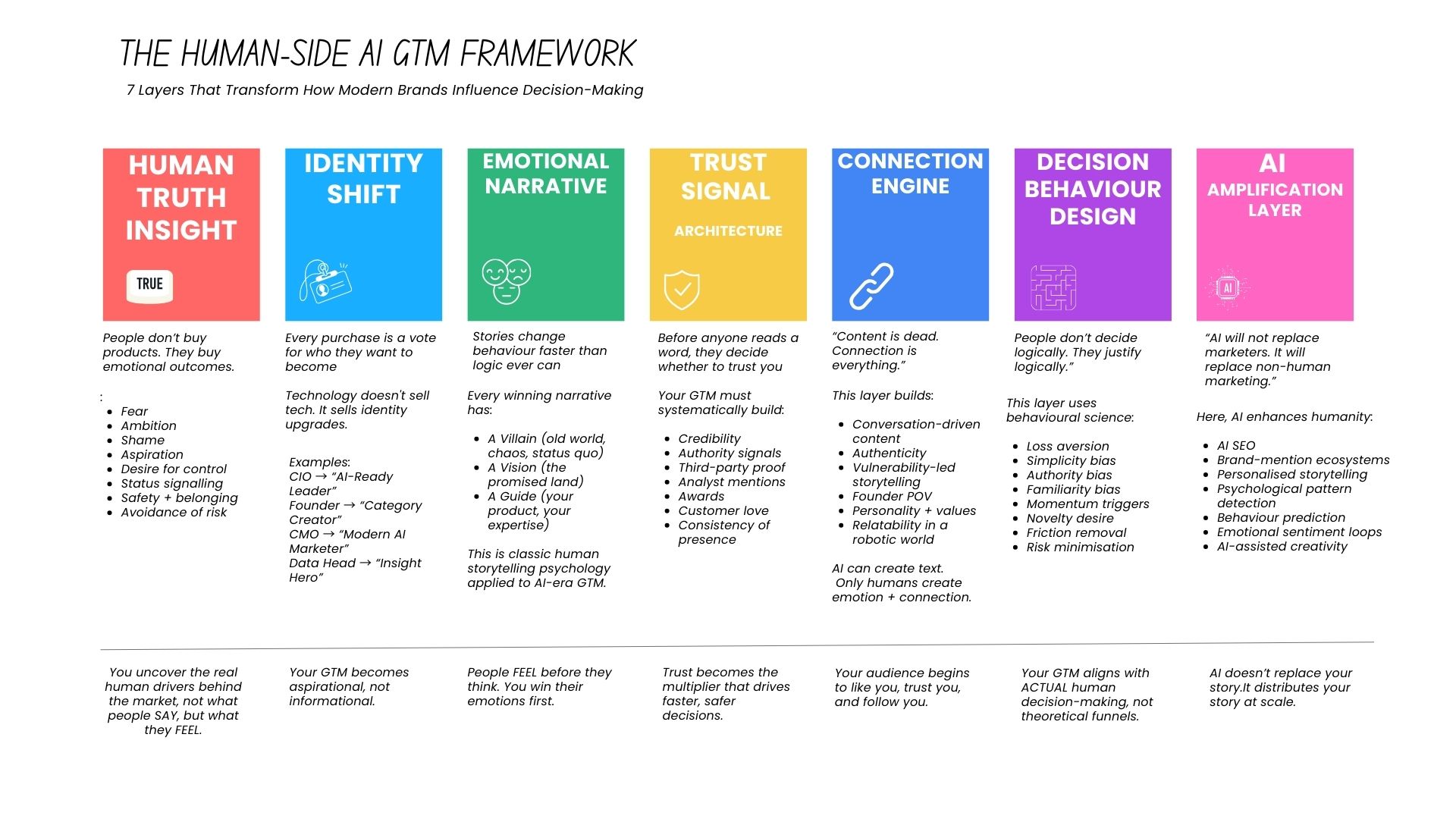
What emerged was not a process, but a set of human layers that shape how decisions actually form. These layers don’t operate in sequence. They operate in parallel. When one is missing, the entire GTM effort weakens.
At a high level, modern GTM succeeds only when it aligns with:
- Human truth (what people really feel, not what they say)
- Identity (who the buyer believes they are becoming)
- Narrative (how change is emotionally framed)
- Trust (signals before words)
- Connection (human presence over content volume)
- Behavioral reality (how decisions are actually made)
- Amplification (where AI belongs, at the end, not the beginning)
This isn’t a framework to follow step by step.
It’s a reminder of how humans work.
Where Most GTM Teams Go Wrong
Once you see GTM this way, common failures become obvious. Teams try to:
- Scale content before earning trust
- Automate conversations before building connection
- Use behavioral tricks without emotional grounding
- Push performance marketing without identity clarity
- Replace human judgment with AI in sensitive moments
One of the clearest examples is customer support and complaint resolution.
AI is excellent at handling requests.
But complaints are emotional moments.
A customer raising a complaint is already frustrated. They want speed, yes but also reassurance, accountability, and empathy. When brands fully automate these moments, resolution may be fast, but the experience feels dismissive. AI can assist here, but removing humans entirely often escalates anger instead of resolving it. This pattern repeats across GTM.
Whenever emotion is high, humans matter more.
Also Read: https://sociallistener.in/we-buy-identity-not-products-why-product-positioning-is-identity-design/
What Changes When GTM Is Designed This Way
When GTM aligns with human decision-making, the entire system feels different.
Marketing becomes calmer and clearer.
Sales conversations feel less pushy and more consultative.
Content compounds instead of expiring.
Trust accelerates velocity.
AI becomes leverage—not a crutch.
You stop asking: How do we push harder? And start asking: What does the buyer need to feel right now to move forward?
That shift changes everything.
The Real Role of AI in Human-Centered GTM
AI does not replace GTM teams.
It replaces non-human GTM.
AI is extraordinary at:
- Distribution Pattern detection
- Personalization at scale
- Optimization and recall
But it must sit on top of a human-first foundation.
When identity, trust, narrative, and connection are strong, AI multiplies their impact. When they’re weak, AI only spreads the weakness faster. This is the difference between AI as an accelerator and AI as a liability.
