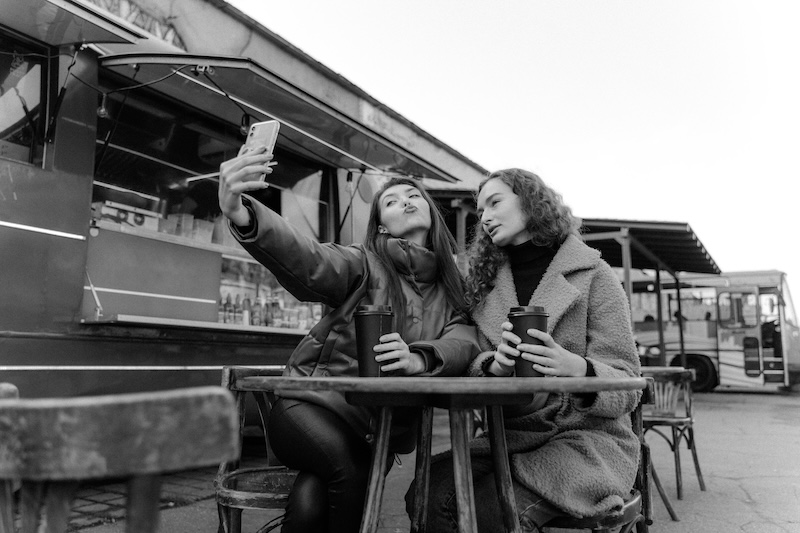
For Gen Z, sharing isn’t an add-on to life, it’s part of how life is processed. A weekend with friends doesn’t quite feel complete until it appears in Stories. A workout feels unfinished if the app didn’t record it. A trip to a new city doesn’t feel fully real until the reel is live. Experiences aren’t just lived anymore; they’re captured, ranked, and validated.
And this isn’t just a Gen Z phenomenon. Older generations are quietly drifting there too. Many of us catch ourselves thinking, “If I didn’t share that… did it even happen?” It’s an uncomfortable realization, but an honest one.
What’s changing isn’t only human behavior, it’s the world around us. Physical spaces are increasingly being designed with the camera in mind. Restaurants obsess over lighting, neon signs, and angles as much as food. Cafés plan interiors for reels before menus. Malls carve out pastel backdrops and “photo moments.” Cities promote “Instagrammable corners” alongside heritage trails. With a high-quality camera built into every pocket, visibility has become a design requirement.
There’s a reason this logic wins budgets. Spaces optimized for color, brightness, and visual novelty reliably trigger user-generated content, turning visitors into distribution. Gen Z spends hours each day inside social feeds, and that attention rhythm shapes how physical environments are conceived. Designing for the lens is no longer aesthetic indulgence, it’s strategic.
Food culture offers a clear example. “Internet-famous” restaurants are now a documented phenomenon. A viral spike online often translates directly into footfall, queues, and a predictable lifecycle of popularity. The plate isn’t just plated to taste good; it’s plated to photograph well.
Major life moments are being staged the same way. Buying a car now often includes a theatrical delivery bay, spotlights, LED screens with your name, countdowns, oversized bows—so the first drive begins as content. Weddings feature 360-degree spin booths, sparkler tunnels, cold-pyro first dances, live hashtag walls, and QR guestbooks. Parties script “content beats”: neon quotes, smoke-filled cocktails, ring-lit corners, reveal desserts timed for midnight posts.
Even traditionally private rituals, baby showers, housewarmings, anniversaries, now come with custom backdrops and digital guest notes. The event isn’t just happening; it’s being designed for capture, circulation, and memory in-feed.
This is the Gen Z effect in practice: spaces engineered to be experienced through a lens and scaled through sharing. It isn’t cynical, it’s the current physics of attention. The smarter response isn’t to resist it, but to design better within it: create moments that photograph beautifully and feel meaningful once the phone goes face-down.
That’s the hidden math of modern design. The more shareable a space feels, the more it multiplies its reach. Architecture, retail, and hospitality aren’t just shaping experiences anymore, they’re building distribution channels, one post at a time.
Marketing Takeaways: Designing for the Shareable Moment
This shift isn’t just cultural, it’s strategic. When spaces become shareable, marketing moves from messaging to environment design.
1. Your space is now media.
Every physical touchpoint, store, restaurant, event, office, packaging—functions like a content channel. If it doesn’t invite capture, it limits reach.
2. Design for distribution, not just experience.
The most successful spaces don’t ask visitors to share; they make sharing effortless. Lighting, contrast, framing, and visual hooks matter as much as usability.
3. User-generated content is the new amplification engine.
People trust people more than ads. When visitors become creators, brands gain credibility, scale, and cultural relevance without increasing ad spend.
4. Moments matter more than messages.
Gen Z and millennial audiences don’t remember taglines—they remember moments. A reveal, a ritual, a visual surprise travels further than any campaign copy.
5. Don’t trade substance for aesthetics.
Shareability brings people in, but meaning keeps them there. The most effective spaces photograph beautifully and feel worth staying in once the phone goes down.
6. Marketing teams must collaborate beyond marketing.
Today, growth depends on partnerships with architects, interior designers, product teams, and experience designers. GTM now starts at the blueprint stage.
In the attention economy, the most scalable marketing asset isn’t an ad, it’s a space people want to share.
