
When you want to understand a new concept, you don’t go hunting through ten brand blogs anymore. You ask an AI tool, or you read the summary box on top of search results. In a few seconds you get a decent explanation, a quick comparison, maybe even pros and cons. You feel “educated enough” to move on.
The awareness layer still exists, it just doesn’t belong to us anymore.
What lands on our websites today isn’t curiosity, it’s caution. Buyers are arriving already educated. They’ve consumed summaries, watched demos, compared tools, joined community threads, and debated internally. They’re not asking “What does this do?” They’re asking “Will this work here? Will this fail politically? Can I defend this decision later?” Most of the buying journey now happens invisibly, and by the time they surface, they don’t need teachers, they need reassurance. By the time someone finally lands on your site, they’re not there for a lesson. They’ve already done the homework somewhere else.
What they’re really carrying is not curiosity. It’s caution.
What B2B Buyers Actually Want When They Finally Show Up
When a serious buyer reaches your product page or books a demo today, they usually already know what you do. They’ve seen your competitors. They’ve read comparisons that you didn’t write. They’ve debated you in internal channels you will never see. The question in their mind is no longer “What is this thing?” The real questions sound more like:
- Will this work here, in our messy stack?
- How long before anyone sees value?
- What happens to me if this fails?
- Can I defend this in front of finance and leadership?
The energy of the conversation had changed. Suddenly, people arrived on calls saying, “We saw how you did this for a company like us. Can we talk about what that would look like here?” That’s when it really hit me: AI killed commodity awareness, not curiosity. Buyers still want to learn. They just don’t need you for the basics. They need you for confidence.
The Confidence Framework: From Content to Conviction
Over the years, I’ve stopped asking, “How much content do we have?” and started asking a much smaller question: “Does any of it actually make someone feel confident taking the next step?” That shift completely changed how I look at B2B marketing. Traffic is nice. Awareness is nice. But deals don’t move because people are aware. They move when risk feels manageable. That’s where the idea for what I now call the Confidence Framework really came from watching buyers hesitate, not because they didn’t understand something, but because they weren’t emotionally or politically ready to commit.
The framework is deliberately simple. Instead of thinking about “top,” “middle,” and “bottom” of a funnel, I look at content through one lens: does this reduce doubt? If the answer is no, it might still be useful, but it probably won’t influence revenue. When the answer is yes, you can almost feel the conversation shift. A skeptical buyer suddenly has language they can take back to their team. A cautious stakeholder begins to imagine success instead of failure. That’s when marketing starts doing its real job. Over time, that evolved into a three-part mental model I now call The Confidence Framework.
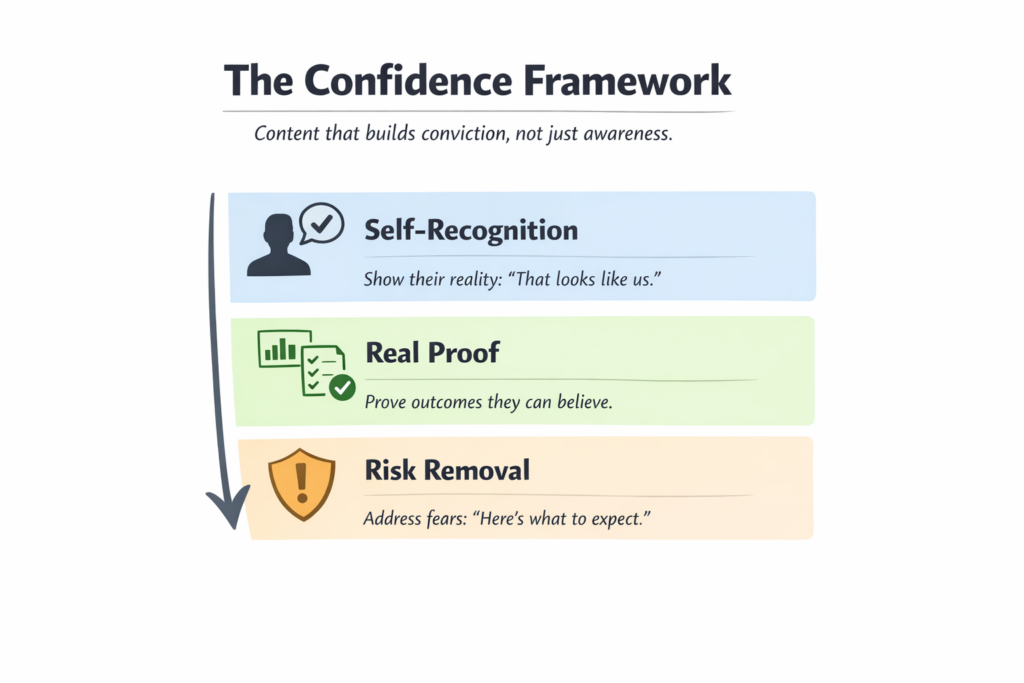
Self-Recognition: “That Looks Like Us.”
The first layer is self-recognition. Buyers need to see themselves in your stories. Not a vague “global enterprise customer,” but a company with similar size, constraints, industry, and chaos. When they read a page and think, this is basically our situation, resistance drops. Without that recognition, they feel like they’re evaluating an idea. With it, they feel like they’re evaluating a realistic option.
Real Proof: Outcomes That Feel Believable
The second layer is real proof. Not just quotes and logos, but outcomes that feel grounded in reality. How long did it actually take? What broke along the way? What changed in numbers that matter: revenue, cost, risk, time, accuracy? The best proof is slightly imperfect. It admits trade-offs. It sounds like a story a customer might tell over coffee, not a script a marketer wrote in a vacuum. That kind of proof travels inside buying committees because people trust it enough to repeat it.
Risk Removal: Making “Yes” Feel Safe
The third layer is risk removal, and this is where most content disappears. Every big B2B decision carries career and political risk. People worry about adoption, disruption, integration, security, internal perception. When you speak directly to those fears — with implementation guidance, change management stories, security clarity, rollout options — you don’t just inform them. You calm them down. And calm decision-makers say yes more often.
Put together, these three elements turn content from decoration into a decision tool. I’ve seen a single honest comparison page or rollout guide outperform an entire blog archive because it finally answered the question nobody was willing to write down: are we going to be okay if we choose this?
In a world where AI can explain almost anything, the brands that win won’t be the ones who teach the fastest. They’ll be the ones who help people decide without fear, without pressure, and with enough confidence to stand by their choice later. And that’s really all this framework is. A reminder that the job isn’t to make noise. It’s to make decisions easier.
AI will keep owning the top of the funnel. That’s fine. Let it.
None of this means AI is the enemy. It just means we should stop pointing it at the wrong problem. If you use AI to churn out even more generic explainers, you’re racing to the bottom with everyone else. But if you use it to personalize proof by industry, reshape technical stories into executive language, build interactive ROI models, or help your sales team respond quickly and consistently, you’re doing the opposite of commodity work. You’re using AI to remove friction from the decision, not to create more noise around the definition.
The things that actually tell the truth are quieter: how often do decision-makers touch proof pages before signing? Are sales cycles getting shorter? Are deals stalling less? Are renewals and expansions easier because expectations were set honestly the first time? When we map content to those outcomes, the pattern is consistent. Top-of-funnel content may make us visible. Bottom-of-funnel confidence makes us money.
What really needs to change are the Marketing metrics we celebrate. For years, we’ve rewarded traffic, impressions, downloads, and followers. Those numbers are pleasant, but misleading. Mature teams now look at influenced pipeline, engagement with decision assets, demo-to-close rates, shortened sales cycles, and deal confidence. When you map content to revenue honestly, you see the pattern clearly: top-funnel content informs the world. Bottom-funnel content moves decisions.
Does that mean TOFU should disappear?
No. It still has a role in shaping markets, staying visible, and educating long-term audiences. But it is no longer the growth engine. AI owns explanations. Platforms own discovery. Human marketers win where trust, proof, and risk-reduction matter most. The smartest B2B teams I see today aren’t building more awareness machines, they’re building confidence architectures. They’re reallocating budget into the content that answers: Why this? Why now? Why safe?
So here’s the uncomfortable sentence more marketers will eventually say out loud: if your content doesn’t help someone feel surer about acting, it may simply not deserve the budget anymore. The market has become unforgiving about vanity effort. Growth belongs to teams who can guide a skeptical, well-informed buyer from “I understand the category” to “I’m confident choosing you.”
The work now is less about filling the internet and more about giving buyers the nerve to act. And that, in the AI era, is where serious marketing lives.
Also read How to get discovered in B2B and AI Era
If you’re navigating similar questions inside your organization, I’m happy to exchange notes.
